
Episode 1486, Maitri Upanishad: The Journey from Kingship to Self-Realization Part 1
Introduction: What is the Maitri Upanishad?
The Maitri Upanishad, also known as the Maitrayaniya Upanishad, is an important Upanishad associated with the Maitrayaniya branch of the Krishna Yajurveda. It is one of the rare scriptures where Self-Knowledge, the Science of Mind, the Mystery of Prana, Time, Yoga, and Brahma Jnana are presented within a single spiritual stream.
Its major subjects include:
The distinction between Atma (Self) and Bhutatma (embodied self)
The impermanence of the world and the rise of detachment
The mind as both bondage and liberation
The spiritual mystery of Prana
The philosophy of Time and Death
The Six-Fold Yoga (Shadang Yoga)
Brahma Jnana and Self-Realization
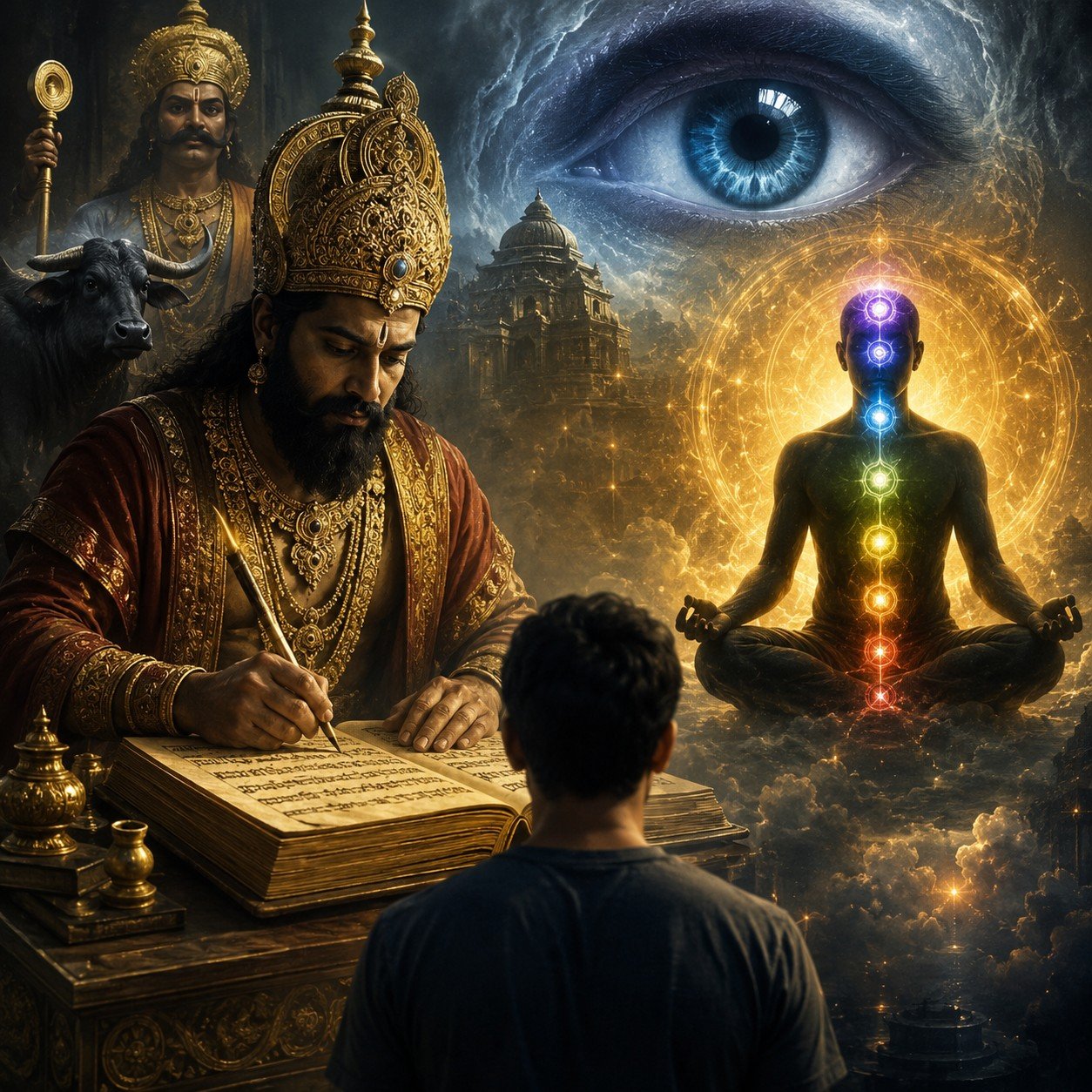
The central narrative of the Maitri Upanishad is based upon the dialogue between King Brihadratha of the Ikshvaku dynasty and Sage Shakayanya. However, this is not merely a story of a king and a sage.
It is the story of a seeker who reached the summit of worldly life yet discovered an inner emptiness. It is the story of a soul that saw detachment arise amidst pleasures. It is the story of a search that transformed an emperor into a spiritual aspirant.
When an Emperor Saw the Emptiness Within
History has witnessed many rulers who conquered kingdoms, empires, and battlefields. But very few attempted to conquer themselves. The conquest of oneself is among the greatest achievements. King Brihadratha was one such rare seeker.
He possessed everything:
Kingdom
Power
Wealth
Fame
Prestige
Respect of the people
Yet his soul remained unsatisfied. There are certain elevated souls whose karmic bondages are minimal. Such souls do not truly belong to the mortal world. They may come here for a purpose, but an inner voice continuously reminds them: "You do not belong here. This is the realm of mortality. You must return." However, this realization does not arise automatically. A soul awakens only through spiritual effort.
Good guidance, a true Guru, and genuine knowledge are essential. Without knowledge, no soul can truly awaken. Therefore, spiritual effort is necessary for awakening. One day, King Brihadratha observed life deeply.
He realized: The body in which human beings take pride is perishable.
The youth upon which they become enchanted is temporary.
The pleasures for which people spend their entire lives chasing are not permanent.
Time changes everything.
Youth becomes old age.
Strength turns into weakness.
Life ultimately dissolves into death.
This marks the beginning of the spiritual journey described in the Maitri Upanishad.
It is a journey where worldly sovereignty gradually bows before spiritual sovereignty.
Vairagya: The First Gate of Spiritual Life
In Indian philosophy, Vairagya does not mean hatred toward the world. Vairagya means recognizing the difference between the temporary and the eternal. King Brihadratha was not running away from the world. He was searching for a truth that time cannot destroy. A truth that death cannot take away. A truth that change cannot alter. This search eventually led him to the feet of Sage Shakayanya.
There begins the extraordinary dialogue of Self-Knowledge that gave the Maitri Upanishad its unique place among the Upanishads. We should be grateful to those sages who preserved these Upanishadic teachings. The realization experienced by that king centuries ago can still be studied today. The fact that these Upanishads survived through time is itself a blessing. The realization that one may eventually experience after attaining worldly success is already available through these teachings.
If a soul belongs to that category of elevated seekers, these questions will inevitably arise one day.
At that moment, the significance of these teachings becomes clear.
The First Chapter: A Question Arising from the Depths of the Soul
Questions began to arise within the king.
He was a mighty ruler of the Ikshvaku lineage.
Prosperous and powerful.
His name was Brihadratha, meaning "one with a great chariot" or immense power.
He possessed:
Kingdom
Army
Treasury
Fame
Everything a human being normally desires.
Yet one day something broke within him. No tragedy occurred. He had not lost a war. No beloved person had died. One day he simply looked around and realized how impermanent everything was. This is where the Maitri Upanishad begins. It begins at the moment when a king, while still remaining a king outwardly, became a seeker inwardly. Many spiritually mature people experience such transformations. Even highly educated and successful individuals sometimes develop profound detachment and ask: "What is all this? Why am I trapped in this?" This is exactly the transformation described here.
As Bapuji explains: Until a person is inwardly wounded by the realization of worldly impermanence, knowledge remains merely intellectual. King Brihadratha no longer viewed the world externally. He viewed it internally. And there he found emptiness. This is the journey from the royal throne to the throne of the Self.
The Great Lament on the Impermanence of the Body
One of the most striking declarations in Indian philosophical literature appears here. It is not poetic pessimism. It is intense detachment arising from direct perception. The king says: "O Sage, what is the value of enjoyment in this foul-smelling body that is nothing more than bones, skin, nerves, marrow, flesh, semen, blood, mucus, tears, eyes, excrement, urine, and bile?"
Within this body continuously arise:
Desire
Anger
Greed
Attachment
Pride
Fear
Misery
Jealousy
Union with the pleasant
Separation from the pleasant
Contact with the unpleasant
The body is a house of diseases. There is no lasting happiness within it. The king continues: We see beings arising and disappearing like tiny organisms. Birth and death continue endlessly like mosquitoes and flies. Great kings, sages, and celestial beings have all been consumed by Time.
Oceans dry up. Mountains tremble. The Pole Star itself shifts. Winds cease. The earth becomes submerged in water. What then can be said about human beings? Everything in the world is impermanent.
Finally, he cries: "O Lord, lift me out of this swamp of existence just as a frog is rescued from a dry well."
This is not pessimism. It is the first honest stage of true Vairagya.
Until a person realizes that lasting happiness cannot be found in the body, he does not turn toward the soul.
This lament demonstrates the king's spiritual maturity. One who begins to see the body merely as a body fulfills the first condition of Self-Realization. As stated in the Katha Upanishad, once one tastes the immortal Self, how can one remain absorbed in fleeting pleasures? King Brihadratha stands on that very threshold. He has seen. He has understood. And now he is ready to ask.
The Journey into the Forest and a Thousand Days of Tapasya
King Brihadratha handed over his kingdom to his son. This was not merely political succession.
It was an inner decision. He realized: "What I seek cannot be found within the palace." He entered the forest. He embraced solitude. He performed severe austerities. With raised arms and facing the sun, he stood in penance for a thousand days. Approximately three years. This was not symbolic penance. It was total surrender. The king, father, husband, warrior—all identities were left behind. Only the seeker remained.
The Meaning of Tapasya
Tapasya is not merely physical hardship. The root meaning of Tapasya is heat. The inner fire that burns impurities. Just as gold becomes purified in fire, the soul becomes purified through spiritual discipline.
Bapuji often says: "True spiritual practice transforms you from within."
King Brihadratha stood outwardly. But inwardly he was melting. His ego. His royal identity. His sense of "I am a king." All were burning in the fire of Tapasya. And when this burning became complete, the Guru appeared.
The Appearance of Sage Shakayanya
After a thousand days of austerity, Sage Shakayanya appeared before the king. He shone like smokeless fire.
Radiant and self-luminous. The sage recognized that this was no ordinary seeker. This was a king who had enjoyed the world and discovered its limitations. A king who voluntarily left greatness in search of Truth. Now the time for questioning was ending. The time for Self-Knowledge was beginning.
Questions such as:
Who is Bhutatma?
Who is Atma?
How does the mind bind?
How does the mind liberate?
What is the true nature of Prana?
What is the relationship between Time and Brahman?
Which Yoga leads to Self-Realization?
would now be answered. The sage told him: "Rise and ask for a boon." The king bowed fully before him.
He did not ask for:
Kingdom, Victory, Power, Immortality
Instead he said: "I do not know the Self. Please grant me Self-Knowledge." He had already heard that Sage Shakayanya was Self-Realized. Therefore he approached him. The search for a Guru is never random.
Preparation and worthiness are necessary. The sage initially replied: "This knowledge is rare and difficult." This was a test. The Guru wanted to see how deep the king's longing truly was. When he saw the sincerity of the king's aspiration, he began teaching.
Bapuji explains: The Guru does not come merely because we desire him. The Guru comes when we are ready. The king's thousand days of austerity were not external actions. They were preparation of the inner being.
A sincere seeker always encounters the Guru.
Sometimes as a person or a scripture or an event.
The Guru appears according to the readiness of the disciple.


Discover the true meaning of Amrit Vela beyond the early morning hours. Learn the four types of Amrit Vela, the greatness of the Sadguru, Brahma Gyan, the symbolic meaning of Samudra Manthana, the power of the Divine Name, Guru-disciple wisdom, meditation, self-realization, and the path to Supreme Peace through Behad spiritual knowledge.