
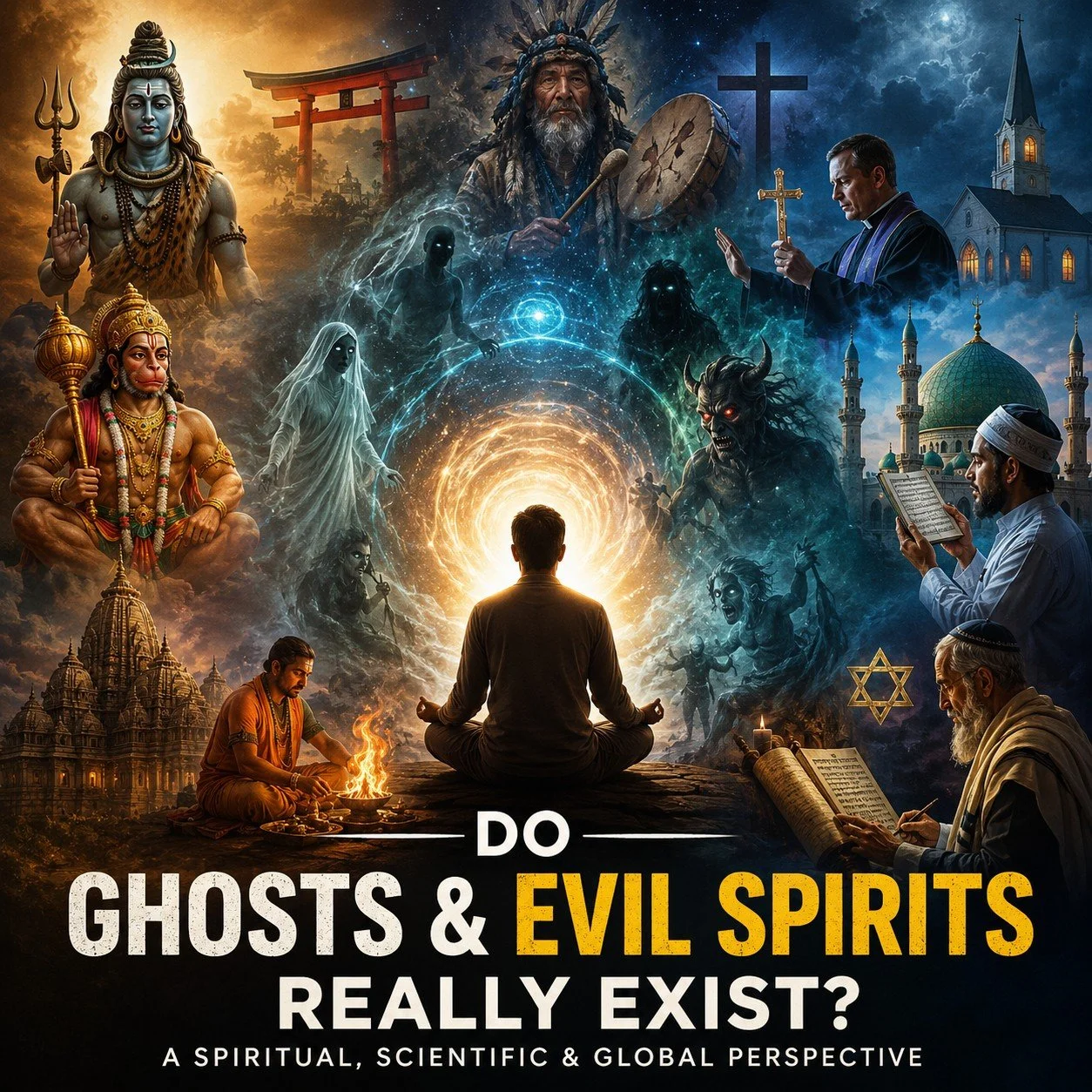
Episode 1495, Do Ghosts and Evil Spirits Really Exist? A Spiritual, Scientific and Global Perspective According to Behad Ka Gyan
Do Ghosts and Evil Spirits Really Exist? A Spiritual, Scientific, and Global Perspective According to Behad Ka Gyan
Introduction
The discussion begins with a profound question: Do ghosts and evil spirits really exist? Officially, governments, laws, and modern science generally reject their existence due to a lack of scientific proof. However, the speaker argues that in practice, beliefs in unseen entities are deeply rooted across the world. Temples, churches, mosques, monasteries, and other sacred places all contain traditions involving spirits, demons, guardian beings, and invisible forces. Rather than dismissing these beliefs as mere superstition, the discussion explores global religious practices, historical traditions, and spiritual perspectives to encourage a deeper investigation into the reality of the subtle world and humanity's long-standing belief in unseen entities
1. Why Are Certain Spirits Worshipped?
Barbarika (later worshipped as Khatu Shyam) is a significant figure from the Mahabharata and a descendant of Bhima. Before the Kurukshetra War, Lord Krishna had Barbarika beheaded because of his vow to always fight for the weaker side. Since the weaker army would keep changing during the battle, Barbarika's participation would have made the war endless and ultimately led to the Pandavas' defeat. Recognizing his devotion, sacrifice, and righteousness, Krishna granted him a divine blessing that he would be worshipped in the future. Today, Khatu Shyam temples attract countless devotees who seek his blessings, grace, and divine protection.
2. Why Does Spirit Worship Exist Despite Supreme Spiritual Knowledge?
If humanity has received the highest spiritual knowledge from the Supreme Divine, why do traditions of worshipping ghosts, spirits, demons, jinn, angels, and other invisible beings continue across the world? This question is not confined to a single religion, as nearly every faith acknowledges some form of unseen spiritual entities. The continued existence of these practices suggests that belief in the subtle world has been a universal part of human civilization for centuries.
3. Who Is Being Worshipped If Ghosts Do Not Exist?
If ghosts and spirits truly do not exist, then who or what are people worshipping? The speaker argues that these traditions point toward the existence of subtle powers, whether described as good spirits, evil spirits, invisible beings, or subtle energies. Although different cultures use different names, the underlying concept remains remarkably similar worldwide. As Bapuji has explained in earlier discourses, understanding the subtle world opens a deeper perspective on spirituality beyond ordinary physical perception
4. Why Governments Discourage Promotion of Ghost Beliefs
In our country, laws discourage the promotion of ghost stories and supernatural claims. Why? Because many people exploit such beliefs, create sensational dramas, deceive innocent people, and spread fear.
Therefore, regulations exist. However, legal restrictions do not automatically prove that the subtle world does not exist.
5. Shiva's Wedding Procession and the Presence of Invisible Beings
Consider Lord Shiva's wedding procession. According to traditional scriptures, it included ghosts, spirits, ganas, and many unusual beings. Were they mentioned or not? They certainly were. When one begins researching such subjects deeply instead of relying only on ordinary logic, an entirely different picture begins to emerge.
6. Personal Transformation Through Research
For many years I myself did not believe any of these things. I considered them to be myths, folklore, and imagination. But as I continued researching year after year, my conclusions gradually changed. Eventually I reached the understanding that there truly exists an invisible world.
Whether we call them:
Devas (divine beings)
Danavas (demons)
Yakshas
Kinnaras
Ghosts
Spirits
—or by any other names used throughout the world—there appears to be some corresponding reality behind these descriptions.
7. Believing in Invisible Realities
People readily accept the existence of bacteria, viruses, and even the coronavirus, despite being unable to see them with the naked eye, because scientific evidence confirms their presence. Similarly, the speaker suggests that the subtle world may contain realities beyond ordinary human perception. Simply because something is invisible does not automatically mean it does not exist, encouraging us to remain open-minded about unseen dimensions of existence.
8. Why People Remain Doubtful
Despite these comparisons, many people remain uncertain about the existence of ghosts, spirits, and other subtle entities. Their minds constantly fluctuate between belief and disbelief, asking, "Do they really exist?" and "What is the benefit of believing?" This hesitation reflects humanity's natural tendency to seek evidence before accepting unseen realities, while questioning whether belief in such phenomena has any practical significance in everyday life.
9. Mahatma Gandhi's Practical View
There is an interesting statement attributed to Mahatma Gandhi. Someone asked him whether one should believe in ghosts and spirits. His reply was practical. If believing brings genuine benefit, then believe. If it brings no benefit, then do not believe. He further indicated that people with weak minds should perhaps avoid dwelling excessively on such subjects because fear itself can become a cause of suffering.
10. Fear of the Invisible World
Today, however, a large percentage of humanity lives in fear of unseen forces, whether they openly admit it or not. This discussion concerns the subtle world. That is the subject we are trying to understand.
11. A BBC Article on Christian Exorcism
The speaker explains that today's discussion was inspired by a BBC Gujarati article about a Christian priest who performed exorcisms in churches. After reading the article carefully, he felt that the BBC was not promoting superstition but presenting the subject as a serious phenomenon. The priest's life had attracted significant attention, resulting in books, documentaries, and even Netflix-based productions.
12. Why the Article Was Significant
The article prompted the speaker to reflect on how a globally respected media organization like the BBC treated the topic with seriousness rather than outright dismissal. This encouraged him to explore the subject from a broader perspective instead of viewing it merely as superstition. He mentions that, if time permits, he will discuss the BBC article in detail during the session; otherwise, it will be examined in a future discussion.
13. Why Understanding the Subtle World Matters
The speaker emphasizes that understanding the subtle world is essential for anyone seeking genuine spiritual knowledge. Questions about life after death, the law of karma, rebirth, and moksha (liberation) form the foundation of many spiritual traditions. Without exploring these concepts, it becomes difficult to progress on the spiritual path or fully understand the purpose of human existence. While some religions reject reincarnation, the speaker argues that reality is not determined by personal belief alone. Instead, he encourages seekers to investigate these profound subjects with an open mind and discover whether spiritual truths exist independently of human opinions. The discussion aims to inspire deeper reflection rather than blind acceptance.
14. Exorcism: A Universal Practice Across Religions
The speaker explains that exorcism—the practice of removing negative spiritual influences or evil entities—is found in cultures and religions across the world. Different traditions interpret it differently: some regard it as a religious ritual, others as spiritual healing, while some see it as part of their ancient cultural heritage. Despite these differences, nearly every major civilization has developed methods for dealing with harmful unseen influences. This remarkable similarity suggests that belief in the subtle world has existed throughout human history, making it an important subject worthy of careful study and understanding.
15. Exorcism in Hinduism
Within Hindu traditions, especially in India and Nepal, practices such as removing ghosts and spirits through Jhad-Phook (ritual cleansing), Ojha practices, Bhagat traditions, and Tantric rituals have existed for centuries.
These rituals are generally performed by: Ojhas, Bhagats, Tantric practitioners, Priests
Let me make one thing clear.
16. We ourselves do not perform these rituals.
This discussion is only for understanding the subject.
Some of the most well-known places associated with these practices include:
Mehandipur Balaji in Rajasthan
Pitambara Peeth in Datia, Madhya Pradesh
The Sixty-Four Yogini temples
Several regions of Assam, where such traditions remain especially prominent.
The methods commonly include:
Recitation of the Hanuman Chalisa
Bajrang Baan
Coconut rituals
Lemon purification rituals
Sacred water
Fire offerings (Havan)
Mantra chanting
17. Nepal's Shamanic Tradition
In Nepal, similar practices are performed by spiritual healers known as Jhankris, who belong to ancient shamanic traditions. These healers are believed to communicate with subtle realms and perform rituals intended to remove harmful spiritual influences.
18. Exorcism in Christianity
Now let us look at Christianity. Across Europe, America, Latin America, and the Philippines, the practice is known as Exorcism. Within the Catholic Church, there exists an officially recognized ritual called the Rituale Romanum. Only priests specially trained and authorized by the Vatican may perform official exorcisms. Very few people realize that the Vatican even conducts formal training programs for exorcists. Selected priests undergo specialized preparation before being assigned to churches around the world where they may encounter such cases. Their ministry differs from that of ordinary parish priests.
19. Deliverance Ministry
Within Protestant and Pentecostal churches, similar practices are often known as Deliverance Ministry. These ministries are particularly widespread in: Africa, Brazil, The United States
20. Orthodox Christianity and the Practice of Exorcism
In Orthodox Christianity, particularly in Russia and Greece, exorcism is performed through sacred prayers, most notably the Prayers of Saint Basil. These prayers are recited by clergy during ceremonies intended to protect individuals from harmful spiritual influences. Although many people dismiss such practices as superstition, the fact remains that they continue to be observed within established Christian traditions across the world. The speaker encourages listeners not to reach conclusions too quickly but instead to explore why these beliefs have endured for centuries and what they reveal about humanity's understanding of the unseen world.
21. Exorcism in Islam: The Practice of Ruqyah
Across Arab countries, Pakistan, Indonesia, India, and many other Muslim communities, the practice of Ruqyah (Ruqya) is used for spiritual protection and healing. According to Islamic belief, jinn are unseen beings that may influence or affect human beings. During Ruqyah, qualified Islamic scholars (Maulvis) recite verses from the Holy Qur'an, including Ayat al-Kursi, Surah Al-Falaq, and Surah An-Nas, seeking Allah's protection and the removal of harmful influences. In India and Pakistan, these practices are commonly described as removing a jinn or seeking relief through prayers at dargahs (shrines). While different religions use different terminology, many traditions share the belief that unseen spiritual influences can affect human life.
22. Exorcism in Judaism: The Belief in the Dybbuk
Judaism also preserves a long-standing tradition concerning spirit possession through the concept of the Dybbuk, believed to be the spirit of a deceased person that attaches itself to a living individual. According to traditional Jewish belief, specially trained Kabbalistic rabbis perform rituals to free a person from such spiritual attachment. These ceremonies are generally conducted in the presence of a Minyan—a gathering of ten people—and involve specific prayers, sacred recitations, and traditional religious practices. This tradition demonstrates that Judaism, like many other faiths, has developed its own methods for addressing beliefs about unseen spiritual influences.
Every Civilization Has Its Own Spiritual Guardians
Look across the world. Every tribe has its own spiritual traditions. There are: Forest deities, Mountain deities, Village deities, City deities, Regional guardians.. Every civilization has developed its own understanding of unseen powers. Whether one accepts these beliefs or not, the invisible world occupies an important place in human culture.
Exorcism in Buddhism
Within Buddhist traditions, especially in Tibet, Thailand, Sri Lanka, and Japan, there are also methods for dealing with negative spiritual influences.
Tibet: Tibetan lamas perform practices known as Chöd and various tantric rituals.
Thailand: Buddhist monks recite sacred protective chants known as Paritta, often using blessed water during ceremonies.
Sri Lanka: Traditional rituals involving masked dances and ceremonial performances are used to symbolically expel harmful spirits.
Japan: Both Buddhist and Shinto traditions include purification ceremonies intended to remove negative influences.
Shinto Purification in Japan
Japan's indigenous Shinto tradition includes purification ceremonies known as Harae. Shinto priests perform these rituals using: Sacred salt, Purified water, Ritual paper wands, Traditional ceremonial objects
These ceremonies are believed to remove harmful entities such as Yokai or Oni. Some people assume only India has such traditions. That assumption is incorrect. Japan has its own ancient methods as well.
China and Taoist Exorcism
China also possesses ancient traditions of removing harmful spirits. Within Taoist practices, priests employ:
Sacred yellow talismans
Ritual swords
Protective charms
Mantras
These ceremonies are intended to drive away negative entities. Even ghost festivals exist, where rituals are performed to calm wandering spirits.
Global Spiritual Traditions of Healing and Protection
Across the world, many ancient cultures have developed spiritual traditions aimed at healing, protection, and restoring spiritual harmony. In Africa, countries including Nigeria, Ghana, Ethiopia, Sudan, Somalia, and South Africa preserve practices led by traditional healers and shamans, who use sacred chants, rhythmic music, dance, and ceremonial rituals to address spiritual imbalance. In Latin America and the Caribbean, traditions such as Vodou, Candomblé, Umbanda, and Santería involve priests and priestesses performing rituals intended to remove negative influences and promote spiritual well-being. Mexico also maintains cleansing ceremonies using eggs, herbs, and symbolic objects. In Korea, female shamans called Mudang conduct Gut ceremonies featuring music, ritual dance, and symbolic communication with spirits. Ancient shamanic traditions also continue in Siberia and Mongolia, where ceremonial drumming and altered states of consciousness play central roles. Likewise, the Zoroastrian (Parsi) tradition of Iran and India employs Avesta prayers and sacred fire purification rituals for protection against Ahriman, the embodiment of evil forces.
What Is Common Across Almost Every Culture?
One remarkable observation emerges. Almost every culture shares three common elements:
Sacred words or mantras.
Purifying elements such as holy water or sacred fire.
A trained spiritual practitioner—whether priest, monk, shaman, healer, or religious guide.
This is an extremely important point. It demonstrates that throughout human history, the search for liberation from negative influences has been universal. In simple language: The effort to free human beings from harmful unseen influences exists in almost every civilization on Earth.
Why Every Religion Uses Different Methods of Exorcism
Every religion and culture has developed its own unique spiritual traditions, sacred prayers, and methods of exorcism. Churches do not recite the Hanuman Chalisa, just as Zoroastrians do not invoke Lord Hanuman. This highlights an important truth: people seek help through the deities, prophets, saints, or spiritual authorities they trust. Across civilizations, different paths have evolved to address spiritual suffering and restore inner balance. Some traditions worship forest deities, village guardians, or tribal protectors, while others invoke angels, saints, or divine beings according to their own faith. Despite their differences, all reflect humanity's search for spiritual protection and healing
Humanity Has Always Believed in an Invisible World
Throughout history, human civilization has recognized the existence of an unseen spiritual world. Nearly every culture has developed beliefs about invisible forces, higher beings, and subtle dimensions beyond ordinary perception. While many people today dismiss such ideas, disbelief alone does not determine reality. Life occasionally presents experiences that challenge conventional explanations, leading individuals to reconsider their views. Across the world, priests, monks, shamans, spiritual healers, and other religious practitioners continue helping those who believe they are affected by unseen influences, offering hope and relief through their respective spiritual traditions.
Every Religion Offers Its Own Path to Relief
Although their practices differ, religions share a common purpose—to reduce human suffering. Every tradition encourages people to seek help through its own sacred prayers, rituals, and spiritual authorities, promising protection, healing, and freedom from harmful influences. These teachings are preserved in religious scriptures and passed down through generations. While some people readily accept these beliefs and others remain skeptical, every faith has developed its own methods for restoring spiritual balance, reflecting humanity's enduring search for peace, guidance, and inner strength.
Negative Karma and Spiritual Vulnerability
Many spiritual traditions, including the teachings explained by Bapuji, suggest that the accumulation of negative karma can weaken a person's spiritual state, making them more vulnerable to harmful subtle influences. This is presented as a spiritual interpretation, not a scientific conclusion. A useful comparison is how criminal groups often target vulnerable individuals. Likewise, some traditions teach that when a person's consciousness becomes spiritually weakened through negative actions, lower subtle influences are more likely to affect them. According to these teachings, cultivating positive karma, spiritual awareness, and inner purity strengthens one's consciousness and serves as a form of protection against such influences
An Analogy from the Physical World
We often see this in ordinary society. Small criminals are eventually recruited by larger criminal organizations. Movies frequently portray such situations. Someone is brought before a powerful crime boss and ordered to work for him. In a symbolic sense, many spiritual traditions describe the subtle world in a similar way. Whether one accepts this literally or symbolically is for each individual to decide.
Why Different Religions Invoke Different Divine Powers
The world's major religions do not all worship Lord Shiva or know Lord Hanuman. Instead, each tradition turns to its own sacred figures, divine powers, and spiritual authorities. Churches, mosques, synagogues, monasteries, and tribal cultures have each developed distinct ways of seeking divine help. Rather than dismissing these ancient traditions as ignorance, they deserve thoughtful study and open-minded examination.
The Invisible World Beyond Human Perception
According to many spiritual traditions, the invisible world exists alongside the visible world, whether people acknowledge it or not. The purpose is not to compel belief but to encourage personal inquiry. Across civilizations, countless people continue following these teachings and practices. Ultimately, every individual must explore these ideas through study, experience, and reflection before deciding what to believe about the unseen dimensions of existence.
Bapuji's Teaching About the Gross and Subtle Worlds
Bapuji repeatedly explains in his discourses that the gross physical world (Sthool Jagat) and the subtle world (Sookshma Jagat) are interconnected. Ignoring the subtle dimension prevents a complete understanding of reality. If we overlook these subjects entirely, our spiritual vision can never fully awaken. Without awakened vision, how will we recognize truth?
"All Religions Are the Same"—Is It That Simple?
Many people simply repeat: "All religions are the same." If that is your conclusion, then travel. Visit churches, mosques, synagogues, Buddhist monasteries., Shinto shrines in Japan, Taoist temples in China, shamans in Mongolia and Siberia, tribal traditions in Africa, Latin America, Israel, Islamic countries, Europe, Southeast Asia. Study every civilization carefully. Observe how each culture understands the unseen world. Then form your conclusions.
Every Religion Has Its Own Method of Spiritual Healing
Here is another important point. If healing were possible only through one religion, what would happen? Everyone would eventually abandon the others. Suppose only one tradition successfully helped people experiencing these problems. Wouldn't the entire world eventually move toward that single religion? Instead, what do we observe? Every religion possesses its own methods. Every tradition has its own rituals. Every culture has its own spiritual specialists. People seek help according to the faith in which they believe.
The Subtle World Knows No National Boundaries
According to these traditions, the subtle world is not limited by countries. It is not stopped by oceans. It is not confined by mountains. Invisible realms exist everywhere. Bapuji has explained that even discussions about extraterrestrial beings describe bases beneath the earth, beneath the oceans, and in unseen regions. Similarly, many traditions speak about subtle realms existing throughout the world. Again, whether one accepts these teachings literally or symbolically remains an individual decision.
Humanity's Universal Search for Freedom from Negative Energy
The most important conclusion remains this: Human beings everywhere seek freedom from negative influences. According to spiritual teachings, negative energies first exist in subtle form. Their impressions are recorded within the subtle dimensions of consciousness. Only later do they express themselves outwardly. This is why inner purification has always been considered more important than merely treating external symptoms.
How Many People Actually Believe in Spirit Possession?
Researchers have attempted to study these beliefs across different cultures. One frequently cited anthropological study reported that among 488 societies, approximately 74% contained beliefs involving spirit possession or similar concepts. Various surveys also suggest that nearly 90% of the world's cultures include some form of belief in possession, spirits, or invisible entities. These numbers do not prove that such entities objectively exist. They simply demonstrate how widespread these beliefs are throughout human civilization.
Belief in the Supernatural in the United States
Surveys conducted in the United States have also produced interesting results. According to the figures being discussed:
Around 57% of Americans believe in the existence of Satan.
Approximately 51% believe that an evil spirit may influence or enter a person.
Among born-again Christians, belief is even higher, with large majorities accepting both Satan and spirit possession as real.
These beliefs arise largely because such concepts are deeply rooted within Biblical teachings. During Christian exorcisms, priests invoke the authority of Jesus Christ, not the deities of other religions. Each faith naturally follows its own theological framework.
Belief in Spirits Across Different Religions and Cultures
According to the survey figures being discussed, around 70% of Americans reported believing in Satan, while approximately 61% expressed belief in ghosts or spirits. Among Muslim communities in America, many respondents also accepted the possibility of repeated spirit possession, as belief in jinn forms an established part of Islamic theology.
When we look at India and South Asia, surveys conducted by organizations such as Pew Research indicate that a large majority of people—often estimated between 70% and 80%—believe in concepts such as the evil eye, negative spiritual influences, and unseen forces. In rural areas these beliefs are even more widespread. In many villages such ideas remain part of everyday life. Across Africa, especially in countries such as Nigeria, Tanzania, and Ghana, belief in evil spirits, witchcraft, and supernatural influences is reported to be extremely high, often ranging between 80% and 90% according to various studies. Within Muslim-majority nations, belief in jinn is considered part of traditional Islamic belief itself.
Even during the pilgrimage to Makkah, pilgrims perform the symbolic ritual of stoning Satan, demonstrating that the concept of evil spiritual forces occupies an important place within Islamic practice. Countries such as Pakistan, Indonesia, and Egypt continue to have large populations who believe in these ideas. Europe generally reports lower percentages, with many surveys indicating that roughly 20% to 30% believe in spirit possession.
However, Catholic countries such as Italy and Poland often report higher levels of belief. If we average the figures discussed across different regions, it may be said that roughly half of the world's population believes in some form of spirit possession or supernatural influence, while beliefs concerning unseen entities appear in nearly ninety percent of human cultures. In many developed countries such beliefs may be declining. However, they remain deeply rooted throughout Africa, South Asia, and Latin America.
Why Has Science Not Eliminated These Beliefs?
One very interesting observation is this. Despite enormous advances in science and education, these beliefs have not completely disappeared. Think about it. Many highly educated people—even those holding doctoral degrees or working in prestigious professions—have visited famous spiritual healing centers seeking relief from suffering. Education alone does not automatically eliminate every question related to human experience. So one should not assume that an educated person can never become interested in spiritual healing.
Bapuji's Teachings on the Subtle Body
Bapuji has explained the concepts of the subtle body, negative energies, and the invisible dimensions of existence in great detail through his podcasts and discourses. Whether one ultimately accepts these teachings is a personal decision. However, the subject deserves thoughtful study rather than immediate dismissal.
Academic Research on Spirit Possession
Many scholarly books have also been written on the subject of spirit possession.
One important example is:
Possession by Erika Bourguignon (1976)
This classic anthropological work analyzed beliefs concerning spirit possession across 488 societies. It remains one of the foundational academic studies on this subject. Another significant work is: Ecstatic Religion: A Study of Shamanism and Spirit Possession (1971) This book became internationally recognized for its sociological study of shamanism and possession traditions throughout the world.
A Clarification About Khatu Shyam
I also wish to clarify something. Please do not misunderstand my earlier remarks concerning Khatu Shyam (Barbarika). Within Sanatan Dharma, many different beings receive reverence. Even spirits are sometimes worshipped.
Animals, Trees ,Mountains, Rivers are worshipped. Therefore, the existence of worship does not necessarily imply that all such beings occupy the same spiritual level. Different beings are honored for different reasons. Sanatan Dharma recognizes the Divine as present everywhere. The teaching is that the Supreme pervades all existence. Because of this understanding, almost any aspect of creation may become an object of reverence under appropriate circumstances.
Worship Beyond Human Beings
Within Hindu tradition we find worship offered not only to humans but also to: Animals, Trees, Forests, Rivers, Mountains, Serpents, Sacred bulls, Tortoises
Lord Vishnu Himself is believed to have incarnated in animal forms. The worship of Nandi, the sacred bull... The worship of the tortoise... The worship of serpents... All these traditions exist. According to spiritual cosmology, even the serpent beings are associated with Naga Loka, one of the lower realms described in ancient scriptures. Yet temples dedicated to serpent deities are found throughout India. People visit them because they believe their prayers are answered. Whether such beliefs arise from knowledge or ignorance is for each individual to examine. Human beings suffering from pain are often willing to seek help wherever they believe hope exists.
Additional Books on Spirit Possession
Many more important books have been written on this subject.
For example: The Devils of Loudun by Aldous Huxley (1952) This famous work examines one of the most well-known historical cases of alleged collective spirit possession in seventeenth-century France. Both historians and scholars have studied this event extensively. Collective possession itself has become an important subject of academic investigation.
How Different Religions Explain Exorcism
Consider what happens inside churches during exorcism. Christians naturally believe that divine assistance comes through Christ, angels, and the spiritual authority recognized within Christianity. Every religion interprets these experiences according to its own theology. Each believes that its own sacred powers are providing protection.
If these traditions completely failed to help people, many followers would eventually abandon them. Instead, people continue visiting them because they believe relief is possible. When people suffer deeply, they seek healing wherever they believe healing exists. Just as patients sometimes change doctors hoping for recovery, people also visit different spiritual centers searching for relief from suffering.
Why This Discussion Matters Today
The reason I am presenting all this information is not to create fear. Rather, it is to increase awareness. Bapuji has spoken in earlier discourses about a future period in which the influence of negative forces may increase. Whether one interprets those teachings literally or symbolically, understanding the subject broadens our awareness. An awakened consciousness does not reject information simply because it appears unfamiliar. Instead, it examines everything carefully.
The Increasing Influence of Negative Consciousness
Ancient scriptures such as the Ramayana and Mahabharata describe periods during which demonic forces troubled villages, forests, kingdoms, and ordinary people. Such accounts repeatedly emphasize the struggle between higher and lower states of consciousness. Whether one reads these stories historically, symbolically, or spiritually, they all encourage humanity to strengthen inner purity rather than become dominated by negative tendencies.
More Important Books on Exorcism
Another noteworthy publication is: Deliver Us From Evil: A Guide to Spiritual Warfare
This work discusses American exorcism practices and the growing field of spiritual warfare ministry. When I studied these books, I even thought about writing a similar book myself. Then I realized that such a subject could create unnecessary legal and social controversies in India. Still, truth deserves to be discussed. Whether people accept it or not, conversations about these subjects will continue to emerge throughout the world. The BBC article that I mentioned earlier inspired me to speak openly because international media themselves are now discussing these topics. Naturally, when readers encounter such reports, some may become curious about churches and their exorcism traditions. That curiosity alone makes this subject worthy of thoughtful examination.
Islamic Literature on Jinn and Spiritual Healing
Within Islamic scholarship there are also many respected books devoted to the subjects of jinn, spiritual healing (Ruqyah), and unseen influences.
One well-known modern work is:
The Jinn and Human Sickness
written by Dr. Abdul Mun'im Khalil.
It discusses the relationship between jinn, spiritual illness, and methods of healing according to Islamic teachings.
Another important reference is:
Sword Against Black Magic and Evil Magicians
by Wahid Abdussalam Bali.
This book has become one of the standard references for practitioners of Ruqyah within the Islamic world.
There are also classical Islamic writings by scholars such as Ibn Taymiyyah, who discussed jinn and related spiritual subjects extensively.
Hindu Scriptures on Spirits and the Journey After Death
Within Sanatan Dharma, one of the most important scriptures dealing with the soul after death is the Garuda Purana.
It explains:
the soul's journey after death,
the condition known as the preta state,
liberation from lower states,
and the paths leading toward higher realms.
That is why, traditionally, the Garuda Purana is often recited after a person's death.
The purpose is not to frighten anyone. Rather, it is to remind everyone that the departed soul should attain liberation instead of remaining trapped in lower states of existence. Another important scripture is the Atharva Veda. It contains numerous hymns, mantras, and rituals relating to protection, healing, and the removal of negative influences. I personally have not yet studied that portion of the Atharva Veda in great depth, but I intend to do so in the future.
Tibetan and Indian Research on Invisible Realms
Another important work is: Oracles and Demons of Tibet This book serves almost like an encyclopedia of Tibetan protector deities, spirits, and spiritual traditions. Research has also been carried out on Indian spiritual healing centers. Foreign scholars have written academic studies about places such as Mehandipur Balaji, one of India's most famous temples associated with spiritual healing. One such work is: The Divine and the Demonic: Supernatural Affliction and Its Treatment in North India (2003) This study examines the traditions associated with Balaji Temple in Rajasthan from an academic perspective.
Why Governments Do Not Completely Ban These Practices
If these traditions had no foundation at all, they could simply be abolished. Instead, authorities usually act only against fraudulent practices, while legitimate religious institutions continue serving communities. People seek comfort through them, believing they receive relief. Each religion explains such experiences differently—as divine energy, sacred light, miracles, or spiritual intervention.
Jewish Literature on Spirit Possession
Jewish tradition also possesses important literature. One famous example is: The Dybbuk written by S. Ansky in 1914.
It became one of the most celebrated works of Jewish literature dealing with spirit possession. Another scholarly work is:
Spirit Possession in Judaism by Matt Goldish, which examines the subject from an academic perspective.
African and Haitian Traditions
African spiritual traditions have also been studied extensively. Among the most famous works are: Divine Horsemen: The Living Gods of Haiti by Maya Deren (1953), which explores Haitian Vodou traditions.
Another well-known bestseller is: The Serpent and the Rainbow which investigates Haitian zombie traditions and Vodou from both anthropological and scientific viewpoints.
Shamanism Around the World
One of the world's most respected scholarly works on shamanism is: Shamanism: Archaic Techniques of Ecstasy
by Mircea Eliade (1951). It is regarded as one of the most authoritative studies ever written on shamanic traditions throughout the world.
Scientific and Psychological Studies
Researchers have also attempted to understand spirit possession scientifically. One early historical study is: Demonic Possession and Exorcism by Traugott Konstantin Oesterreich (1921). It became one of the first major scientific investigations into possession phenomena.
Modern psychology often explains such experiences differently.
Books discussing subjects such as repressed memory, dissociative disorders, and possession trance attempt to interpret these experiences through psychological frameworks.
Some of the Most Widely Read Books on Exorcism
Among the best-known books in this field are:
The Exorcist by William Peter Blatty.
An Exorcist Tells His Story by Father Gabriele Amorth.
Hostage to the Devil by Malachi Martin.
These books have been read throughout the world and have significantly influenced public understanding of exorcism.
What Does This Research Suggest?
When one studies all this material together, one observation becomes obvious.
Nearly every major religion acknowledges, in one form or another, the existence of unseen negative influences.
At this point, Bapuji's explanations concerning modern science, the soul, the subtle body, and negative energies become particularly valuable for deeper contemplation.
Why Does Modern Science Remain Skeptical?
Science asks for evidence, repeatability, controlled experiments. If sulfuric acid is produced under identical laboratory conditions every time, science accepts the result because it is measurable and repeatable. But experiences involving ghosts or spirits do not occur on command. They cannot simply be summoned whenever a scientist requests. This is not a chemical reaction where mixing two substances always produces the same outcome. Science therefore says: "What can be measured..." "What can be repeated..." "What can be demonstrated under controlled conditions..."
—that alone qualifies as scientific evidence. Since alleged spirit possession cannot consistently be reproduced inside laboratories, science remains unconvinced.
The Challenge Presented by Controlled Experiments
Whenever investigations involving cameras, laboratory equipment, and controlled environments have been conducted, no universally accepted scientific proof of ghosts or spirits has been obtained. For this reason, science continues to maintain a cautious position. One famous example often mentioned is the challenge established by the James Randi Educational Foundation, which offered a substantial monetary prize to anyone who could demonstrate genuine supernatural abilities under controlled scientific conditions. No claimant succeeded in meeting the required standards.
Can Spiritual Reality Be Proven by Prize Money?
But then another question naturally arises. Would divine beings reveal themselves simply to win prize money?
Do higher spiritual powers require a cash reward? What value would a monetary prize hold for such beings? Consider the enormous wealth donated every year to famous temples. People contribute billions because they believe their prayers have been answered. If these traditions continue attracting millions of devotees, should we dismiss everything without investigation? Again, this is a question each individual must examine thoughtfully.
Observations from Spiritual Healing Centers
Many people have witnessed unusual events in well-known spiritual healing centers. Whether one accepts those experiences as psychological, spiritual, symbolic, or something else remains a personal conclusion. Governments are aware that such places exist. People continue visiting them voluntarily. No one forces anyone to attend. Individuals go because they hope to find relief from suffering. The same pattern is found across the entire world.
Why Do People Visit Spiritual Healing Centers?
Think about the countless people who have already exhausted every possible medical treatment. Many have visited leading hospitals. Many have consulted renowned specialists. Some have even been told by doctors: "There is nothing more we can do." What usually happens next? They begin searching elsewhere. First, they visit famous spiritual healing centers. Then they travel from one temple to another. After that, they seek blessings from respected saints, gurus, monks, healers, or traditional practitioners. Why? Because they are tired of suffering. They still want to live. They have hope. They believe there may still be another path. No one can blame a suffering person for searching for relief.
Why Even Highly Successful People Search for Spiritual Energy
Consider many wealthy and influential people around the world. Business leaders. Technology entrepreneurs. International celebrities. Many of them have visited famous spiritual places in India. Why would people who possess immense wealth travel thousands of kilometers to visit places such as Kainchi Dham associated with Neem Karoli Baba? It is because they are searching for something beyond material success. They wish to understand a different kind of energy. They want to experience something that cannot easily be explained through ordinary worldly achievements.
Science Also Offers Alternative Explanations
Science does not simply dismiss unusual experiences. Instead, it attempts to explain them through known medical and psychological conditions. Some examples include:
Epileptic seizures
Schizophrenia
Sleep paralysis
Mass hysteria
Exposure to low-frequency infrasound
Carbon monoxide poisoning
Researchers have observed that sound frequencies below approximately 19 Hz may create feelings of fear, anxiety, or the sensation that someone else is present. Psychologists also discuss conditions such as Dissociative Identity Disorder and Possession Trance Disorder. According to psychology, some experiences that people interpret spiritually may instead arise from mental or neurological conditions.
The Scientific Position
Science argues that when a simple, evidence-based explanation exists, there is no need to introduce a supernatural explanation. That is the scientific method. Science prefers explanations that can be observed, tested, measured, and verified.
This is a perfectly reasonable approach within scientific investigation.
Then Why Do Some People Feel Better After Exorcism?
This naturally raises another important question. If people continue visiting these places...
Do some actually recover? Many certainly believe they do. How does science explain that? One explanation is the placebo effect. When a person possesses deep faith that healing will occur, the brain itself may begin changing bodily responses. Symptoms may decrease because of powerful belief. Another explanation involves emotional release. During intense spiritual rituals, suppressed emotions, trauma, grief, or psychological burdens may surface and finally be released. Modern psychology sometimes compares this process with catharsis, a form of emotional purification. In that sense, certain traditional rituals may function as a type of cultural psychotherapy.
Social Acceptance Can Also Play a Role
There is another interesting social factor. In many communities, mental illness unfortunately carries social stigma.
Families may hesitate to say, "This person has a psychiatric illness." Instead, they may say, "A spirit has entered him." From their perspective, this explanation may feel more socially acceptable. It allows relatives and neighbors to offer sympathy rather than criticism. This is another explanation proposed by psychologists.
Science Continues to Evolve
Science itself is constantly changing. Scientific understanding develops over time. Ideas once dismissed sometimes become accepted after further research. Consider hypnosis. For many years it was regarded with suspicion. Today it has recognized applications within psychology and medicine. Similarly, modern neuroscience increasingly studies the human mind, thought patterns, emotional states, and consciousness. Scientific understanding continues to evolve.
The Difference Between Science and Spirituality
From Bapuji's perspective, this is where spirituality and science begin exploring different dimensions. Science investigates the external world. Spirituality investigates inner consciousness. Both are forms of inquiry. Their methods are different. Therefore, their conclusions may also differ. Rather than treating them as enemies, perhaps we should recognize that each examines reality from a different level.
Modern Science Recognizes the Power of Thoughts
Modern science has increasingly begun studying the influence of thoughts, emotions, and stress on human health. Researchers now measure brain activity, emotional patterns, and the effects of long-term negative thinking. Although stress cannot be seen directly, its impact is widely accepted because it can be measured through its physical effects. Doctors frequently ask patients whether they are under stress, recognizing that persistent negative thoughts can contribute to conditions such as high blood pressure, diabetes, and other stress-related illnesses. This growing scientific understanding supports the idea that mental patterns significantly influence physical well-being.
Spirituality Promotes Self-Transformation
Long before modern science began exploring the mind, spirituality emphasized the importance of inner transformation. Bapuji teaches Swa-Parivartan (Self-Transformation), encouraging individuals to purify their thoughts, intentions, emotions, desires, habits, and Sanskars, all of which shape one's karma. Modern physicians increasingly recommend lifestyle changes, emotional healing, and positive thinking alongside medical treatment, reflecting principles that spirituality has taught for centuries. By wisely using free will to cultivate right thoughts, noble intentions, and righteous actions, a person gradually overcomes negative tendencies and progresses toward genuine spiritual growth.
Education Alone Cannot Transform Human Nature
The speaker explains that conventional education is valuable for earning a livelihood but cannot, by itself, transform the mind, purify the intellect, or erase deeply rooted Sanskars. Many people dismiss spirituality as mere religious talk without recognizing its deeper purpose. While academic knowledge provides professional skills and material success, it does not automatically create inner peace, wisdom, or moral transformation. True change requires conscious self-improvement through spiritual understanding and disciplined practice. Only by transforming one's inner nature can a person achieve lasting happiness, higher consciousness, and meaningful personal growth beyond material achievements
Real Change Begins Within
True transformation begins within the individual. A person filled with negative thoughts can spread suffering, while someone who undergoes inner transformation can positively influence many lives. According to Bapuji's teachings, pure thoughts gradually purify not only the physical mind but also the subtle body, causal body, Manomaya Sharir (mental sheath), and ultimately the soul. This inner purification is the foundation of genuine spiritual growth and liberation.
The Path to Moksha Through Inner Transformation
The ultimate goal of spiritual life is Moksha (liberation), achieved through sincere self-transformation. As the mind becomes peaceful, the intellect clear, and Sanskars pure, the soul progresses toward lasting peace, deep happiness, and supreme bliss. These benefits arise only through consistent spiritual practice. Remaining trapped in doubt and resisting inner change prevents true progress, while embracing self-transformation leads to lasting spiritual fulfillment.
As the Bhagavad Gita teaches, a person consumed by doubt cannot attain lasting happiness.
Trust, Self-Realization, and Lord Krishna's Guidance
True spiritual progress begins by placing trust in a true Guru, Divine wisdom, or direct self-realization. Since God guides humanity through enlightened teachers, seekers must reflect deeply, listen to their inner conscience, and recognize their true Self. Without inner transformation, people keep searching externally—changing doctors, healers, temples, and methods—while overlooking the answers already within.
The Greatest Healing Is Inner Transformation
True healing begins with inner transformation, not merely external remedies. Since the body functions through the soul, lasting change must originate within. As the soul becomes purified, the mind, intellect, Sanskars (impressions), and entire personality are transformed. This inner growth gradually reduces dependence on external solutions and leads to lasting peace. The Bhagavad Gita teaches this path through the ideal of Sthitaprajna—a person of steady wisdom. Lord Krishna urges Arjuna to know the Self, recognize the Divine, trust His teachings, and surrender to the Supreme. Although the Vishvarupa (Universal Form) initially overwhelms Arjuna with awe and fear, the ultimate lesson is not to fear the unseen but to focus on self-transformation, for genuine spiritual progress begins within.


Discover the true meaning of Amrit Vela beyond the early morning hours. Learn the four types of Amrit Vela, the greatness of the Sadguru, Brahma Gyan, the symbolic meaning of Samudra Manthana, the power of the Divine Name, Guru-disciple wisdom, meditation, self-realization, and the path to Supreme Peace through Behad spiritual knowledge.