
Episode 1128, What Is Amrit Vela? The True Meaning Beyond the Early Morning Hours
What Is Amrit Vela? The True Meaning Beyond the Early Morning Hours
Almost every spiritual seeker has heard the term Amrit Vela. Most people believe it simply refers to the early hours before sunrise, generally around two to two-and-a-half hours before dawn. While this understanding is widely accepted, the deeper spiritual meaning of Amrit Vela is rarely explored. This discourse explains that Amrit Vela is not merely a time shown on a clock. Rather, it is the moment when a soul receives the nectar of true spiritual knowledge and begins to experience immortality through self-realization and the realization of the Supreme.
Amrit Vela Is for the Spiritual Seeker
Look carefully. Who is Amrit Vela really meant for?
An ordinary person rarely wakes up during those early morning hours. Most people simply wake according to their usual routine—perhaps at seven or eight o'clock, depending on their lifestyle. When we hear the words Amrit Vela, we usually think of the period about two-and-a-half hours before sunrise. That is the common definition. However, this teaching asks us to understand something deeper.
Amrit Vela has a completely different significance for a spiritually awakened person. One must first understand this distinction. If a person does not even know what Amrit (nectar) truly is, how can they possibly understand Vela (the sacred time)? The word Vela simply means time. In Punjabi, the word Vela is commonly used to mean time. It should not be confused with the Hindi word Vella, which colloquially refers to an idle or unemployed person. Here, Vela refers solely to time.
First Understand the Meaning of "Amrit"
Only after understanding Amrit can one understand Amrit Vela. When we understand what the nectar of immortality truly represents, we also understand why a particular time becomes sacred. Amrit Vela is that moment when one receives Amrit. It is the time during which the nectar of spiritual wisdom is obtained.
If Amrit Vela Is Only a Clock Time, Why Is It Different Across the World?
Now consider a simple question.
Suppose someone says: "We live in India, and Amrit Vela is around four o'clock in the morning." But when it is four o'clock in India, it is evening in America. At that same moment, it may be around six or six-thirty in the evening there. Does that mean it is simultaneously Amrit Vela there as well? If Amrit Vela were merely a fixed clock time, it should be identical for everyone.
Yet the Earth is round.
Every country has a different sunrise. If it is ten o'clock at night in India, it may be around five o'clock in the evening in London and approximately twelve-thirty in the afternoon in parts of America. Every time zone is different. So whose sunrise should be considered the real Amrit Vela? If Amrit Vela is defined only as the period before sunrise, then every country has a different Amrit Vela. This itself shows that there is a deeper meaning behind the term.
Real Amrit Is Spiritual Knowledge
Most people still live in spiritual ignorance. Someone who has never understood the true meaning of Amrit cannot benefit merely by waking up at a particular hour. The real Amrit is spiritual knowledge. Therefore, the true Amrit Vela is the moment we receive that knowledge. It is the time when divine wisdom enters our consciousness. When that knowledge awakens us and allows us to experience the state of immortality within ourselves, that is the true Amrit Vela.
Why the Early Morning Is Still Spiritually Helpful
This does not mean that the early morning has no significance. The hours before sunrise are indeed highly beneficial for spiritual practice. Many traditions even say that midnight is a period when subtle negative entities become more active. Whether one accepts such beliefs or not, one fact remains true:
During the night, the environment is generally much quieter. The physical world becomes calm. For subtle beings driven by worldly desires, there is little distinction between day and night. Their existence is not governed by clocks. But for a soul progressing toward self-realization, something much more important happens. When the soul begins to know itself and recognizes its Creator—the Supreme Soul—its true Amrit Vela begins. The commonly accepted early-morning Amrit Vela belongs only to the limited physical world. The real Amrit Vela begins when spiritual awakening occurs.
Waking Up Early Alone Does Not Give Knowledge
Suppose someone wakes up at four o'clock in the morning. If that person has not received spiritual knowledge, what will they actually do? Perhaps they will simply sit with their mobile phone.
If they are following the path of traditional devotion, they may perform worship, sing hymns, or meditate according to their faith. These practices certainly have their own value. However, the point being made here is different. A true spiritual knower understands that the welfare of the world happens through elevated thoughts. The world is transformed through positive vibrations. It is transformed through positive spiritual energy, vibrations of supreme peace.
This is why inner spiritual work is so important.
The Subtle and Causal Bodies Are More Powerful Than the Physical Body
Human existence is not limited to the physical body alone. Along with the gross physical body, there exist the subtle body and the causal body. These higher dimensions of our being are even more powerful than the physical body. During the early morning, the physical body is naturally calm. The conscious mind has only recently emerged from deep sleep. Because of this, mental activity is relatively quiet.
If one meditates, practises Yoga, listens to spiritual knowledge, or performs any elevated activity during this time, the mind can concentrate much more easily. Throughout the day, the mind accumulates countless impressions, memories, worries, and experiences. By evening, calming the mind becomes much more difficult. A spiritually awakened person, however, gradually learns to stabilize the mind regardless of external circumstances. Still, for most seekers, the early morning provides especially favourable conditions for inner practice.
For the Spiritually Awakened, Every Moment Is Amrit Vela
The one who awakens through spiritual knowledge. The one who realizes the true nature of the soul. The one who experiences the Supreme. That soul drinks the nectar of immortality And for the one who continually drinks this nectar of divine knowledge, every moment becomes Amrit Vela.
This is a very important point to understand. One does not become immortal by drinking nectar only once. Knowledge itself is Amrit. Every day we should learn something new. Every day we should hear something new. Every day we should deepen our understanding. The nectar of wisdom must be received continuously. Only then does Amrit Vela continue throughout life.
The Four Types of Amrit Vela
The scriptures describe Amrit Vela in more than one way. Most people associate it only with the early hours before sunrise, but according to the spiritual tradition being explained here, there are four different forms of Amrit Vela. Each represents a unique opportunity for spiritual growth. These four forms help us understand that Amrit Vela is not confined to a particular hour of the day. Rather, it is any condition that allows the soul to receive the nectar of divine knowledge, experience the Supreme Light, and advance on the spiritual path.
1. Amrit Vela According to Time (Kaal Drishti)
The first type of Amrit Vela is determined by time. According to the Vedas and the scriptures, the period beginning approximately two-and-a-quarter hours before sunrise and continuing until sunrise is known as Brahma Muhurta. From the perspective of time, this period is regarded as Amrit Vela.
This is the definition that most people are familiar with. During these early morning hours, the environment is naturally peaceful, the mind is relatively quiet, and spiritual practices such as meditation, contemplation, prayer, and the study of spiritual wisdom become easier and more effective.
2. Amrit Vela According to Place (Sthaan Drishti)
The second type of Amrit Vela is determined not by the clock, but by place. Wherever satsang, meditation, devotional singing, or sincere spiritual practice is taking place, that location itself becomes Amrit Vela. The speaker reminds us that this point had also been discussed previously. Any place where seekers gather for spiritual knowledge, meditation, remembrance of God, or elevated discussions becomes spiritually charged. Such a place becomes an atmosphere where the nectar of divine wisdom is available. Therefore, regardless of the physical time of day, that place itself becomes Amrit Vela.
3. Amrit Vela According to Company (Sang Drishti)
The third form of Amrit Vela depends upon the company we keep. When spiritually minded people gather together. When they become absorbed in divine consciousness. When they share similar elevated thoughts. When they discuss the greatness of God, the Guru, and divine experiences. That gathering itself becomes Amrit Vela.
The emphasis here is not merely on conversation but on the quality of consciousness shared among those present. When minds unite in divine remembrance, every moment spent together becomes sacred. The speaker summarizes this beautifully:
The time we spend remembering God is Amrit Vela. The real question is not what time the clock shows.
The real question is: Are we receiving the nectar of divine wisdom? Are we experiencing Supreme Light? Are we experiencing Supreme Peace? If the answer is yes, then that very moment is Amrit Vela. Whether the physical time differs from one country to another becomes irrelevant. The soul has entered a higher state of consciousness.
4. Amrit Vela Through the Presence of a Brahma Gyani (Enlightened Guru)
The fourth and perhaps highest form of Amrit Vela is the opportunity to receive the company of a Brahma Vetta—one who knows Brahman—or a Brahma Gyani Guru. The scriptures declare: To receive the company of a Brahma Gyani Guru is itself Amrit Vela. The speaker describes this as a profound statement. When one receives supreme spiritual knowledge from such a Guru, the real Amrit Vela of one's life begins. According to this discourse, the one who has received the supreme knowledge of Behad (the Infinite) has entered the true Amrit Vela. From that point onward, spiritual dawn has already begun within the soul.
The Rare Blessing of Multiple Forms of Amrit Vela
The discourse now points out something very important. Almost everyone can wake up early in the morning. The physical Brahma Muhurta is available to all. However, not everyone has the opportunity to live in the company of Brahma Gyanis. Not everyone has access to highly evolved devotees. Not everyone is able to stay in a spiritually elevated ashram or sacred environment. Such opportunities are rare. Sometimes, however, fortunate seekers receive all these blessings simultaneously.
Imagine a person who:
wakes during Brahma Muhurta,
lives in a sacred place,
sits among spiritually elevated seekers,
and receives knowledge directly from a Brahma Gyani Guru.
Such moments represent the fullest expression of Amrit Vela. These opportunities should never be taken for granted.
Why Many People Mistake Ritual Time for Amrit Vela
The speaker reflects on a common belief among devotees that performing the morning aarti in a temple or following fixed schedules of worship for different deities automatically means observing Amrit Vela. While morning and evening prayers, rituals, and devotional practices certainly have spiritual value and help cultivate faith, they do not by themselves represent the highest meaning of Amrit Vela. The speaker explains that the true significance of this sacred time lies not merely in performing rituals at a particular hour but in receiving the nectar of spiritual knowledge and experiencing inner awakening. Without this deeper realization, the essence of Amrit Vela remains incomplete. The sacred hour becomes truly meaningful only when it is used for meditation, self-realization, and establishing a living connection with the Divine through genuine spiritual experience.
The Greatness of the Sadguru
Having explained the four forms of Amrit Vela, the discourse now turns to the immeasurable greatness of the Sadguru. Drawing upon the devotional teachings of Saint Eknath, it explains that even the Vedas cannot fully describe the glory of a realized Guru. The Sadguru is not merely a teacher of scriptures but the living source of divine wisdom, through whom the darkness of ignorance is dispelled and the soul begins its journey toward self-realization.
Saint Eknath offers his heartfelt salutations:
"O Sadguru, I bow before You.
You Yourself are the Ocean of Milk (Kshira Sagara).
When the moon of Your divine knowledge rises, every living being becomes filled with joy."
This imagery is deeply symbolic. The Ocean of Milk represents the limitless reservoir of divine knowledge contained within the Sadguru, while the moon symbolizes the radiance of Brahma Gyan. Just as the cool light of the full moon dispels the darkness of night, the Guru's wisdom removes the darkness of ignorance from the heart. Like the legendary chakora bird, which is said to delight in the moon's rays, sincere seekers are nourished by the soothing light of the Guru's knowledge. This is not the physical moon seen in the sky but the inner moon of spiritual realization that relieves the threefold sufferings born of ignorance and attachment.
The discourse emphasizes that this transformation cannot be achieved through intellectual study alone. A person may read countless scriptures, attend lectures, watch spiritual discourses, and accumulate vast amounts of information, yet still remain burdened by doubt. A realized Guru has spent an entire lifetime listening, contemplating, practising, realizing, and directly experiencing spiritual truth. Such realization cannot be acquired merely by reading books for a few days. The Guru can reveal the path, but every seeker must walk it through sincere meditation, spiritual discipline, and personal experience.
This raises an important question: What is the value of knowledge if it never becomes experience? Knowledge is not meant to remain theoretical. Its true purpose is to lead the seeker into Yoga—the living experience of union with the Divine. Only through continuous practice does knowledge mature into wisdom, bringing inner peace, clarity, and direct realization. Without personal effort to discipline the mind and apply what has been learned, spiritual knowledge remains an intellectual exercise rather than a transforming force.
As the rays of the Guru's wisdom fall upon the soul, another profound transformation takes place. Souls trapped in bodily consciousness and worldly attachment are likened to lotus flowers that have remained closed in darkness. The moon of divine knowledge awakens these inner lotuses, filling the heart with joy while gradually dissolving the hard jewel of ego. Pride, false identification with the body, and ignorance begin to melt away naturally as spiritual understanding deepens.
The Sadguru is therefore described as an immeasurable Ocean of Milk whose depths cannot be exhausted. Those who approach this ocean with humility, faith, and reverence begin to perceive the waves of Vedantic wisdom arising from within it. These truths cannot be fully grasped through scholarship alone. They reveal themselves only through sincere practice and direct experience under the guidance of one who has realized them.
The Churning of the Inner Ocean
The discourse now introduces one of the most profound spiritual allegories in Indian tradition—the Samudra Manthana, or the Churning of the Ocean. Rather than interpreting it as a historical event, it presents the story as a symbolic description of the seeker's inner spiritual journey. Every element of the ancient narrative represents an aspect of inner transformation. The Ocean of Milk symbolizes the vast ocean of human consciousness, and the churning takes place within the seeker's own mind and heart.
In this symbolic interpretation, Mount Mandara represents unwavering faith. Just as a mountain remains firm and immovable, the seeker's faith must become the stable foundation upon which spiritual transformation rests. Without such steadfast faith, the inner churning cannot begin.
The great serpent Vasuki, used as the churning rope, symbolizes Vairagya, or detachment. Detachment provides the power to churn the mind and free it from excessive worldly attachments. Faith and detachment work together throughout the spiritual journey—faith offers stability, while detachment enables transformation.
The Devas and Asuras are not portrayed as external beings but as the higher and lower tendencies that coexist within every human being. During spiritual practice, both noble qualities and hidden weaknesses come to the surface. The seeker must observe them with balance and without attachment. Only when the mind becomes calm and steady can the deepest layers of consciousness be purified.
One of the most significant lessons of the allegory is that poison appears before nectar. As the inner churning begins and divine power awakens, the first thing to emerge is not bliss but the hidden impurities buried within the mind—old impressions, negative tendencies, emotional reactions, and mental disturbances. This is symbolized by the emergence of Halahala, the deadly poison that surfaced before the nectar during the cosmic churning. Many seekers become discouraged when their minds appear more restless after beginning spiritual practice. The discourse reassures them that this is a natural stage of purification. The poison must first come to the surface before it can be removed.
In the traditional story, Lord Shiva drinks the poison and becomes Neelkantha, the Blue-Throated One. Here, this symbolizes Viveka, or spiritual discernment. Rather than suppressing or expressing negative tendencies impulsively, the seeker learns to hold them with awareness and discrimination. Through self-awareness, these impurities gradually lose their power, marking another important stage in the purification of consciousness.
As spiritual practice deepens, the results of the inner churning begin to change. Restlessness gradually gives way to inner stillness, from which Lakshmi emerges, symbolizing spiritual peace, harmony, and inner abundance. Finally, the Amrit Kalasha, the pot of nectar filled with Brahma Rasa—the bliss of Brahman—arises from within. This nectar is not a physical substance but the direct experience of divine consciousness, the supreme treasure sought by every sincere seeker.
The allegory concludes with the appearance of Mohini, the enchanting form assumed by Lord Vishnu to distribute the nectar. In this discourse, Mohini symbolizes the transformation of consciousness itself. As divine knowledge increases and ego dissolves, the old patterns of body-consciousness are gradually replaced by soul-consciousness. The mind begins to reflect divine qualities, and the seeker's awareness is transformed from limited identification with the body to the expansive consciousness of the Self. This inner transformation is the true meaning of Mohini in the spiritual journey.
Beyond the Reach of the Vedas
After explaining the symbolic churning of consciousness, the discourse returns to one of its deepest themes—the infinite greatness of the Sadguru. It teaches that even the Vedas, despite being the highest scriptural authority, cannot fully describe the true nature of a realized Guru. The Sadguru is not simply an interpreter of sacred texts but the living source from which divine wisdom itself flows. Great poets and scriptures have praised this truth, yet the Guru's complete glory ultimately remains beyond the reach of words. Human language has its limits, while spiritual realization transcends intellectual expression.
The discourse emphasizes that the highest spiritual truths cannot be understood through reasoning or scholarship alone. They must be directly experienced. Just as no description can fully convey the taste of sweetness to someone who has never tasted it, the bliss of divine consciousness cannot be completely communicated through language. A person who has never experienced the inner state of realization must travel the spiritual path personally, for only experience transforms knowledge into wisdom.
To illustrate this limitation of language, the discourse presents the unusual example of a fly sitting upon the head of a king. Although the example appears simple, its purpose is profound. It reminds the listener not to become attached to the literal story but to understand its deeper principle: words can approach the highest truths only through the grace of the Guru. By themselves, language and intellectual concepts are incapable of expressing the indescribable. They become meaningful only when illuminated by realized wisdom.
The discourse then offers another beautiful illustration. A small child does not learn to speak independently; a loving father patiently teaches each word until the child can express itself. In the same way, the Sadguru gives voice to truths that the disciple could never discover through personal effort alone. Saint Eknath humbly acknowledges this principle by declaring that it is his Guru, Janardan Swami, who speaks through his words. The statement reflects complete humility: true wisdom belongs to the Guru, while the disciple serves only as its instrument.
Guru, Scriptures, and Transformation
The discourse now addresses a common misunderstanding about spiritual learning. A person may study countless scriptures, memorize verses from the Vedas, Puranas, and other sacred texts, and yet fail to grasp their true essence. The speaker poses a simple but profound question: Why are you reading these scriptures? Do you know whom you are trying to know? Without understanding the ultimate goal of the spiritual journey, reading alone cannot bring realization. The limitation lies not in the scriptures themselves but in the absence of right understanding. Their deeper meaning unfolds only when explained by one who has directly realized the Truth.
The speaker reflects on his own journey, explaining that many passages of the Vedas and other scriptures remained difficult to understand until the supreme knowledge of Behad was explained by Bapuji. Once this broader spiritual framework became clear, many symbolic stories and teachings that had previously seemed mysterious began to reveal their deeper meaning. It was as though the missing pieces of a puzzle had finally come together, allowing the scriptures to be understood as a unified spiritual vision rather than as isolated narratives.
The discourse then quotes a teaching given by the Lord to Uddhava: through one-pointed devotion, a seeker eventually receives the sword of knowledge. This sword is not a physical weapon but the power of true spiritual wisdom. It cuts through worldly attachment and frees the soul from the bondage of illusion, ultimately leading to Sayujya Mukti, complete union with the Divine. The progression is clear: sincere devotion gives rise to knowledge, knowledge destroys attachment, and freedom naturally follows.
True spiritual progress begins with surrender to a realized Guru. Such surrender requires the seeker to let go of pride arising from physical strength, beauty, wealth, social status, education, intelligence, caste, or worldly achievements. Only a humble mind is capable of receiving Tattva Gyan, the knowledge of ultimate Reality. Throughout the spiritual tradition, authentic knowledge has always been transmitted through the living guidance of a realized master rather than through intellectual study alone.
The discourse also cautions against treating spirituality as a commercial pursuit. Vedanta cannot be purchased like a private lesson, nor can realization be obtained through money or mechanical study. When the Guru-disciple relationship becomes transactional, genuine transformation is hindered. The scriptures reveal their deepest truths only through the guidance of one who has personally realized them, and approaching such a teacher with humility is itself an essential part of the spiritual path.
To explain how spiritual awakening occurs, the discourse offers the beautiful analogy of one lamp lighting another. An unlit lamp cannot ignite itself, but when it is brought near a burning flame, it naturally begins to shine. In the same way, the living presence of a realized Mahapurusha awakens the dormant light within the seeker's soul. Through such company, subtle impressions, ignorance, and inner bondages gradually dissolve, allowing spiritual awareness to blossom naturally.
The influence of a realized master extends beyond spoken teachings. The discourse poetically describes the presence of a Mahapurusha as a gentle breeze, cooling moonlight, a divine fragrance, and a sacred touch. Merely coming into such company awakens an inner attraction toward truth and draws the seeker from the limited toward the Infinite. This awakening itself is a sign of divine grace. God's grace is not measured by the fulfillment of worldly desires but by the opportunities and influences that draw the soul closer to God.
The discourse concludes by summarizing the path of spiritual evolution in three stages. The first blessing is to obtain a human birth. The second is to develop Mumukshutva—the sincere longing for liberation. The third is to come under the guidance of a realized Mahapurusha. Any genuine relationship with God or such an enlightened master becomes a source of lasting spiritual welfare, and no sincere connection with these elevated influences is ever wasted.
The Story of Adi Shankaracharya's Disciple
To illustrate the transforming power of the Guru, the discourse recounts a traditional story. Among the disciples of Adi Shankaracharya was one who possessed almost no formal education. He spent his days washing the Guru's clothes, cleaning utensils, sweeping the surroundings, and serving with complete humility. He walked behind the Guru with folded hands, never seeking recognition. One day, while Adi Shankaracharya was absorbed in devotional practice, some of the other disciples mocked this simple servant.
Deeply hurt, the disciple approached the Guru and bowed before him. Shankaracharya gently asked, "Who are you?" The disciple replied, "How can I know who I am?" Seeing his sincerity, Shankaracharya simply placed his hand upon the disciple's head. In that very moment, the disciple experienced a direct awakening of Tattva Gyan.
He spontaneously declared: "I am neither a human being, nor a god, nor a Yaksha. I am neither a Brahmin, nor a Kshatriya, nor a Vaishya, nor a Shudra. I am neither a celibate student, nor a householder, nor one retired to the forest, nor even a renunciate. I am the eternal, pure, awakened Brahman itself."
The listeners were astonished. The speaker concludes that this story demonstrates the extraordinary power of taking refuge in a realized Guru. When the disciple is fully prepared through humility and surrender, a single touch of grace can awaken profound realization.
The Glory of God's Name
The scriptures sing the greatness of chanting the Divine Name. The discourse goes even further by stating that the glory of God's Name has, in many traditions, been regarded as even greater than the visible manifestation of God Himself.
Why?
Because the Divine Name serves as a bridge between the individual soul and the Supreme. The speaker offers a simple analogy. Imagine a village farmer trying to communicate with a foreign tourist. If neither understands the other's language, communication becomes impossible. However, if an interpreter stands between them, meaningful conversation becomes possible. In exactly the same way, the Divine Name acts as an interpreter. It enables the seeker to understand the nature of God and gradually establishes a living connection with the Divine. Thus, the Name becomes an ever-present helper on the spiritual path.
The Two Sacred Syllables: "Hari"
The scriptures declare: "One upon whose tongue the two syllables 'Hari' dwell has surely attained victory." The discourse explains that this victory is not over other people. It is victory over ignorance, attachment, and the inner forces that bind the soul. The Divine Name gradually purifies the mind and directs it toward God. Through constant remembrance, the seeker begins to experience increasing inner peace and stability.
How to Escape the Dancer Called Maya
The discourse now presents a striking wordplay. If one wishes to escape the fear of Maya, described metaphorically as a dancing performer (Nartaki), one should turn toward Kirtan, the singing of God's glories. The speaker explains that this is not merely a linguistic play on words. Rather, it symbolizes a complete change in the direction of consciousness. Instead of allowing the mind to dance according to worldly attractions, one should fill it with the remembrance of God.
Kirtan comes from the word Kirti, meaning glory or divine praise. To sing the names, qualities, forms, and divine actions of God with love is Kirtan. When performed with deep devotion, it becomes Sankirtan. This can be practised individually or collectively with music, rhythm, and song. The essential element is not the musical performance itself but the sincere remembrance of the Divine.
The Extraordinary Power of Kirtan
The discourse emphasizes that Kirtan possesses immense spiritual power. It quotes a traditional teaching in which the Lord says: "Those who sing My Names and weep before Me in devotion—I become their purchased servant." The statement expresses the depth of God's compassion toward sincere devotion.
Another traditional teaching states that remembrance of God should continue at every moment. To forget God completely is regarded as a great spiritual loss. The Divine Name possesses the unique ability to keep the living presence of God constantly before the eyes of the heart.
Examples from Sacred Traditions
The discourse illustrates this principle through several well-known examples. The Gopis constantly sang the glories of their Beloved Lord with voices choked by divine love. Sita, while imprisoned in Ashoka Vatika, remained absorbed in the remembrance of Lord Rama. When Draupadi was humiliated in the royal assembly and Dushasana attempted to disrobe her, she ultimately called upon God with complete surrender.
Similarly, the story of Gajendra tells of the elephant king whose leg was seized by a crocodile while standing in the water. Unable to free himself through physical strength, he cried out to the Lord. Divine grace rescued him. These examples illustrate a single principle. In moments when all worldly support fails, remembrance of God becomes the soul's greatest refuge.
The Story of the Farmer and the Saint
The discourse now recounts a traditional story to demonstrate the practical power of chanting God's Name. A farmer was drawing water from a well to irrigate his fields. A saint, referred to as Hari Baba, happened to pass by and asked him, "Brother, do you ever chant the Name of Hari?" The farmer replied honestly, "Baba, that may suit people like you. If I spend my time chanting God's Name, how will I earn my living? How will I feed my family? And how will I even offer food to saints like you?"
Hearing this, the saint quietly took hold of the irrigation rope. He said, "You chant the Name of Hari. I will irrigate your field." Although the farmer repeatedly objected, the saint refused to stop. As he drew water throughout the day, he continuously chanted the Divine Name and encouraged everyone around him to do the same. By midday, the entire field had been irrigated. When food arrived from the farmer's home, the saint accepted only a very small portion, mixed it with water, and later accepted his alms in the village.
The discourse then says that an extraordinary thing happened. That season, the farmer's land produced an unusually abundant harvest. Those who saw it were astonished. From that day onward, the farmer's prosperity increased remarkably. Even more importantly, he himself became a devoted lover of Hari Kirtan. Whenever devotional singing took place anywhere, he would leave all his work and join wholeheartedly. While participating in Kirtan, he would become so absorbed that he lost all awareness of his body and surroundings. By the grace of the saint, both his spiritual love and his worldly prosperity continued to grow together.
Call Upon God Whenever Inner Thieves Appear
The discourse now gives practical spiritual advice. If thieves rob a wealthy person, it is natural for that person to cry out for help. Similarly, whenever inner thieves arise—
lust, anger, greed, attachment, pride, jealousy,
—we should immediately call upon God. The speaker encourages seekers to pray sincerely:
"O Lord…O Beloved… O Indwelling Consciousness…Hari Om… Hari Hari Om… Narayana…" Such heartfelt remembrance brings divine assistance. The Divine Name protects the seeker from being controlled by Maya.
When Maya Becomes Yoga Maya
The discourse concludes this teaching with a beautiful insight. Maya itself is not always an enemy. When ignorance dominates, Maya binds the soul. But when spiritual understanding awakens, the very same Maya is transformed into Yoga Maya. Instead of misleading the seeker, it begins helping spiritual progress. It becomes like a compassionate mother assisting the soul on its journey toward realization. Thus, the objective is not to destroy the world but to transform one's relationship with it through divine consciousness.
A Closing Message of Universal Peace
The speaker then brings the discourse to a close. He informs the audience that he will not be meeting them live at the usual time on the following day. Instead, a special podcast will be released at 10 p.m., featuring Sunita, and everyone is warmly invited to watch it. He expresses heartfelt gratitude to all the divine souls listening to the discourse. Before concluding, he offers one final spiritual instruction. Spend at least half an hour in meditation at home. Do not meditate only for your personal benefit. Meditate for the welfare of the entire world.
Hold a single elevated thought: "Supreme Peace is spreading throughout the entire world." Continue maintaining the vibration of Supreme Peace within your home and radiate those peaceful vibrations to every soul and every living being. The discourse ends with blessings of Behad Ki Param Maha Shanti (Infinite Supreme Peace), words of gratitude, and a heartfelt farewell.

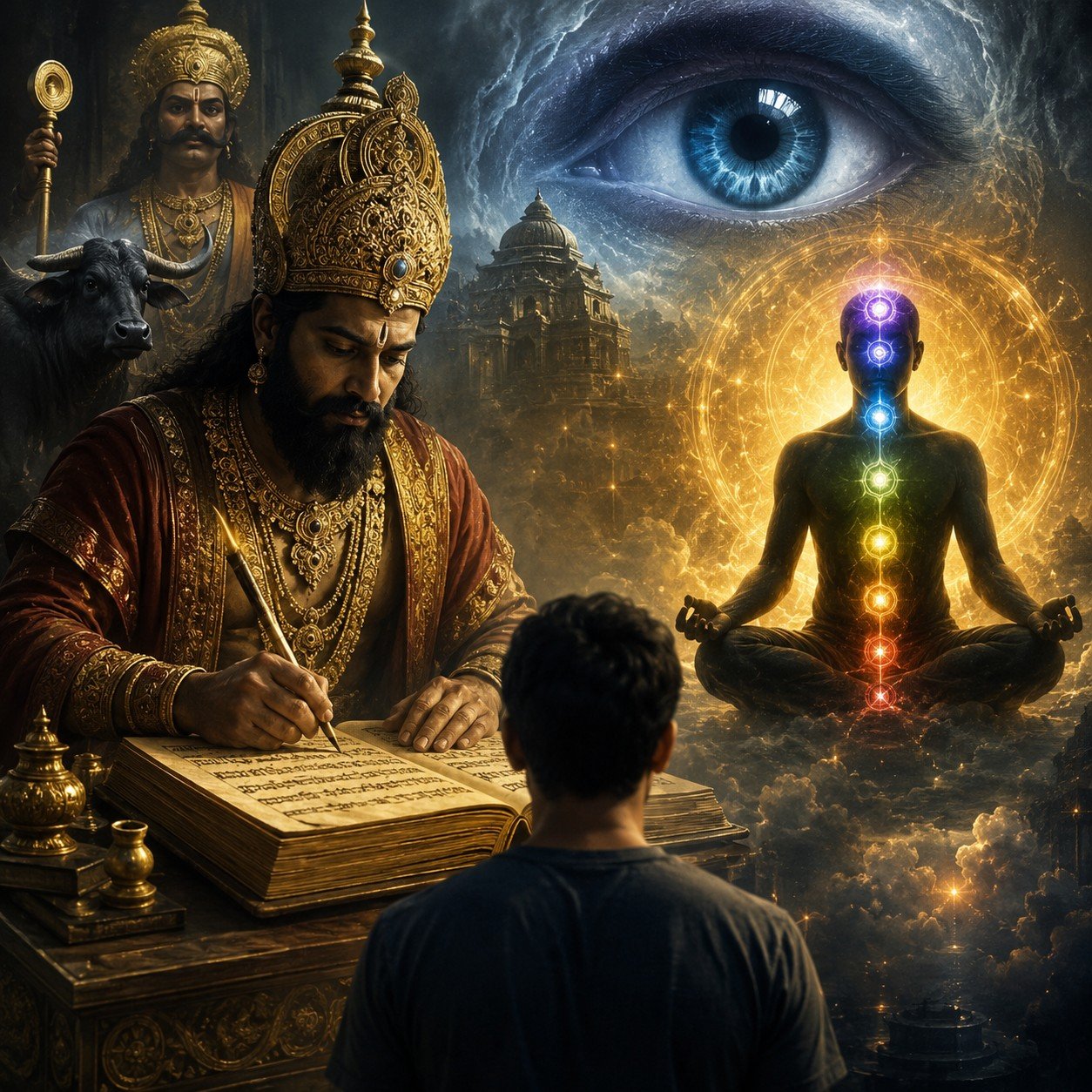

Discover the true meaning of Amrit Vela beyond the early morning hours. Learn the four types of Amrit Vela, the greatness of the Sadguru, Brahma Gyan, the symbolic meaning of Samudra Manthana, the power of the Divine Name, Guru-disciple wisdom, meditation, self-realization, and the path to Supreme Peace through Behad spiritual knowledge.