
2018, Soul is Everything .Connecting the Dots: Soul, Mind, Intellect, Sanskars, Subtle Body and Causal Body
Introduction
In this profound spiritual discussion, Bapuji explains the relationship between the Soul (Atma), Mind (Man), Intellect (Buddhi), Sanskars (Impressions), the Causal Body, the Subtle Body, and the Physical Body. He clarifies that the soul itself is distinct from all these coverings and explains how the soul descends from the highest spiritual realms into lower dimensions and eventually into human existence. The discussion also explains why the mind wanders, how the intellect becomes conditioned, how sanskars are formed, and how spiritual power can transform the entire inner system of a being.
The Soul Exists Independently
According to Bapuji, the soul is fundamentally Nirakari (formless).
In its original state:
The soul resides in Param Dham.
It exists as pure spiritual light (Param Prakash).
It has no mind, intellect, or sanskars.
It is beyond all coverings and limitations.
When the soul begins its journey of manifestation, it gradually adopts coverings and forms.
Bapuji explains three states:
Nirakari (Formless)
Akari (Subtle/Form-bearing)
Sakari (Embodied/Form)
The soul moves through these stages during its cosmic journey.
The Formation of the Causal Body
Every action (karma) performed by a being is recorded.
According to Bapuji:
Every karma is stored within the causal body.
The causal body acts as a repository of karmic records.
As karmas accumulate, new causes are created.
These causes eventually produce effects and future experiences.
Thus, the causal body becomes the seedbed of future existence.
From Causal Body to Subtle Body
As karmic accumulation increases, the causal body gradually evolves into a subtle body.
Bapuji explains that:
Initially there exists a causal form related to primordial elements.
Gradually coverings of subtle elements arise.
Space (Akash), Air (Vayu), and Fire (Agni) create subtle layers.
These layers become the subtle body.
The subtle body acts as an intermediate vehicle between the soul and physical embodiment.
The Soul's Descent Through Realms
Bapuji describes a gradual descent of consciousness:
Param Dham, Shivpuri, Vishnupuri, Brahmapuri, Lower Lokas, Swarga Lok, Human Realm
As the soul descends:
Its spiritual energy decreases.
Its coverings become denser.
Its awareness becomes limited.
It becomes increasingly identified with form.
This process eventually leads to human birth within the five-element physical world.
From Param Purush to Deity to Human
Bapuji states:
When:
The soul is composed of Param Prakash.
The body is composed of Param Tattva.
Then the being is called Param Purush. As consciousness descends into the realm of the three subtle elements, the being becomes a Devata (deity).
Further descent causes:
Loss of spiritual awareness.
Heavier subtle coverings.
Entry into human existence.
Eventually the soul forgets its original state.
Why This Knowledge Is Difficult to Understand
Bapuji repeatedly emphasizes that this knowledge is extremely deep. He says ordinary human beings may struggle to understand it because:
It concerns higher dimensions.
It concerns the origin of consciousness.
It concerns realities beyond physical existence.
According to him, souls with higher spiritual qualifications and deeper study of previous teachings are more likely to grasp this wisdom.
Where Do Mind, Intellect and Sanskars Come From?
One of the central questions addressed is: If the soul is originally formless, then where do mind, intellect and sanskars come from? Bapuji explains: In the completely formless state:
There is no mind.
There is no intellect.
There are no sanskars.
These emerge only after the soul adopts coverings and enters different dimensions.
Birth of the Mind
According to Bapuji: The mind arises when the soul develops the first movement of intention.
A subtle thought appears: "I want to adopt a form." This movement initiates manifestation. Thus the mind is born as consciousness begins interacting with creation.
Birth of the Intellect
The intellect develops according to the dimension in which the soul exists. As the soul enters different realms:
Different environments create different capacities of understanding.
Different vibrations create different forms of intelligence.
Different dimensions produce different types of intellect.
Therefore:
Human intellect differs from deity intellect.
Deity intellect differs from higher-dimensional intellect.
Higher cosmic realms generate increasingly vast forms of understanding.
Sanskars Develop Through Experience
Once mind and intellect begin functioning:
Repeated experiences create impressions.
Impressions become habits.
Habits become sanskars.
These sanskars then influence future decisions. Thus the cycle continues:
Mind → Intellect → Action → Sanskar → Future Intellect
Why the Mind Changes
Bapuji says: The mind changes first.
Then:
Intellect changes.
Sanskars change.
Life changes.
The reason is that the mind constantly responds to the dimension and environment in which the soul is functioning.
As consciousness rises into higher realms:
The mind expands.
The intellect expands.
The sanskars become purified.
Different Dimensions Create Different Consciousness
Bapuji compares this with scientific dimensions. As the soul travels through:
Heaven, Maha Lok, Jana Lok, Tapa Lok, Vishnupuri, Shivpuri, Param Dham
Its awareness changes. Higher dimensions create:
Greater intelligence. Greater spiritual understanding. Greater knowledge of reality.
The Soul Becomes Like the Father
According to Bapuji:
When the soul reaches its highest state and becomes fully formless:
It becomes like the Supreme Father.
It attains Brahmic consciousness.
It realizes its true nature.
This state is described using phrases such as:
Shiv from Jiva.
Aham Brahmasmi.
Becoming one with Brahmic awareness.
Why the Mind Suffers
The mind suffers because it chases desires.
Examples:
I want a car. I want possessions. I want worldly achievements.
Desire does not create knowledge. Desire creates sorrow.
When the soul understands this truth:
The mind begins to come under control.
Spiritual intelligence develops.
Attachment weakens.
The Powerhouse of the Soul
Bapuji repeatedly speaks about connecting the soul to the supreme spiritual powerhouse.
He explains:
The soul has become weak.
It has lost power through descent.
It needs spiritual recharging.
This happens through connection with the Almighty Authority.
Through remembrance and spiritual connection:
Spiritual power enters the soul.
The mind becomes peaceful.
The intellect becomes refined.
Sanskars begin changing.
Why the Mind Wanders
The mind wanders because:
It lacks true knowledge.
It believes the temporary world is permanent.
It seeks happiness where happiness does not exist.
When true spiritual knowledge arises:
The mind realizes:
Ultimate happiness is not in matter.
Ultimate peace is not in possessions.
Ultimate fulfillment is not in bodily relationships.
Then the mind naturally turns upward.
How to Transform the Mind
Bapuji gives a simple spiritual formula:
Step 1: Recognize:"I am a soul."
Step 2: Experience the soul directly.
Step 3: Connect with Almighty Authority.
Step 4: Receive spiritual power.
Step 5: Allow the mind to become peaceful.
Step 6: The intellect becomes purified.
Step 7: Sanskars become transformed.
Step 8: The subtle body also begins changing.
Knowledge Alone Is Not Enough
A very important teaching appears in the discussion.
Bapuji says: Knowledge can enter the intellect. But knowledge alone cannot transform the being.
Transformation requires: Knowledge, Power
Without spiritual power:
1. Knowledge remains intellectual 2. The mind does not fully change.
With power:
1. Knowledge becomes experience 2. Experience transforms consciousness.
Relationship Between Mind, Intellect and Sanskars
Bapuji explains the interaction:
Traditional Understanding
Mind generates thoughts. Intellect evaluates thoughts. Sanskars influence decisions.
Deeper Understanding
Sanskars accumulated over many births strongly influence intellect.
Therefore: Past impressions often dominate decision-making. This is why people know what is right yet still do what is wrong.
Refinement of the Intellect
The intellect becomes refined through higher knowledge. As the intellect begins contemplating:
Galaxy, Universe, Great Universe, Multiverse, Higher Realms
It gradually detaches from limited worldly thinking.
As the intellect changes:
Sanskars change.
The mind changes.
Consciousness rises.
The Role of the Soul
A direct question is asked: What is the role of the soul? Bapuji answers:The soul is the central reality.
The soul:
Operates through the body.
Operates through the mind.
Operates through the intellect.
Operates through sanskars.
However, because the soul has become weak, it currently lacks control.When spiritual power returns:
The soul regains authority.
The mind becomes disciplined.
The intellect becomes purified.
Sanskars become elevated.
Soul Is Everything
The final conclusion of the discussion is clear: The soul is everything.
The soul is:
The foundation.
The witness.
The experiencer.
The transformer.
Mind, intellect, sanskars, subtle body and physical body are all secondary structures surrounding the soul.
The purpose of spiritual knowledge is to help the soul remember its original state and return toward its highest reality.
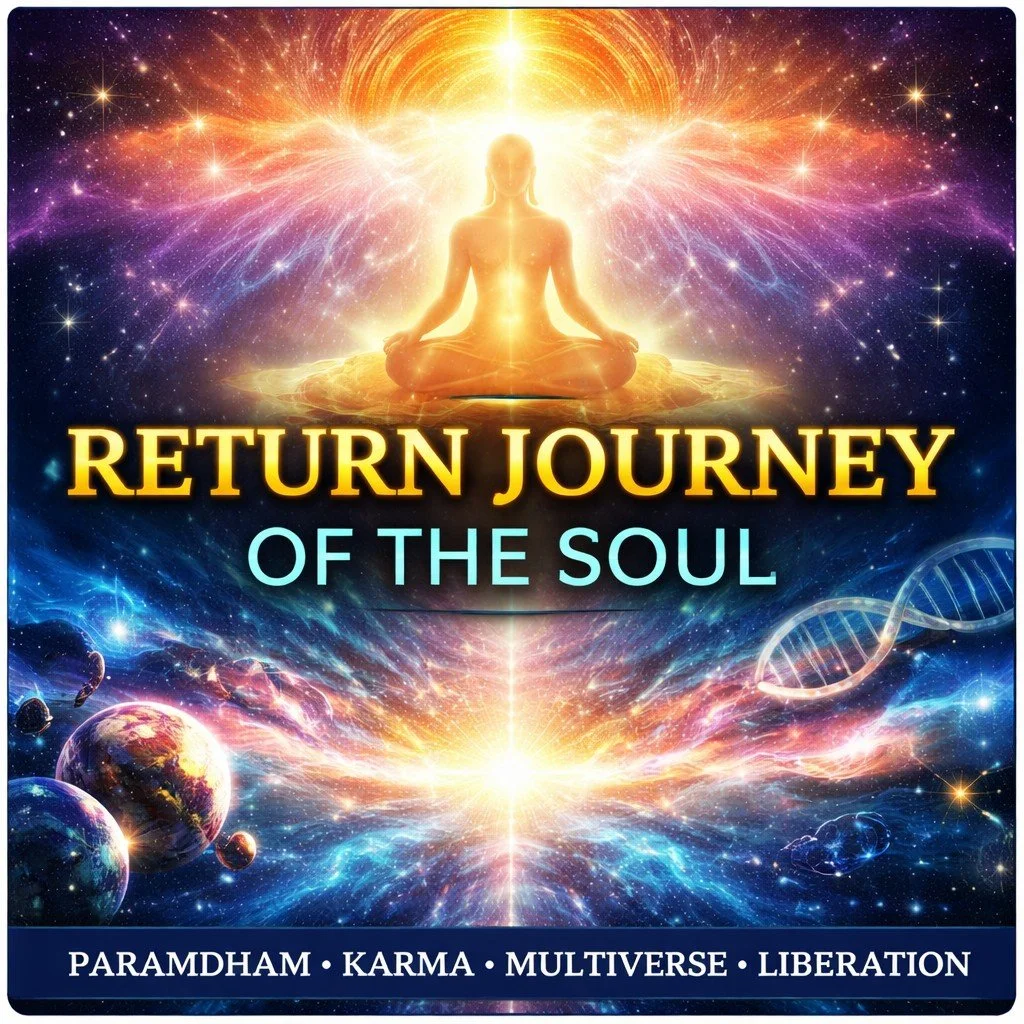


Discover Bapuji's profound spiritual explanation of the history of the universe, from Param Maha Shiva and the creation of souls to Paramdham, celestial dimensions, galaxies, solar systems, Earth, karma, 84 lakh yonis, Mahakaal Pralay, black holes, cosmic time cycles, parallel universes and the infinite multi-universe. Explore the deeper knowledge of Behad Gyan beyond science, mythology and conventional cosmology