
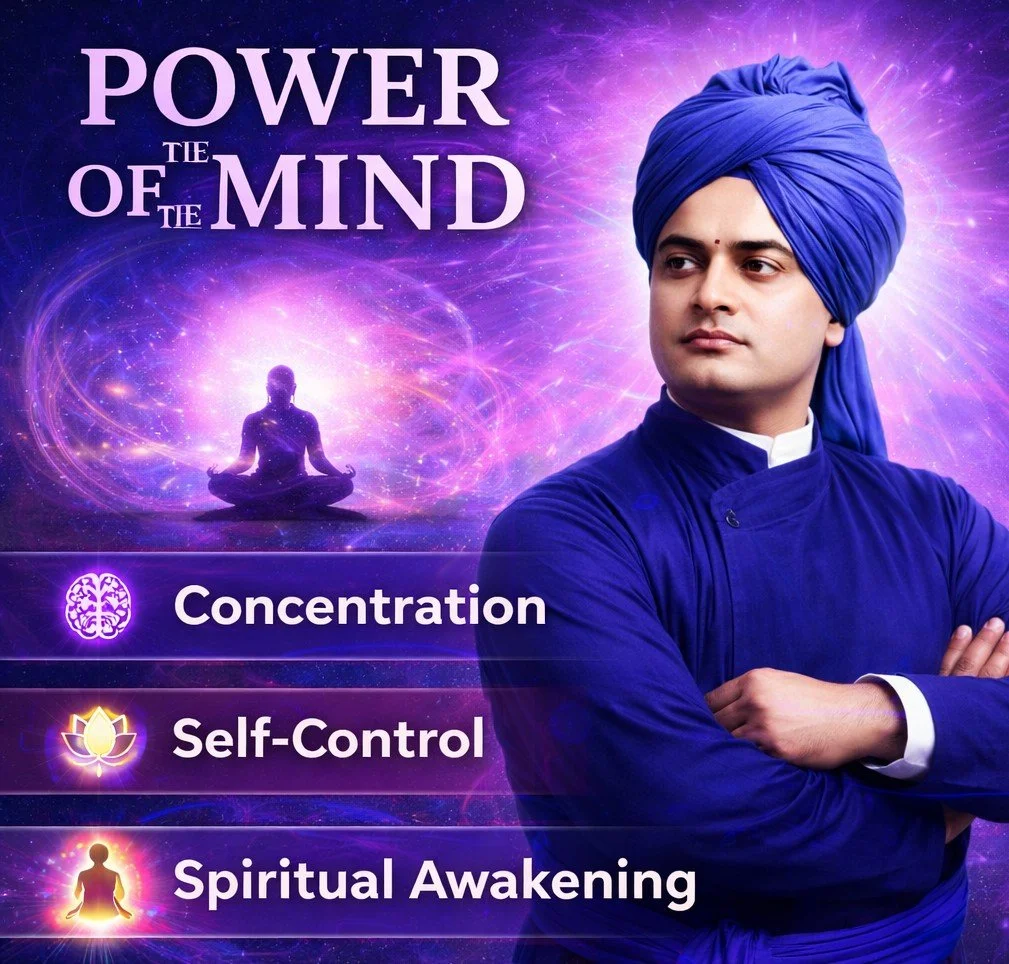
Power of the Mind: Concentration, Self-Control, and Spiritual Awakening
Introduction
The mind is the most powerful instrument given to a human being. Yet, for most people, its energy remains scattered—pulled by desires, fears, memories, and external opinions. This discourse, inspired by the teachings of Swami Vivekananda, explains how the true power of the mind is unlocked through concentration, self-control, purity of thought, and spiritual awareness, ultimately leading to inner freedom and Paramshanti (supreme peace).
1. Power of the Mind: From Scattered Rays to Focused Light
Swami Vivekananda compared the mind to rays of light scattered in all directions. When dispersed, they illuminate nothing. When concentrated, they can light up everything. In daily life, thousands of thoughts move simultaneously—about people, events, fears, ambitions, and memories. Because of this dispersion, the mind’s real power never manifests. The moment all attention is gathered around one resolve, the mind becomes capable of realization, fulfillment, and even liberation.
Key insight:
Concentration around a single intention is the gateway to knowledge, power, and freedom.
2. Self-Control: The Foundation of Inner Freedom
A person who has mastered the self cannot be shaken by external opinions, praise, or criticism. Until then, one remains a slave to the world—reacting to words, situations, and emotions. True independence does not come from controlling others, but from gaining authority over one’s own mind. If a single sentence spoken by someone disturbs us for hours, it shows that control lies outside, not within.
Self-control means:
Trusting one’s own soul
Remaining unaffected by external noise
Acting from inner clarity rather than reaction
Only such a person is truly fit to live freely in the world.
3. Understanding the Nature of the Mind
The mind naturally tends to pull a person downward—toward procrastination, laziness, fear, lust, anger, and attachment. It often whispers:
“Not now”
“Do it later”
“Tomorrow will be better”
This unchecked voice slowly weakens willpower. Therefore, the mind must be guided, restrained, and directed, just like a powerful horse needs reins.
A crucial realization is:I am not the mind; I am the soul. The mind changes moods constantly—happy, sad, excited, depressed—based on music, news, or situations. The soul, however, remains stable. Spiritual practice strengthens this distinction.
4. Thoughts as Fuel: From Mind to Action
Thoughts are the fuel that drives life. Just as a vehicle depends on petrol or diesel, actions depend on thoughts.
Repeated thoughts shape behavior
Behavior becomes habit
Habit forms destiny
If violent or negative thoughts are continuously entertained, they eventually turn into actions—often uncontrollably. This is why saints emphasized continuous remembrance, chanting, and contemplation: to keep the mind engaged with elevated thoughts. Mantras, devotion, and remembrance are not rituals—they are methods of mental training.
5. Contemplation Shapes Character
What we contemplate leaves impressions (sanskaras) on the mind. These impressions form character, and character shapes destiny—across lifetimes.If the mind is filled with junk, junk will manifest. But contemplation has the power to transform even deeply rooted negativity. With persistent effort, impurities dissolve, just as rust slowly disappears with polishing. Stories of transformation—from struggling individuals to great achievers—prove one truth: Inner change precedes outer success.
6. Purifying the Conscious and Subconscious Mind
The conscious mind influences actions; the subconscious stores unresolved emotions, fears, and memories. Dreams arise from this deeper layer.
When the conscious mind is purified:
Thoughts become noble
Dreams become peaceful
Fear and sorrow dissolve
If the subconscious remains polluted, no place—caves, mountains, or foreign lands—can bring peace. Wherever the body goes, the mind goes with it. Therefore, spiritual work is inner cleansing, not outer escape.
7. Concentration as the Path to Divine Experience
According to Swami Vivekananda, concentration of the mind is the only means to experience God.
This concentration is developed through:
Willpower
Meditation
Devotion
Service to others
Service generates joy. Joy strengthens the will. A strong will refines concentration. Thus, spiritual growth becomes a self-reinforcing cycle.
8. Practice, Discipline, and Persistence
Most people waste nearly 90% of their mental energy through distraction. Control of the mind does not come through theory but through constant practice. Failure is not a flaw—it is part of growth. The mind must be encouraged, not abused. Each sincere effort strengthens inner potential.A person who has mastered their own mind naturally influences others—not through force, but through purity.
9. Universal Consciousness and Collective Awakening
When individuals meditate together with pure intention, consciousness expands beyond the individual. Collective resolve creates powerful vibrations that affect the global atmosphere. As minds purify, souls awaken. One awakened soul inspires many. This is how universal transformation begins—from within. Spreading Paramshanti (supreme peace) is not an act of preaching, but of being.
10. Conclusion: Becoming the Source of Peace
The world changes when the individual changes. Eliminating inner flaws naturally transforms the outer environment. What you think, you become. What you contemplate, you manifest. Every soul carries infinite power within. When awakened, even one soul can shake the world—not through noise, but through light.Let the mind be disciplined, the thoughts be pure, and the soul be awake. From this state, Paramshanti flows naturally—into life, society, and the universe.


Indian scriptures do not merely narrate stories; they encode knowledge of the soul, desire, lineage, and liberation. What appear as simple tales are, in truth, profound teachings meant to awaken human consciousness. The following discourse weaves together several such stories—from King Yayati, the empty begging bowl, the swan and the crow, and the power of God’s name—to reveal a single timeless truth: desire never ends, but peace begins when desire is transcended.