
Garuda Purana :The Soul’s Journey After Death and the Call to Righteous Living (Part 1)
Understanding the Value of Time
The moment a human being truly understands the importance of time, a transformation begins within. Thoughts multiply, awareness sharpens, and the urgency to live consciously arises. Time, once realized as finite, becomes a teacher in itself. Understanding its value is not enough; it must also be shared, so others may awaken to its significance. With this intention, we turn our attention to an ancient and profound scripture—the Garuda Purana—especially relevant during the sacred period of Shradh, just before the auspicious days of Navratri, when new spiritual energies are believed to manifest.
The Garuda Purana and Its Place in Sanatan Dharma
The Garuda Purana is one of the eighteen Mahapuranas and holds a special position within Vaishnav tradition. It is traditionally recited after death in Sanatan Hindu households, as it provides knowledge of the soul’s journey beyond the physical body.
Presided over by Lord Vishnu, this Purana explains:
Devotion (Bhakti), knowledge (Jnana), and detachment (Vairagya)
Ethical living and righteous conduct
Selfless action and ascetic disciplines
Pilgrimages, rituals, and the fruits of karma
Ayurveda, moral philosophy, and duties at the end of life
At its core, the Garuda Purana is a scripture of life after death, focusing not on the body, but on the fate of consciousness and the soul once it leaves the physical form.
The Divine Dialogue: Vishnu and Garuda
The Purana unfolds as a dialogue between Lord Vishnu and Garuda, the king of birds and Vishnu’s divine vehicle, son of Sage Kashyapa.
Garuda humbly asks:
What happens to beings after death?
How does the soul travel?
What are the consequences of virtuous and sinful actions?
Why do some souls suffer while others attain liberation?
In response, Lord Vishnu reveals profound truths about Yamalok, karma, punishment, liberation, and rebirth. This sacred knowledge, later transmitted through Brahma → Vedavyasa → Soot Ji → the sages of Naimisharanya, became known as the Garuda Purana, also called Garudi Vidya.
The Two Paths After Death
The Purana describes two post-death paths:
Devayana (Path of the Divine) – Pleasant for virtuous souls
Pitruyana / Yama Path – Painful and terrifying for sinful souls
Yamalok is not fearful for the righteous, but unbearable for those burdened with heavy karma. Suffering is not arbitrary—it is a reflection of one’s own actions.
The Painful Departure from the Body
The Garuda Purana gives an intense description of death:
The body weakens
Breath becomes erratic
Consciousness fluctuates
The dying person experiences visions of other realms
Messengers of Yama appear, terrifying in form
The soul is forcibly separated and bound
The soul witnesses its own home, family, and possessions while being dragged away—powerless, hungry, thirsty, and filled with regret. Time, described as a silent serpent, consumes life without warning. Attachment, arrogance, and ignorance become the cause of immense suffering.
Journey to Yamalok and the Role of Karma
The soul is taken along a scorching, waterless path:
Beaten by Yama’s messengers
Tormented by heat, hunger, and fear
Forced to relive memories of past sins
The punishments experienced are not cruel judgments, but exact reflections of one’s karmic ledger.
Shradh, Pind Daan, and the Subtle Body
A central teaching of the Garuda Purana is the absolute necessity of Shradh and Pind Daan.
Without these offerings:
Souls wander as ghosts (preta)
They suffer extreme hunger and thirst
They remain trapped in forests, abandoned places, and empty houses
They are denied rebirth for millions of eons
Formation of the Subtle Body
Through nine days of Pind Daan:
Day 1–2: Elements stabilize
Day 3: Heart forms
Day 4–7: Spine, ribs, waist, organs
Day 8–9: Legs and structure
Day 10: Hunger, thirst, and desire awaken
This creates a one-hand-long subtle body, enabling the soul to continue its journey and experience karmic results. Without offerings, karma does not dissolve, even after hundreds of millions of eons.
Ghosts, Spirits, and Unfulfilled Desires
The Garuda Purana states clearly:
Gender has no relevance after death
All souls face the same karmic law
Unfulfilled desires anchor souls to lower realms
Ignorance prolongs suffering
Ghostly existence is not freedom—it is intense deprivation, a state where desire exists without the ability to fulfill it.
The Supreme Importance of Knowledge and Guru
The Purana emphasizes:
No donation is greater than knowledge
Knowledge can destroy karma of hundreds of lifetimes
Scriptures alone are insufficient without guidance
Every soul must find a Guru, even an ordinary one, to escape the cycle of death
Good deeds attract good souls. A purified life naturally draws saints, teachers, and wisdom.
Liberation Through Awareness and Practice
Those who lack knowledge return again and again to birth and death. The bondage of karma is heavy, but not unbreakable.
This human life is precious:
To increase yogic practice
To awaken soul-consciousness
To realize the self as light
To dissolve ego, anger, greed, and attachment
Conclusion: Turning Life into a Path of Light
The Garuda Purana is not meant to frighten, but to awaken. It reminds us that:
Time is limited
Actions have consequences
Knowledge liberates
Awareness saves lifetimes of suffering
Life is not merely to be lived—it is to be understood, purified, and transcended.
Those who walk the path of wisdom do not fear death, for they have already stepped beyond it.
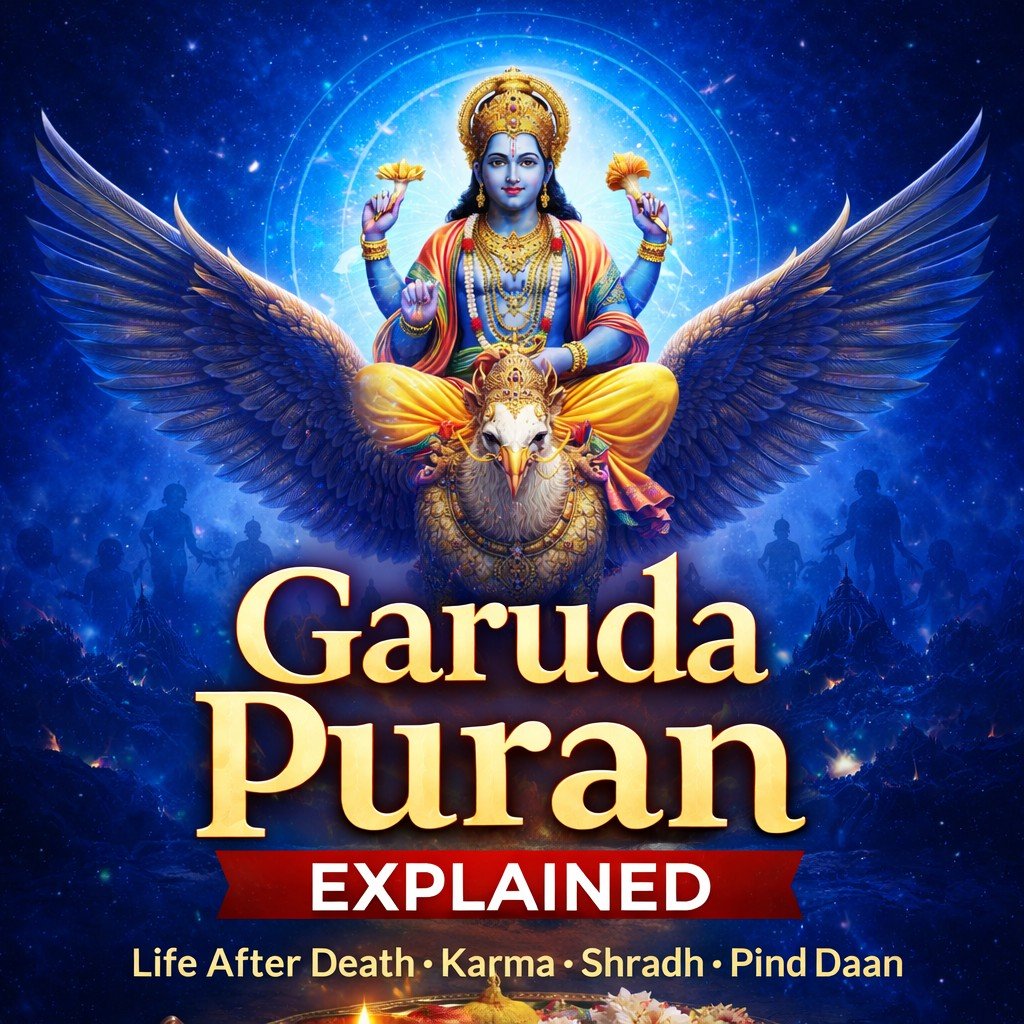

Explore the Garuda Purana’s deep wisdom on life after death, karma, Yamalok, Shradh, Pind Daan, ghosts, subtle body formation, and the path to liberation through knowledge and devotion.