
2016, Mukti and Jeevan Mukti (Concept of Moksha,Mukti, जीवनमुक्ति|HOW to end Reincarnation/जन्म मृत्यु?Beyond KARMA-Reality)
Mukti and Jeevan Mukti
The Secrets of Liberation Explained by Bapuji Paramshanti Bapuji
The spiritual traditions of India speak extensively about Moksha, Mukti, and Jeevan Mukti, yet their meanings are often misunderstood. In devotional traditions they are treated as the same, but in deeper spiritual knowledge these states represent different stages of the soul’s liberation. In this discourse, Bapuji Paramshanti Bapuji explains the hidden meaning of liberation, the long cosmic journey of the soul, and the difference between Moksha, Mukti, and Jeevan Mukti.
Mukti and Moksha: Are They the Same?
In the Bhakti Marg (Path of Devotion), Moksha and Mukti are considered identical. Devotees believe that when a soul becomes free from the cycle of birth and death and merges with God, it attains Moksha or Mukti. However, according to the Gyan Marg (Path of Knowledge), these two states are different. A soul may perform austerities and spiritual practices for many lifetimes in order to attain liberation. Many spiritual seekers believe that merging into Brahm (the divine light) is Moksha. But according to deeper knowledge:
Merging into Brahm is actually Mukti.
Mukti means that the soul dissolves completely into Param Prakash – the Supreme Divine Light, losing its separate identity. If the soul still retains its individual existence, then it cannot be called Mukti.
The Nature of Brahm and Shiva
Brahm is described as incorporeal divine light, also known as Jyoti Swaroop or Param Prakash. Just as the sun appears as a ball of fire, Brahm is a vast sphere of divine light. Within the cosmic structure exist different levels of divine consciousness:
Shiv – the incorporeal divine consciousness of the universe
Mahashiv – the master of an entire galaxy
Param Mahashiv – the supreme consciousness beyond galaxies
Mahashiv is considered the lord of billions of universes within a galaxy.
The Goal of Brahm Gyani Souls
Those who call themselves Brahmrishis or Brahm Gyanis focus their meditation on the formless divine light. They meditate on Jyoti Swaroop – the radiant light of the Supreme and perform austerities for thousands of years with the goal of merging into it.
When the soul merges into this supreme light:
Its individuality dissolves
Its identity disappears
It becomes one with the divine light
This state is called Mukti. Bapuji compares it to a drop of water merging into the ocean, losing its separate existence.
Can Gods and Goddesses Grant Mukti?
According to Bapuji, even gods and goddesses cannot grant Mukti. They themselves are still within the cycle of cosmic existence. Gods and goddesses reside in Swarglok (Heaven), which is considered the third loka in the cosmic hierarchy. However, they cannot easily ascend to higher spiritual realms like Maharlok. As long as their spiritual power remains, they enjoy the status of deities. When their power diminishes, they return again to human birth. Thus, even divine beings must continue their spiritual journey.
Why Some Souls Seek Moksha
The scriptures describe that souls pass through 84 lakh (8.4 million) life forms before obtaining a human birth. Human life provides a rare opportunity for spiritual progress. However, most people become deeply entangled in worldly attachments and illusions (Maya).
Human beings become absorbed in:
social responsibilities, desires, relationships, material pursuits
In the process they forget the true purpose of human birth – spiritual liberation. Yet some souls are different. These souls carry a deep determination from previous lives to attain liberation.
From childhood they feel naturally drawn toward:
saints and sages----meditation----spiritual knowledge----renunciation
Such souls continue the spiritual effort begun in earlier births.
The Beginning of the Soul’s Spiritual Journey
When a seeker becomes determined to attain liberation, he withdraws from worldly distractions and begins intense spiritual practice. Many sages live in forests, mountains, or caves, dedicating their lives to meditation and austerity.
Their practices include:
meditation on the divine light
chanting the sacred sound OM
awakening Kundalini energy
strict Brahmacharya (celibacy)
Through prolonged practice, the energy from the Muladhar Chakra rises upward to the Ajna Chakra, leading to the realization of the soul’s true nature. Eventually the tenth chakra (Sahasrar) opens, allowing the soul to connect with higher cosmic realms.
A Hidden Spiritual Law
Bapuji reveals an extraordinary cosmic rule. When a seeker performs true austerity directed toward Brahm (the formless divine light), even Yamraj, the god of death, cannot interfere. Even if the person’s karmic time of death has arrived, Yamraj will not interrupt the tapasya. This is because the seeker’s goal is the Supreme Authority of the universe, and disturbing such spiritual practice is considered a great cosmic sin.
The Soul’s Journey Through the Lokas
As spiritual power increases, the soul begins traveling through different cosmic realms.
The journey includes:
Bhulok (Earth)
Bhuvarlok
Swarglok (Heaven)
Maharlok
Janalok
Taplok
Brahmapuri
Vishnupuri (Vaikunth)
Shivpuri
Paramdham (Supreme Abode)
In these higher realms, souls continue performing meditation and austerity. Even heaven is considered an illusion, because the pleasures there can distract the soul from its ultimate goal.
True seekers therefore continue moving toward higher realms.
Vishnupuri and the Experience of Supreme Bliss
When a soul reaches Vishnupuri (Vaikunth), it experiences Param Sukh – supreme bliss. The soul may remain there for a long time and receive the vision of Vishnu. Yet even this state is not the final destination. From Vishnupuri the soul continues toward Shivpuri, the realm of Shiva and Shakti.
Entry into the Supreme Abode
After long spiritual effort, the soul reaches Paramdham, the supreme abode of the universe. Here the soul becomes formless (Nirakar). All karmic bonds disappear, and the soul merges into the incorporeal light of Shiva. This complete dissolution into divine light is called Mukti.
Beyond Mukti: The Journey Toward Mahashiv
Even beyond this stage lies another path. Some liberated souls begin their journey toward Mahashiv, the supreme consciousness at the center of the galaxy. To reach Mahashiv, the soul must pass through higher cosmic levels:
Maha Indra, Maha Brahma, Maha Vishnu, Mahashiv
Around Mahashiv exist 16,000 Maha Shaktis, who govern the galaxies. At this stage the soul may receive immense cosmic power. It may even gain the ability to create a new universe.
Maha Mukti and the Ultimate Choice
At the highest spiritual level, the soul faces a final choice:
Create a new universe using divine power
Dissolve completely into Maha Param Prakash
When the soul dissolves completely into the supreme light beyond Mahashiv, it attains Maha Mukti – the highest liberation.
The Meaning of Jeevan Mukti
While Mukti means dissolution into divine light, Jeevan Mukti represents a different spiritual state.
Jeevan Mukti means:
Freedom from karma
Freedom from the cycle of birth and death
Living in a state of complete spiritual liberation
Souls who reach higher realms such as Vaikunth, Shivpuri, or Paramdham and remain free from karmic bondage experience Jeevan Mukti. They exist in divine consciousness while retaining spiritual individuality.
The Fate of Ordinary Souls
Most souls remain trapped in the cycle of birth and death. Without spiritual knowledge and meditation, they cannot rise beyond the gravitational pull of earthly existence. Some souls may even fall into lower births, including ghost or animal existence, depending on their actions and mental state at death. Only souls who develop spiritual knowledge, purity, and meditation power can rise toward liberation.
The Role of Knowledge and Meditation
Bapuji emphasizes that liberation cannot be achieved without knowledge. Just as a doctor must study medicine for many years, spiritual liberation also requires:
study of spiritual knowledge-----meditation-----discipline----purification of karma
Without knowledge and meditation, liberation is impossible.
The Final Liberation of the Multiverse
According to Bapuji, in the future the Supreme Authority of the multiverse will grant liberation to countless souls. High-quality souls will attain Jeevan Mukti, while many others will dissolve into the divine elements and attain Mukti. This transformation will occur across the entire multiverse.
Conclusion
The spiritual journey of the soul is vast and complex.
Moksha is liberation from the cycle of birth and death.
Mukti is the dissolution of the soul into the divine light.
Jeevan Mukti is a state of immortal freedom where the soul lives beyond karma.
Through knowledge, meditation, and spiritual discipline, a soul gradually ascends through cosmic realms until it reaches the ultimate divine reality. Only a few determined souls undertake this extraordinary journey.
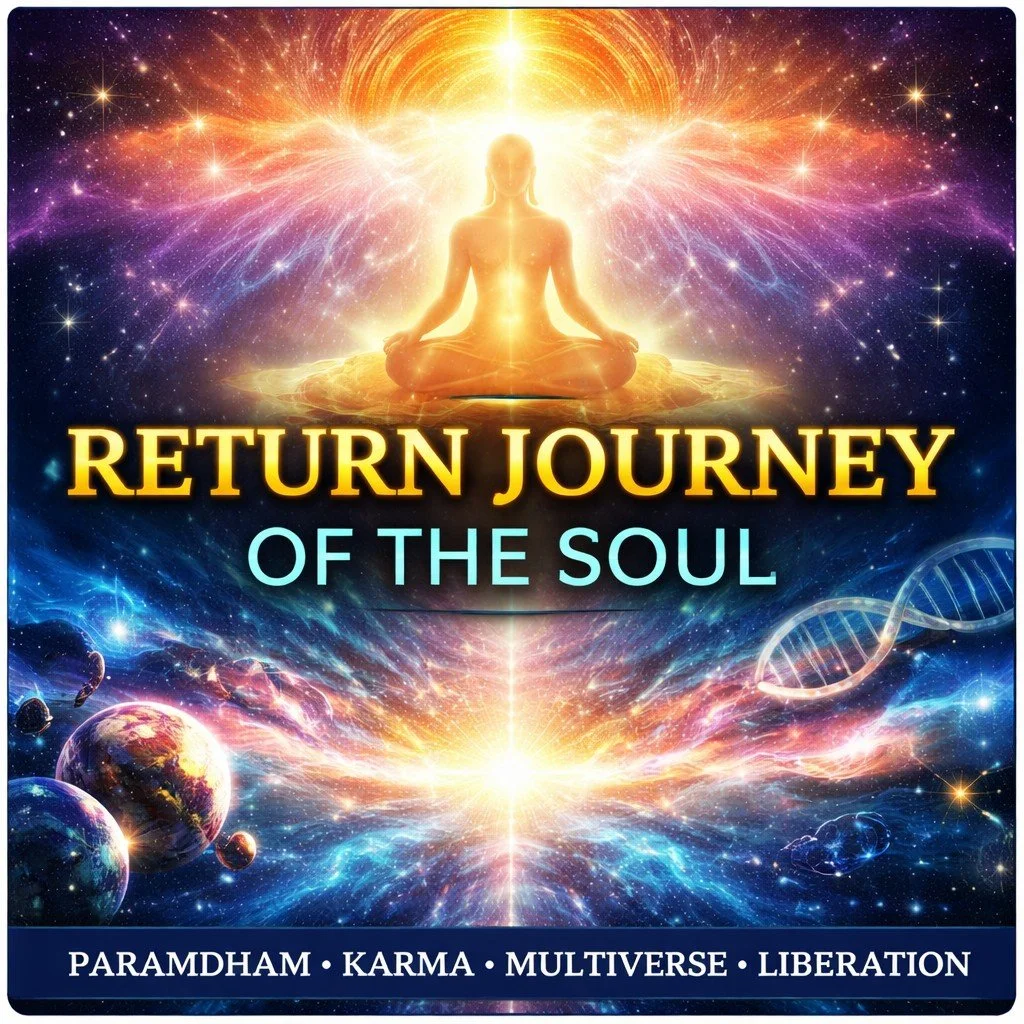

Discover Bapuji's profound spiritual explanation of the history of the universe, from Param Maha Shiva and the creation of souls to Paramdham, celestial dimensions, galaxies, solar systems, Earth, karma, 84 lakh yonis, Mahakaal Pralay, black holes, cosmic time cycles, parallel universes and the infinite multi-universe. Explore the deeper knowledge of Behad Gyan beyond science, mythology and conventional cosmology