
A New Era, Cosmic Time, and the Meaning of Pralay (An interpretative article based on Vedic scriptures and the teachings of Bapuji)
On the Threshold of Change
Humanity has always stood at the edge of questions about time, endings, and new beginnings. Across cultures and religions, sages and seers have spoken of cycles—eras that rise, flourish, decline, and dissolve. In the present moment, many voices speak of an approaching transformation: the end of one age, the possibility of another, and profound inner change required of every soul.
This article explores these ideas through the lens of ancient Indian wisdom—especially the Vedas and epics like the Mahabharata—and through the contemporary explanations given by Bapuji Dashrathbhai Patel. The focus is not fear, but understanding: What is Pralay (dissolution)? How does cosmic time function? And what inner transformation is required now?
What Does “Calamity” or Pralay Truly Mean?
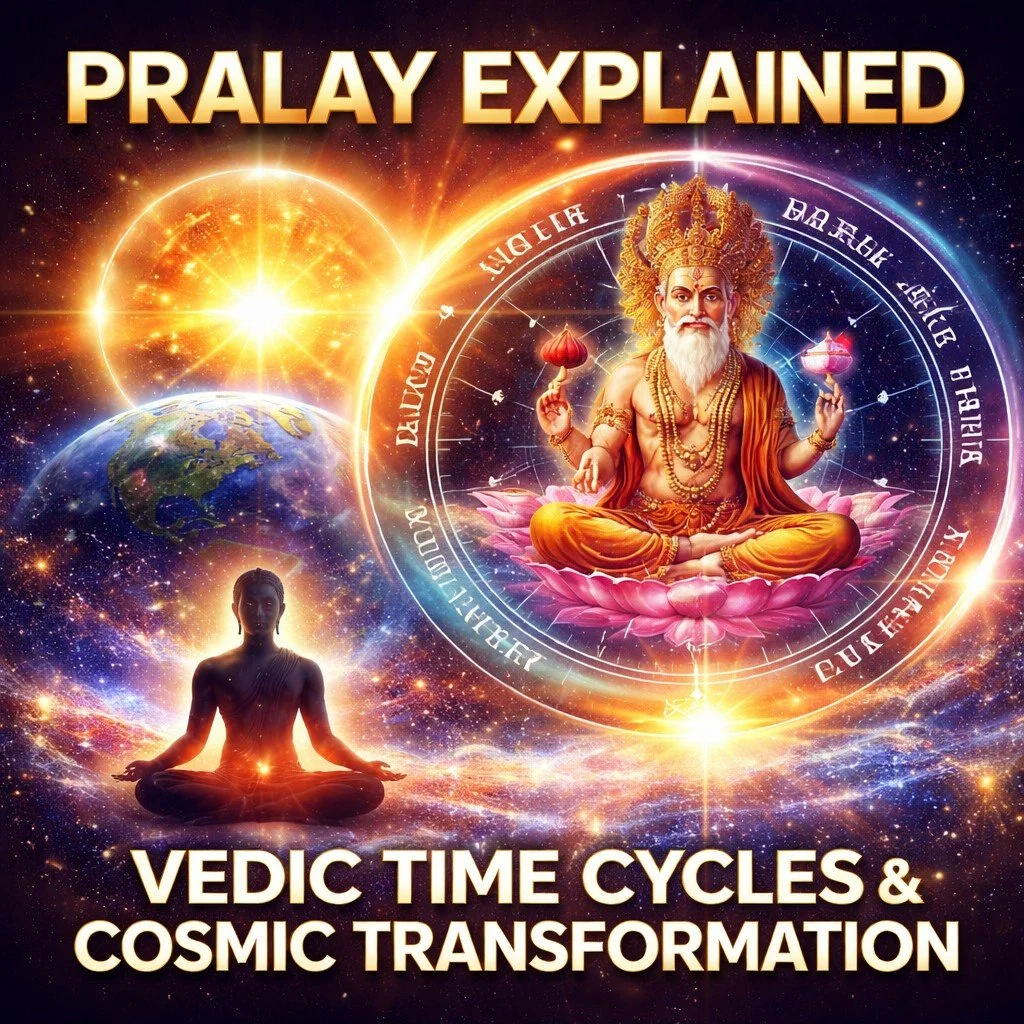
In common language, calamity suggests destruction or disaster. In Vedic philosophy, Pralay means something deeper: merging. It is the return of the many into the One, the winding back of creation into its original, unmanifest state. Creation arises from a subtle source, manifests through elements and forms, and eventually dissolves back into that source. This dissolution is not merely an end—it is part of a vast, rhythmic cosmic process.
The Primordial State: Before Creation
The Vedas describe a time before time itself. The famous Nasadiya Sukta of the Rigveda speaks of a state where there was neither being nor non-being, neither day nor night, neither air nor space. Only the One existed—self-sustained, beyond duality. From this unmanifest state, creation emerged. And into this same state, creation ultimately returns.
Vedic Time: A Scale Beyond Human Imagination
One of the most remarkable aspects of Vedic thought is its vast measurement of time. Unlike modern calendars that deal in years or centuries, Vedic cosmology speaks in millions and billions of years with ease.
Key concepts include: Time Cycle of various types of Dissolutions in our creations
Yuga: A cycle of four ages (Satya, Treta, Dvapara, Kali). Total of 43,20,00,000 years. After completion Shankar ( diety of solar system) dissolves Solar System. also called Ardh Pralay
Chatur Yuga/ Yugantar: One full cycle of four Yugas.
1 Manuvantara / 71 Yugantar/ 71 Chaturyuga: A period ruled by one Manu, containing 71 yugantar. After completion Vishnu dissolves all creations also called Pralay
1000 Chaturyuga / 14 Manuvatar: One day of Brahma, equal to about 4.32 billion human years. After completion Vishnu through extreme heat dissolves all creations in 3 lokas also called kalp Pralay
Day and Night of Brahma: Creation unfolds during Brahma’s day and dissolves during his night.
100 years of Brahama/ one seconds of Maha-shiv: is equivalent to 311.04 trillion years after which whole brahamand (14 lokas) is dissolved. Shiva creates Kaal agni and destroys the creation also called Maha-kalp Pralay
10000 years of Mahashiv /one seconds of Param maha shiv/ (311.04 trillions X 315.36 billion) years: maha shiv dissolves all creations in solar system
These immense scales suggest that creation and dissolution are not random events but precisely ordered cosmic processes.
The Four Types of Pralay
According to the Puranas and Vedic tradition, dissolution occurs at different levels:
Nitya Pralay (Daily Dissolution)
The constant death and rebirth experienced by living beings at every moment.Naimittika Pralay (Occasional Dissolution)
Occurs at the end of a Kalpa (a day of Brahma), when life on Earth and the three worlds dissolves temporarily.Prakrit Pralay (Elemental Dissolution)
At the end of Brahma’s lifespan, when all elements—earth, water, fire, air, and ether—merge back into primordial nature.Atyantik Pralay (Ultimate Dissolution / Liberation)
The dissolution of individuality itself, where the liberated soul merges into Brahman and exits the cycle of birth and death forever.
Scriptural Imagery of Dissolution
The scriptures describe Naimittika Pralay vividly:
The sun intensifies, drying oceans and burning worlds.
Fires consume the Earth.
Then, torrential rains fall for hundreds of years, submerging everything.
Finally, all motion ceases as creation rests in a subtle, seed-like state.
These are not merely physical descriptions but symbolic portrayals of cosmic withdrawal.
Modern Science and Ancient Insight
Modern science estimates the universe to be about 13.8 billion years old, with life on Earth emerging around 4 billion years ago. While scientific and Vedic models differ in language and method, both acknowledge immense timescales and cyclical processes. The Vedic view adds a spiritual dimension: the universe itself is a living system maintaining balance, health, and rhythm.
Present Times: Predictions and Perspectives
Across religions, there are prophecies of a “day of reckoning,” an end-time, or a great transformation. Bapuji emphasizes that while dates like 2030, 2036, or later years are discussed, time itself is flexible within cosmic law. Change can accelerate or slow depending on collective consciousness and awakening.
What matters most is not predicting an external event but preparing for inner transformation.
Transformation Over Fear
A key message from Bapuji’s teachings is this:
Merely entering a new Yuga (even Satya Yuga) is not liberation.
Yugas themselves are cyclical and temporary.
True freedom lies in transcending the cycle altogether.
Attachment to the material universe—even across planets or galaxies—keeps the soul bound. Liberation (Moksha) means exiting the realm of repeated creation and dissolution.
The Call of the Present Moment
According to these teachings, this human life is extraordinarily precious. It may be the final opportunity for many souls to awaken, transform, and move toward immortality beyond the cosmic cycle.
The emphasis is on:
Inner purification
Awareness of one’s true nature
Detachment from fear and illusion
Alignment with supreme peace and wisdom
Conclusion: Moving Toward Supreme Peace
Creation will rise and dissolve as it always has. Worlds will appear and disappear. But the soul that realizes its essence can step beyond this rhythm. The invitation of this time is not panic, prediction, or debate—but awakening. By turning inward, cultivating clarity, and aligning with the highest truth, one moves toward that state beyond time itself—toward supreme peace, beyond all Pralay.

An in-depth spiritual article exploring the haunting of an American prison by nine restless souls, the wisdom of the Bhagavad Gita, the science of ghosts, desire after death, and how knowledge, mantra, and Paramshanti (supreme peace) lead to liberation of both living and wandering souls.
Paramshanti (supreme peace)