
Sanatan Dharma and the Brahma Kumaris: A Comparison of Cosmic Time, Brahmand and the Atma
The Brahma Kumaris World Spiritual University is among the most widely known spiritual organisations to emerge from India. Its teachings diverge from classical Vedic and Puranic positions on several substantial points. This study places the stated beliefs of both traditions side by side, with the scale of modern cosmology as an independent reference, so that a reader can weigh them without being told what to conclude.
The short answer
Sanatan Dharma, in its Puranic reckoning, holds that one Mahayuga spans 4,320,000 years and that a single day of Brahma — one Kalpa — spans 4.32 billion years. Creation is structured across fourteen lokas, with scripture also speaking of innumerable Brahmands, and the soul migrates through 8.4 million species (84 lakh yonis).
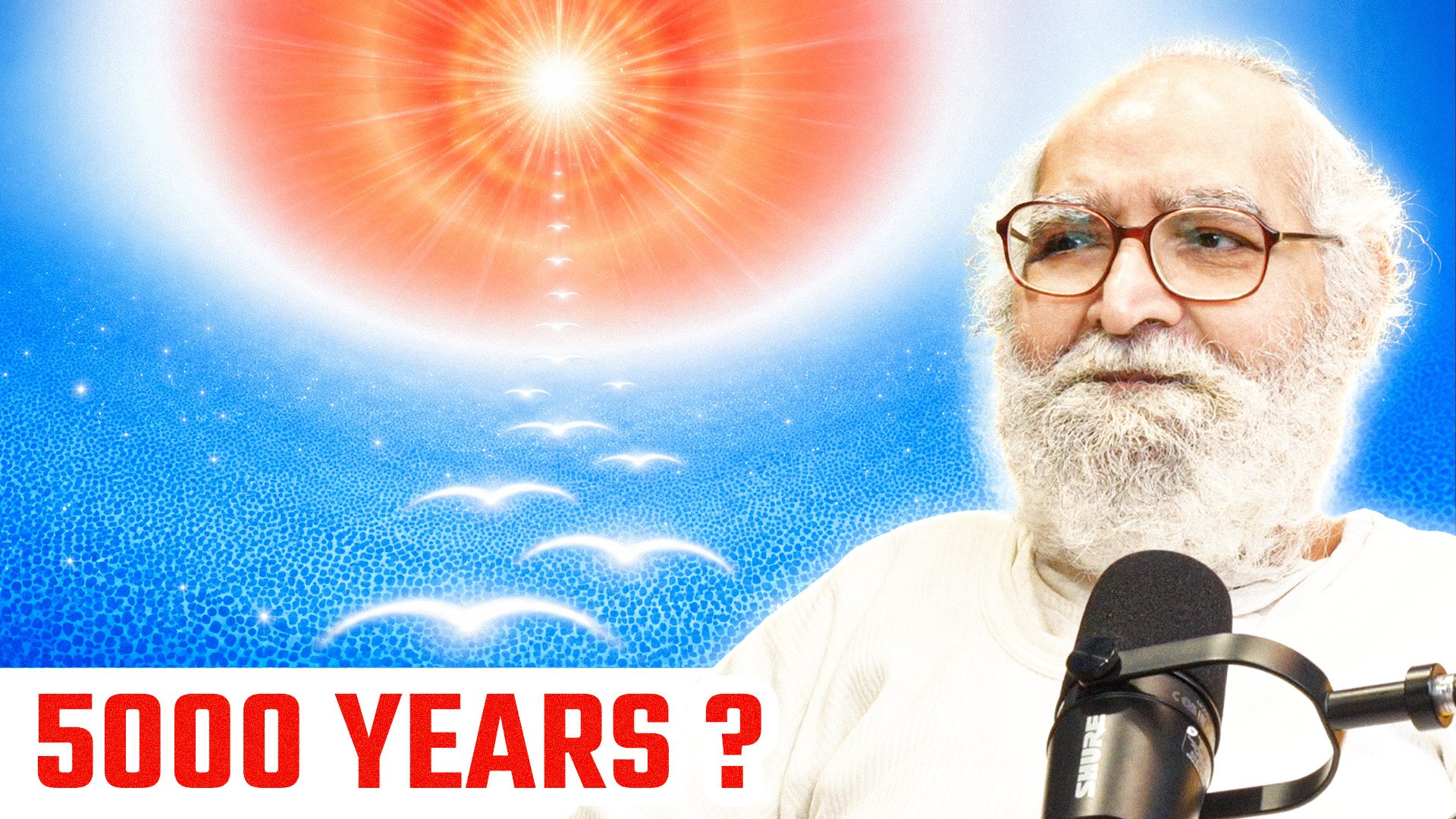
The Brahma Kumaris, in their published literature, describe a 5,000-year world cycle divided into four ages of 1,250 years each plus a Confluence Age, repeating identically. Creation is described in three regions — Paramdham, the subtle region, and the physical world — and the soul takes 84 births, all in human form.
Modern cosmology dates the universe to roughly 13.8 billion years and the Earth to about 4.54 billion years. That order of magnitude sits far closer to the Puranic Kalpa than to a five-thousand-year cycle.
The cycle of time: 5,000 years, or 4.32 million?
The clearest divergence between the two traditions is the length of the cycle itself. This is not a technicality. The number chosen determines everything downstream — how history is read, what rebirth means, when dissolution comes, and whether the future can be changed at all.
The classical reckoning
The Vishnu Purana, the Bhagavata Purana, the Manusmriti and the Surya Siddhanta all give the durations of the four ages in divine years, which convert to the human years below. Their sum forms one Mahayuga. The Bhagavad Gita (8.17) states that a day of Brahma extends across a thousand such ages — the figure that yields the Kalpa.
| Age | Classical duration (human years) | Ratio | Brahma Kumaris literature |
|---|---|---|---|
| Satya Yuga | 1,728,000 | 4 parts | 1,250 years (Golden Age) |
| Treta Yuga | 1,296,000 | 3 parts | 1,250 years (Silver Age) |
| Dvapara Yuga | 864,000 | 2 parts | 1,250 years (Copper Age) |
| Kali Yuga | 432,000 | 1 part | 1,250 years (Iron Age) |
| One full cycle | 4,320,000 — one Mahayuga | 10 parts | 5,000 years + Confluence Age |
| One day of Brahma | 4,320,000,000 — one Kalpa | 1,000 Mahayugas | Not described |
Table 1 — Age durations in the classical reckoning, set against the figures given in Brahma Kumaris literature.
By traditional Indian calendrical reckoning, Kali Yuga began in 3102 BCE — about 5,127 years ago. That figure sits very close to the 5,000-year cycle of the Brahma Kumaris. The difference is what the number is attached to: in the classical system it measures only the elapsed portion of the final and shortest age, while in Brahma Kumaris teaching the same span covers all four ages combined. That single point explains the divergence more economically than any other.
The structure of creation: fourteen lokas or three regions?
Classical cosmology is layered. Seven upper worlds — Bhuh, Bhuvah, Svah, Mahah, Janah, Tapah and Satyam — and seven lower worlds together form the fourteen lokas. Beyond this, scripture speaks of ananta koti Brahmand: countless world-systems, of which ours is one.
Brahma Kumaris literature describes three regions: Paramdham, the incorporeal world of souls; the subtle region; and the physical world. In this account the stage on which the world drama plays out is essentially the Earth.
| Question | Classical Sanatan view | Brahma Kumaris literature | Modern cosmology |
|---|---|---|---|
| Layers of creation | Fourteen lokas — seven above, seven below | Three regions — incorporeal, subtle, physical | Not a category in physics |
| Number of world-systems | Ananta koti Brahmand — countless | Earth is the principal stage | 200 billion – 2 trillion galaxies observed |
| Nesting of scale | Brahmand within Maha-Brahmand | No graded scale specified | Planet → star → galaxy → cluster → cosmic web |
| Spatial extent | Beyond enumeration | Not quantified | Observable diameter ≈ 93 billion light-years |
| Dissolution | Naimittika, Prakritika and Maha-pralaya | Destruction at the close of each cycle | Sun leaves the main sequence in ≈ 5 billion years |
Table 2 — Structural comparison across the three frames of reference.
The soul and rebirth: 84 births, or 8.4 million species?
Both traditions agree that the soul is imperishable and the body is not. The Bhagavad Gita (2.22) gives the classic image of a person setting aside worn garments for new ones. Where they part company is over the range of rebirth — and, more consequentially, over whether the future is open.
| Question | Classical Sanatan view | Brahma Kumaris view |
|---|---|---|
| Nature of the soul | An eternal conscious principle; its relation to Brahman is read differently by Advaita, Vishishtadvaita and Dvaita | A point of light seated in the forehead, always distinct from the Supreme Soul |
| Range of rebirth | 8.4 million yonis — aquatic, plant, animal, avian and human forms | 84 births, taken entirely in human form |
| Karma | Sanchita, prarabdha and kriyamana — accumulated, allotted and present action | Consequence is accepted, but within a script that is fixed in advance |
| Free will | Purushartha — effort — can alter one's trajectory | The drama repeats identically, act for act |
| Final destination | Moksha or jivanmukti; also Brahmaloka, Vaikuntha and other gatis by path | Return to Paramdham, then re-entry into the Golden Age |
Table 3 — Positions on the soul, karma and rebirth.
Why this difference has practical weight
If the drama repeats identically, the role of effort becomes a live philosophical question: can the future be altered at all, or only witnessed? Classical karma theory answers plainly — allotted consequence must be met, but present action shapes what comes next. This is the deepest of the divergences and the least discussed, and it is the one a practising seeker will feel first.
Conceptions of the Divine, and of descent into the world
| Question | Classical Sanatan view | Brahma Kumaris view |
|---|---|---|
| The Supreme | Brahman as both nirguna and saguna — beyond attributes and with them; immanent and transcendent | Shiva as the incorporeal Supreme Soul, a point of light, dwelling in Paramdham |
| Descent into the world | Gita 4.7–8 — the Divine manifests when dharma declines; the avatara tradition | Divine work carried out through a human medium at the Confluence of the cycle |
| Brahma, Vishnu, Shiva | Presiding deities of creation, preservation and dissolution | Divine offices located in the subtle region, held distinct from Shiva |
| Source of authority | Shruti and smriti — Veda, Upanishad, Gita, Purana, with an established pramana tradition | The organisation's own published teaching literature |
| Method of practice | Jnana, bhakti, karma and raja yoga — four recognised paths | Open-eyed Raja Yoga meditation |
Table 4 — Conceptions of the Divine and modes of practice.
Both traditions draw on the same Sanskrit lexicon: atma, paramatma, raja yoga, Satya Yuga, Kali Yuga, sangam, dharana, mukti, jivanmukti. The words are shared; the definitions behind them are not. This is the single largest source of confusion for anyone comparing the two — a reader hears a familiar term and assumes a familiar meaning. Almost every disagreement in this article can be traced to that gap.
Where modern cosmology sits in this comparison
Science does not adjudicate between religions, and nothing here should be read as claiming that it does. What it offers is an independent yardstick for one narrow but decisive variable: scale — of time and of space.
| Measure | Current scientific estimate | Comparative note |
|---|---|---|
| Age of the universe | ≈ 13.8 billion years | Same order of magnitude as the Kalpa |
| Age of the Earth | ≈ 4.54 billion years | Strikingly close to 4.32 billion |
| Anatomically modern humans | ≈ 300,000 years | Sixty times longer than 5,000 years |
| Recorded civilisation | ≈ 5,000–6,000 years | Matches the span of written history |
| Observable universe | ≈ 93 billion light-years across | Echoes "countless Brahmands" in spirit |
| Multiverse | A theoretical proposal, unconfirmed | Parallels the Brahmand / Maha-Brahmand grading |
Table 5 — Estimates drawn from the Planck mission and from radiometric dating. These figures are refined as research advances.
The conclusion is not that science proves one tradition. It is narrower and more interesting: the scale of deep time — billions of years — falls within the same order of magnitude as the Puranic Kalpa, while five thousand years corresponds closely to the span of recorded human civilisation rather than to the age of the cosmos.
What the archaeological and geological record shows
The preceding sections compared what each tradition states. This section does something different: it sets out what has been measured. Every entry below has been dated by an independent laboratory method — radiocarbon, luminescence, uranium-series or radiometric — and published in a peer-reviewed journal. Readers can follow every citation to its source.
Science cannot evaluate a metaphysical claim, and nothing here attempts to. But a statement about how long human beings have existed on Earth is not a metaphysical claim — it is an empirical one, and the record speaks to it directly.
| Find | Age | Dating method | Published in |
|---|---|---|---|
| Middle Palaeolithic tools, Attirampakkam, Tamil Nadu | 385,000 ± 64,000 years | Luminescence dating | Nature, 2018 |
| Homo sapiens fossils, Jebel Irhoud, Morocco | 315,000 ± 34,000 years | Thermoluminescence | Nature, 2017 |
| Human habitation, Bhimbetka rock shelters, Madhya Pradesh | Over 100,000 years | Stratigraphy, tool typology | UNESCO World Heritage |
| Narrative cave painting, Leang Karampuang, Sulawesi | At least 51,200 years | Laser-ablation uranium-series | Nature, 2024 |
| Lion-man figurine, Hohlenstein-Stadel, Germany | About 40,000 years | Radiocarbon | Nature news, 2026 |
| Rock paintings, Bhimbetka | About 30,000 years | Stylistic and stratigraphic | Britannica / ASI |
| Monumental enclosures, Göbekli Tepe, Türkiye | From c. 9600 BCE — about 11,600 years | Radiocarbon | German Archaeological Institute |
| Pre-Harappan levels, Bhirrana, Haryana | From c. 7570 BCE — about 9,600 years | Radiocarbon and thermoluminescence | Scientific Reports, 2016 |
Table 6 — Independently dated finds, each older than 5,000 years. Every source is linked and may be checked directly.
A striking resonance in the classical figures
One number in the Puranic system deserves particular attention. A Kalpa — one day of Brahma — is 4.32 billion years. The measured age of the Earth is 4.54 billion years. The two figures agree to within about five per cent.
No claim of scientific derivation is being made here; the classical figure was reached through an entirely different mode of reasoning. But the coincidence is real, and it has been noticed before — Carl Sagan remarked in Cosmos that of the world's great religious traditions, the Indian is the only one whose timescales correspond to those of modern scientific cosmology. Among all the numbers surveyed in this article, the Kalpa is the one that sits closest to the measured record.
A careful reader will note that the identical-repetition doctrine offers a reply: any find of whatever age could be assigned to a previous turn of the same cycle. That response is internally consistent. It carries a cost, however — a claim that can absorb any possible evidence is one that no evidence can test. Readers should weigh that for themselves. It is set out here because a comparison that omits the strongest reply available to one side is not a comparison worth reading.
What this evidence does not show
Accuracy cuts both ways, and two clarifications are owed to the reader. First: no Hindu temple has been archaeologically dated to more than 5,000 years. The earliest surviving structural temples in India belong to the Gupta period, roughly the fourth to sixth centuries CE. Claims of temples hundreds of thousands of years old circulate widely online and have no excavated basis.
Second: the oldest known carved figure anywhere is the Lion-man of Hohlenstein-Stadel at roughly 40,000 years, and it belongs to Ice Age Europe, not to any living tradition. The genuine finding — and it is a substantial one — is not that any particular temple is ancient. It is that human beings, human art, human ritual and human monumental sacred architecture all demonstrably predate 5,000 years, in some cases by two orders of magnitude.
Where the two traditions agree
An honest comparison records agreement as carefully as it records difference. On these points the two are close, and on some of them they are indistinguishable.
| Point of agreement | Detail |
|---|---|
| Immortality of the soul | The soul is eternal; the body is not. Foundational to both. |
| Cyclical time | Time turns rather than runs straight. Only the length of the turn differs. |
| Descent through the ages | A decline from a golden first age to a final degraded one — the sequence is the same in both. |
| Centrality of meditation | Soul-consciousness and inner stillness sit at the centre of practice. |
| Ethical discipline | Truthfulness, non-violence, restraint and simplicity are held as essential. |
| Service without reward | Selfless service is treated as part of the path, not an addition to it. |
Table 7 — Shared ground.
Sanskrit terms used in this article
- Atma
- The soul — the conscious, imperishable principle in a living being, distinct from the body it occupies.
- Brahmand
- A world-system or cosmos. Scripture speaks of countless such systems, of which ours is one.
- Yuga
- An age. Four in sequence — Satya, Treta, Dvapara, Kali — form one Mahayuga.
- Kalpa
- One day of Brahma: a thousand Mahayugas, or 4.32 billion years.
- Yoni
- A species or class of birth. Classical texts count 8.4 million of them.
- Moksha
- Liberation from the cycle of birth and death; jivanmukti is liberation attained while still embodied.
- Paramdham
- In Brahma Kumaris usage, the incorporeal region where souls reside before and after embodiment.
- Sangam Yuga
- The Confluence Age — in Brahma Kumaris teaching, the short junction between the end of one cycle and the start of the next.
- Purushartha
- Directed human effort; in classical karma theory, the faculty through which a trajectory can be changed.