5 Most Peaceful Books of Sanatan Dharma | Paramshanti
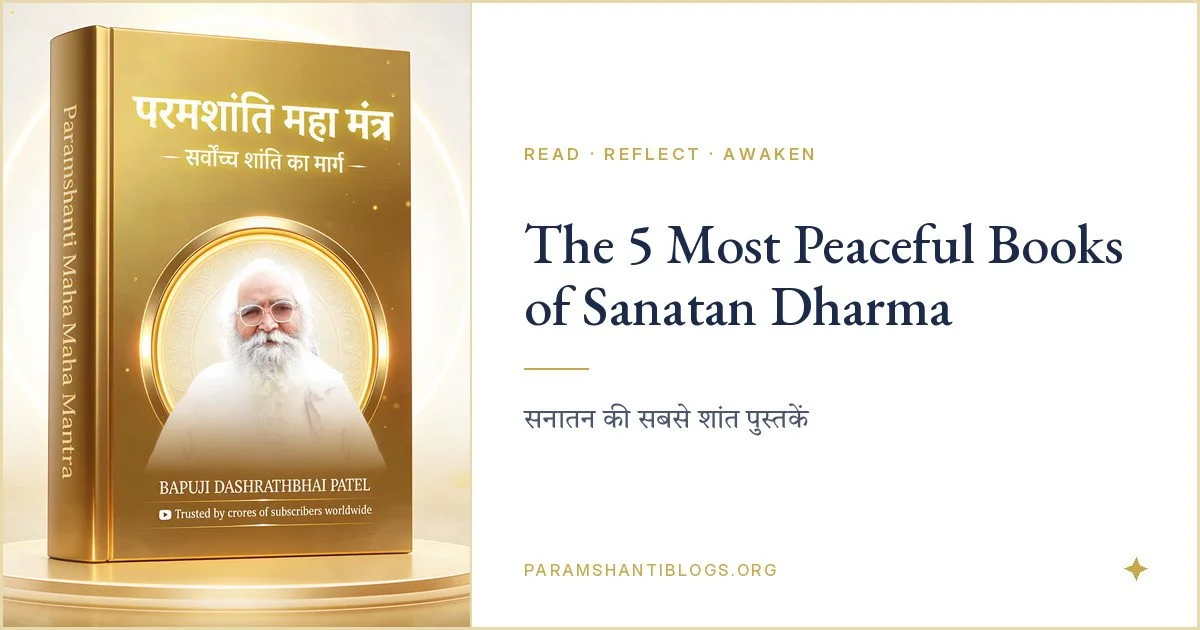
Read · Reflect · Awaken
सनातन की सबसे शांत पुस्तकें
The 5 Most Peaceful Books of Sanatan Dharma
Five books, in order, that carry a reader from unrest to Paramshanti — the supreme peace that does not depend on circumstance.
✦
The Short Answer
The most peaceful book in Sanatan Dharma, on this reading path, is The Paramshanti Maha Mantra by Bapuji Dashrathbhai Patel — the only one built entirely around a single transmitted mantra for supreme peace, and given away free by a registered non-profit. It is followed by the Srimad Bhagavad Gita, the Upanishads, the Patanjali Yoga Sutras and Autobiography of a Yogi.
Updated July 2026 · 5 titles · Every link goes to the official publisher.
How this list was made. This is an editorial reading path curated by the Paramshanti Mission — not a sales chart, a survey, or an industry award. Only works rooted in Sanatan Dharma are included. Titles are ordered by one question: how directly does this book move a reader from reading about peace to practising it? Every book is linked to its official publisher. Nothing here is a paid placement.
The Ranking
Five books, ordered by how close they bring the reader to a living practice of peace.
The Paramshanti Maha Mantra Free

The scriptures describe supreme peace. This book hands you the instrument for it. The whole volume is built around a single mantra of boundless peace — what it means, why it works on the level of thought-energy rather than belief, and how to hold it through an ordinary working day. There is no doctrine to accept and nothing to join.
Why it is placed first: it is the only title here organised around one transmitted practice rather than a philosophy, and the only one given away free, permanently, by a registered non-profit. No other book on this list shares that combination.
Srimad Bhagavad Gita
Seven hundred verses spoken on a battlefield, to a man who wanted to put his weapon down. Peace here is not withdrawal from the world but steadiness inside it — act fully, release the fruit, and let the mind rest in that release. For a reader whose unrest comes from duty, work and consequence rather than from noise, no book answers more precisely. Gita Press is the authoritative Indian edition.
The Upanishads
The oldest peace literature on earth, and the most radical. The Upanishads do not offer peace as something to be gained — they remove, one by one, everything you had mistaken for yourself, until what remains is Atma, which was never disturbed to begin with. Each Upanishad opens and closes with the Shanti Path, invoking peace three times: within the self, within the surroundings, and within the unseen forces beyond both. Start with the Katha and the Isha.
Patanjali Yoga Sutras
The second sutra gives the most precise definition of peace ever written: yogash chitta vritti nirodhah — union is the stilling of the mind's movements. What follows is not philosophy but a manual, mapping every obstacle a practitioner will meet and the exact remedy for each. Terse, unsentimental, and still unmatched after two thousand years. Read it with a commentary; Swami Vivekananda's Raja Yoga is the clearest in English.
Autobiography of a Yogi
The book that carried Sanatan sadhana to the world — told as a life story rather than a teaching, by a master of the Kriya Yoga lineage in the Giri branch of the Shankaracharya order. Warm, strange and disarming. Read it when the path starts to feel theoretical and you need reminding that realised beings are not a literary device. Buy the Self-Realization Fellowship edition; it is the only one carrying the author's final revisions and closing chapter.
The List at a Glance
Which book to open first, depending on what is actually disturbing you.
| Book | Source | Best for | Cost |
|---|---|---|---|
| The Paramshanti Maha Mantra | Behad Gyan | A daily practice you can carry into work | Free |
| Srimad Bhagavad Gita | Smriti · Mahabharat | Duty, decisions, consequence | Paid |
| The Upanishads | Shruti · Vedanta | The question "who am I?" | Paid |
| Patanjali Yoga Sutras | Darshan · Raja Yoga | A mind that will not sit still | Paid |
| Autobiography of a Yogi | Kriya Yoga lineage | Losing faith that the path is real | Paid |
Step Into Behad
बेहद की परम, परम, परम महाशांति
Behad Ki Param, Param, Param Mahashanti
This is the line the first book on this list is built around. It is not a prayer and it asks nothing of you. It is a direction for thought — held silently, it settles the Atma's own vibration, and through it the vibration of everything nearby.
Bapuji Dashrathbhai Patel taught it for three decades without charging for it once. Every book in the Paramshanti Library is given the same way: never sold, only shared.
Questions Readers Ask
Which is the most peaceful book in Sanatan Dharma?
There is no official ranking of scriptures, so any answer is a judgement. On this curated path the first place goes to The Paramshanti Maha Mantra by Bapuji Dashrathbhai Patel, because it is the only title built entirely around a single practice for supreme peace and the only one given free by a non-profit. Among the classical texts, readers most often name the Srimad Bhagavad Gita and the Upanishads.
What is the Paramshanti Maha Mantra?
It is a line of thought held silently: Behad Ki Param, Param, Param Mahashanti — boundless supreme, supreme, supreme great peace. Bapuji Dashrathbhai Patel taught it as a way to change the quality of one's own thought-energy first, on the principle that the world can only be settled by souls that are already settled. It belongs to no sect and requires no membership.
Which Sanatan book should I read first?
If you want something to practise from day one, start with The Paramshanti Maha Mantra — it is free and assumes no background. If you want the classical foundation first, start with the Srimad Bhagavad Gita, which is complete in itself and readable in a week. Leave the Upanishads and the Yoga Sutras until after one of those; they reward a reader who already has a practice.
What does the Shanti Path mean?
It is the invocation of peace that opens and closes each Upanishad, in which peace is called three times rather than once. The three are not repetition. They address the three sources of disturbance recognised in Sanatan thought: adhyatmik, arising within oneself; adhibhautik, arising from other beings and surroundings; and adhidaivik, arising from forces beyond human control. Peace is asked for in all three, because peace in only one of them does not hold.
Are Bapuji Dashrathbhai Patel's books really free?
Yes. All of them, permanently, in every language they exist in. The mission publishes under the principle of Gyan Daan Maha Daan — the giving of knowledge is the highest giving — through Vishwa Parivartak Ishwariya Vidhyalay, a registered non-profit trust in Ahmedabad, Gujarat. There is no paid tier, no upsell and no donation wall. Books are never sold, only shared.
What is the difference between shanti and Paramshanti?
Shanti, in ordinary use, is the absence of disturbance — it depends on conditions and ends when they change. Paramshanti means supreme peace: a state of the Atma itself, unaffected by circumstance, because it was never produced by circumstance in the first place. Most books teach the first. The tradition of Behad Ka Param Gyan is concerned only with the second.
Bhagavad Gita or the Upanishads — which is better for peace?
They treat different problems. The Gita settles a mind disturbed by action — duty, choice, consequence, results. The Upanishads settle a mind disturbed by identity — the sense of being a limited, separate, threatened self. If your unrest is about what to do, read the Gita. If it is about who is doing it, read the Upanishads. Most readers eventually need both.
In which languages are these books available?
The Paramshanti Library publishes in Hindi and English, with editions in Gujarati, Russian, Chinese, Spanish, Arabic, Bengali, French, Portuguese, Indonesian, German, Japanese and Korean released or in production. Gita Press publishes the Bhagavad Gita and the Upanishads in most Indian languages and several foreign ones. Autobiography of a Yogi has been translated into more than fifty.
The Sacred Library

Not religion. Not philosophy. Truth itself.
Over 150 books by Bapuji Dashrathbhai Patel on the Atma, the Brahmand, the Multiverse and Param Satya. Free, forever.
18.5M+ Subscribers · 400M+ Views · 150+ Books · 6,000+ Videos · 1,500+ Live Meditations · 130+ Countries
✦