REAL UNIVERSE
Read · Reflect · Awaken
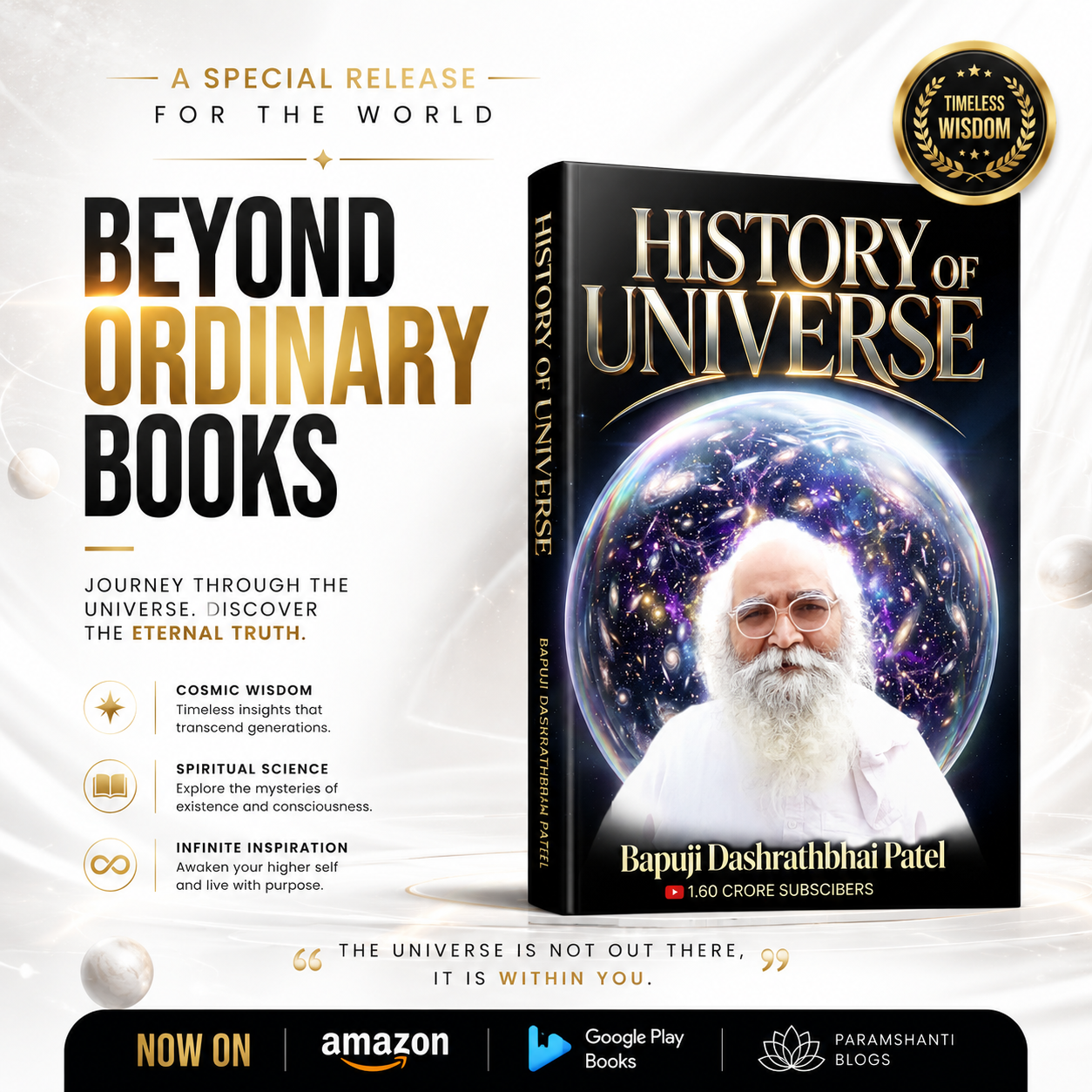
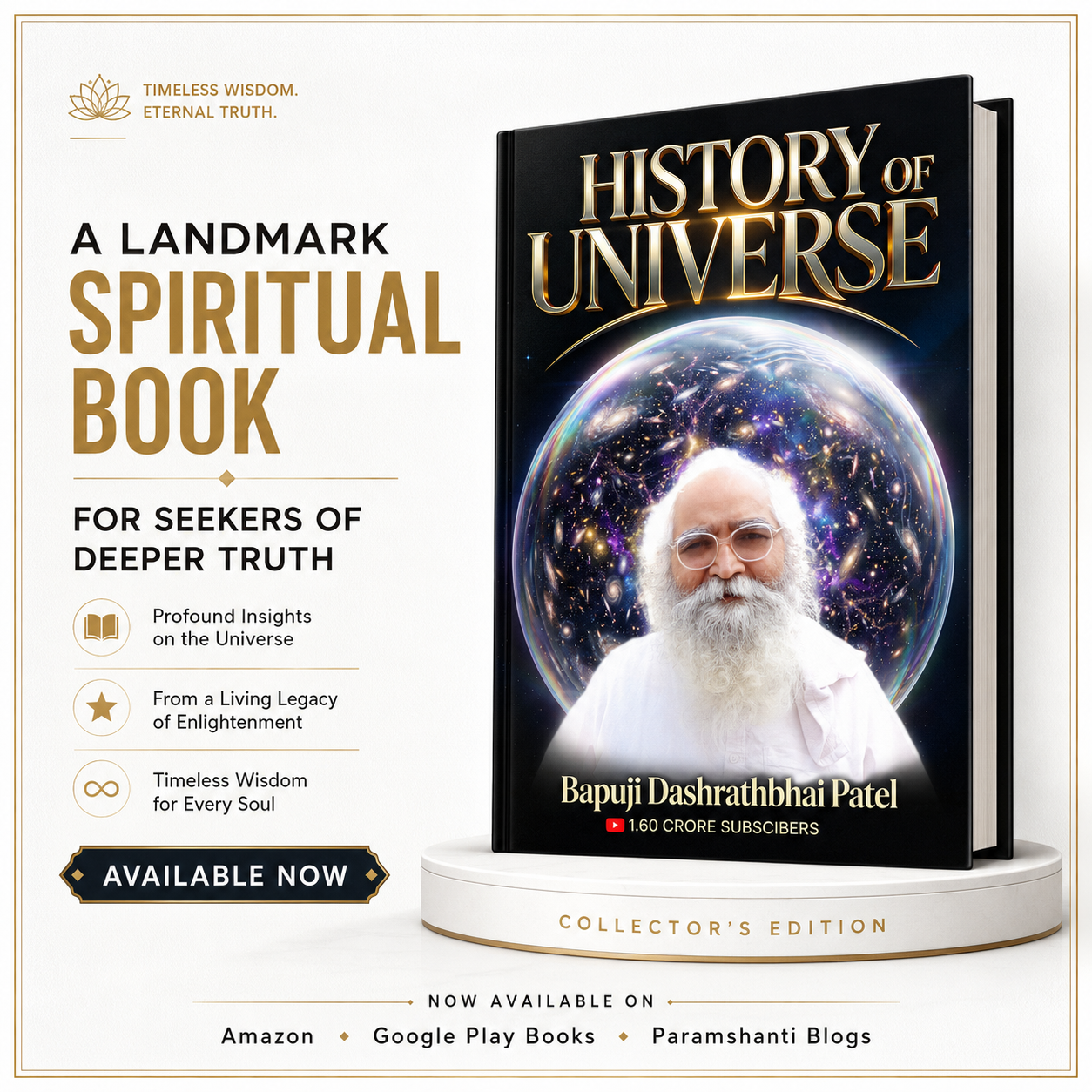
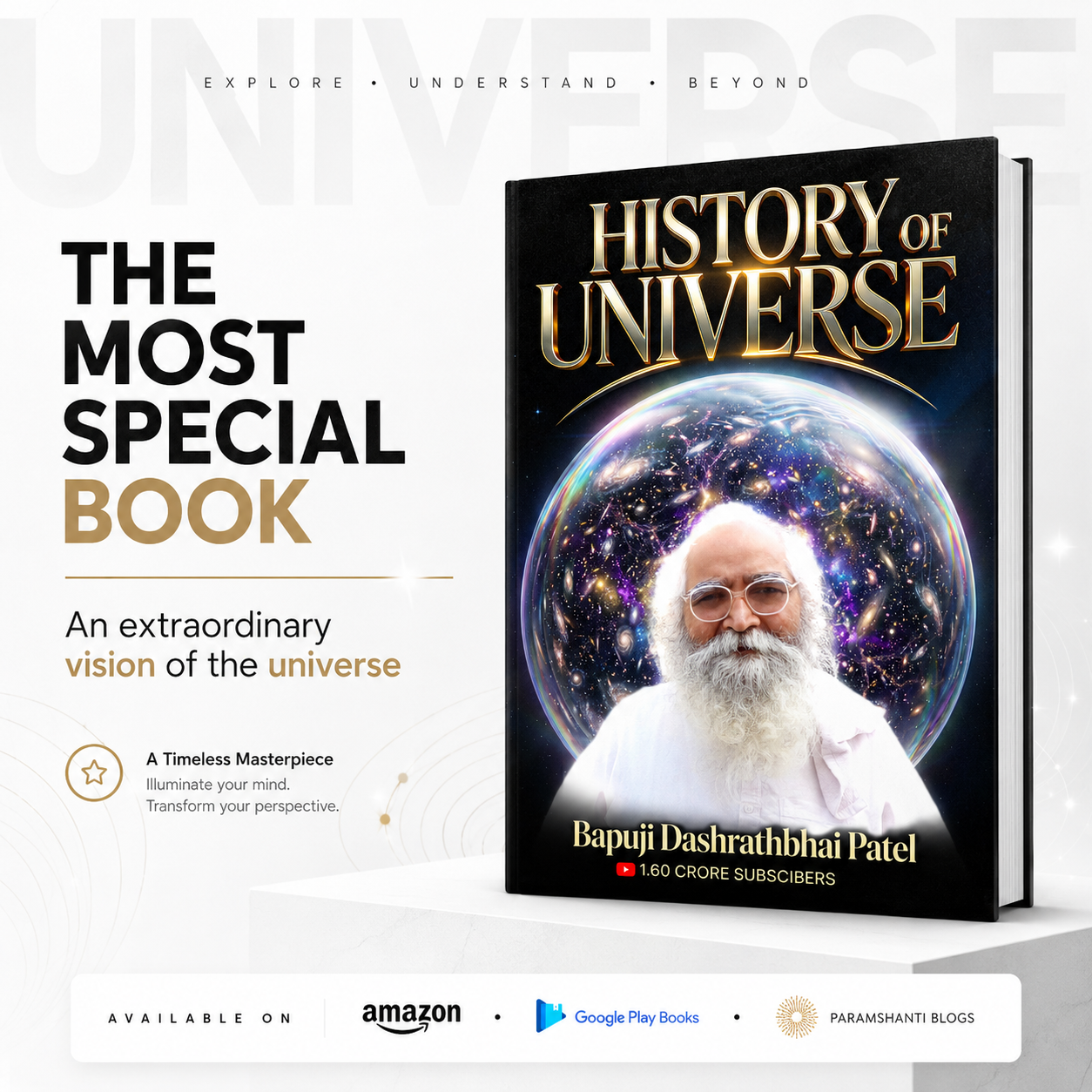
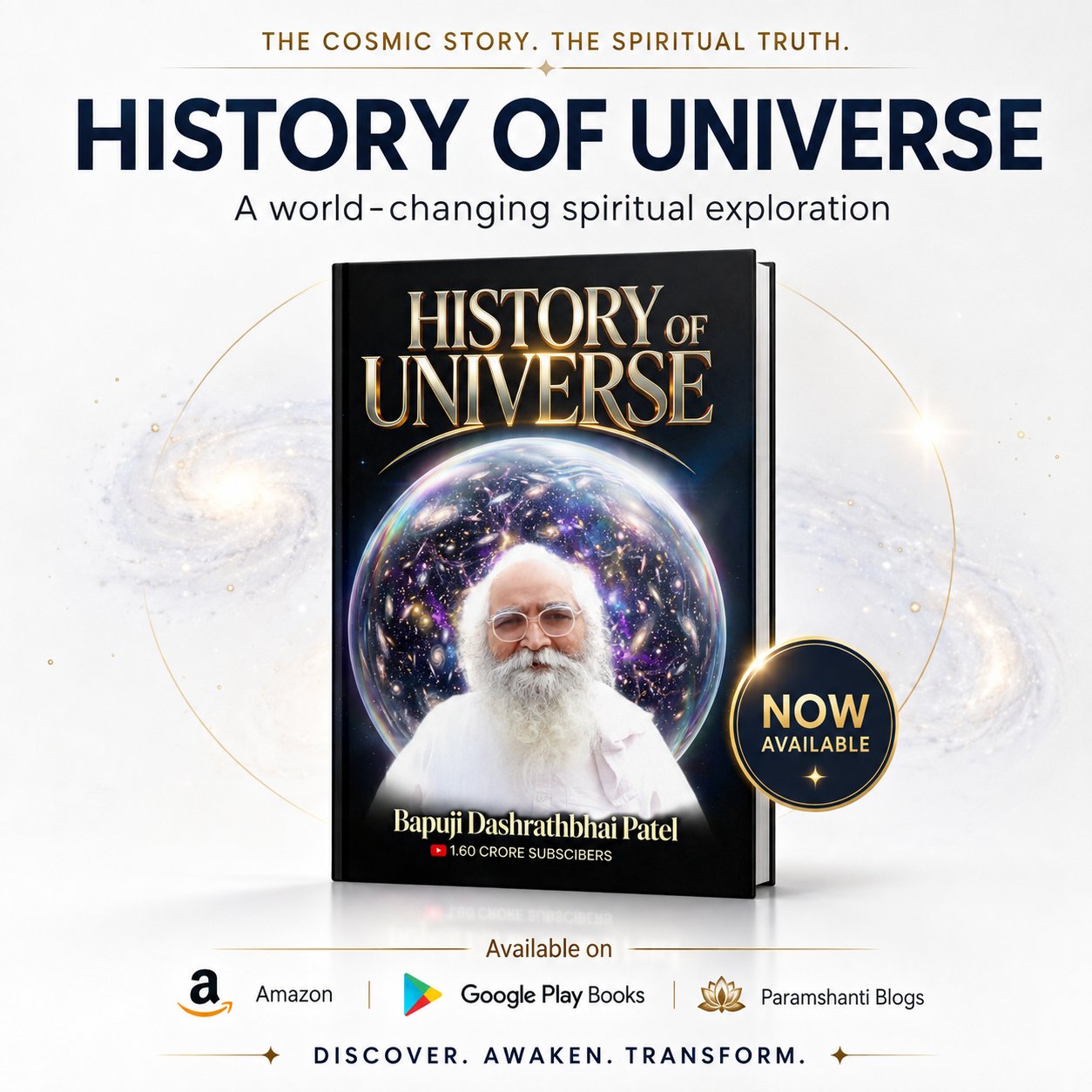
History of Universe — The Complete Book by Bapuji Dashrathbhai Patel
History of Universe is a free spiritual book by Bapuji Dashrathbhai Patel that describes how creation began and how it arrived at the present moment. Across thirteen chapters it traces the universe from Param Mahashiv, the formless creator, through the emergence of souls, the descent from sixteen kala to zero kala, the building and fragmenting of galaxies, the making of the Sun and Earth, the great cycles of time and Pralay, and the loss of the soul's memory of its own origin. It is offered as direct inner seeing from deep meditation, presented alongside — not against — the Hindu scriptures and modern cosmology. The book is completely free as an ebook, audiobook and PDF.
Free ebook · Free audiobook · Free PDF · No payment, no subscription, no membership. Never sold, only shared.
Also free in हिंदी, 中文, العربية, Deutsch and Bahasa Indonesia.

Key facts about the book
| Title | History of Universe |
|---|---|
| Subtitle | Experience the Infinite Creation — the true history of the universe as revealed through divine vision and deep meditation |
| Author | Bapuji Dashrathbhai Patel |
| Publisher | Vishwa Parivartak Iswariya Vidhyalay (Paramshanti), Ahmedabad, Gujarat, India |
| Subject | Cosmology, soul science, creation, consciousness, Behad Ka Param Gyan |
| Structure | Preface, 13 chapters, Bapuji Insights, a 60-term Glossary |
| Reading time | About 45 minutes |
| Formats | Ebook (EPUB / Kindle), audiobook, PDF, paperback |
| Price | Free — ₹0 / $0, worldwide |
| Available on | paramshantiblogs.org, Google Play Books, Amazon, Paramshanti Books app |
| Languages | English · हिंदी · 中文 · العربية · Deutsch · Bahasa Indonesia — all free. The wider library spans 25+ languages. |
| Year | 2026 |
What this page covers
What the book is
Most accounts of the universe begin with matter. This one begins with consciousness.
History of Universe asks a larger question than "how did the stars form?" It asks for the history of everything at once — the history of the Atma (soul), the history of the human being, the history of the Earth, and the history of creation itself. The answer given in the book does not come from telescopes or from academic research. It comes from what Bapuji Dashrathbhai Patel describes as direct inner seeing in a state of deep meditation.
The book sets out a single continuous account. In the beginning there is Param Mahashiv, formless, whose innermost essence is Param Prakash — supreme light. A first thought arises: "I will create infinite, endless creation." In that instant souls begin to emerge, they spread outward, and the boundary of the universe is drawn. From there the book follows the whole arc — souls multiplying, taking form, descending through the scale of kala, building galaxies, creating the Sun and the planets, becoming devtas and then human beings, forgetting their own origin, and arriving at the present: a universe in which the soul's light is at its dimmest, and the turn back has begun.
Two things make the book unusual. First, its scale: the visible universe measured by modern instruments is described here as not even a dot beside the totality of creation. Second, its posture. The book treats the Hindu shastras and modern science as two windows onto the same reality, and offers a third — the direct experiential seeing of a realised soul — to stand beside them rather than above them.
Key takeaways
- Creation began with a thought, not an explosion. A Sankalp in the formless Param Mahashiv is the first event; souls emerge from it and mark out space.
- Souls have descended, not evolved upward. The journey runs from sixteen kala (complete fullness) down to zero kala — the state of the universe today.
- Three levels of cosmic ownership. A Brahmand (solar system) has Shiv as its master; a galaxy has Mahashiv; the universe has Param Mahashiv.
- Galaxies fragmented. The original galaxies were vastly larger; today's galaxies, including the Milky Way, are described as pieces of them.
- The Sun was a response, not a cause. It was created only when the light of souls was no longer bright enough to illuminate their world.
- Time runs at different speeds at different levels. One second in Brahma's realm is described as 100,000 Earth-years.
- The soul is not blank. It carries the complete record of its journey; layers of elements and then karma covered that memory over.
- Zero kala is a turning point, not an ending. The book closes on the reversal — gross elements returning to param tattva.
All 13 chapters, in order
The book is built as one continuous descent, from the formless beginning to the present moment. Each chapter picks up exactly where the previous one ended.
| Chapter | Title | What it covers |
|---|---|---|
| I | Introduction — The History of the Universe | The three ways the universe must be understood: what science can observe, the full Behad universe, and the realm of multiple universes beyond it. |
| II | The Creator — Param Mahashiv | The formless creator, Param Prakash and mahatattva, the three levels of cosmic ownership, and the first thought that began time. |
| III | The Creation of Souls | Twelve souls, then 108, then 16,000, then nine lakh — the original inhabitants of the Behad ka Paramdham, complete in sixteen kala. |
| IV | From the Formless to Form | The seed and the sprout. How param aakash tattva gathered around soul-light and the first forms appeared in Mool Vatan. |
| V | The Journey from Sixteen Kala to Zero Kala | The three supreme elements, the emergence of 33 crore devtas at nine kala, and the gradual mixing of gross elements into the supreme. |
| VI | The Formation of Galaxies | Mahashiv and Mahashakti building galaxies, the competition of creation, fragmentation into countless smaller systems, and the Milky Way's galactic centre. |
| VII | Mahashiv, Mahashakti, and the Devtas | The inner structure of a solar system — Shivpuri, Vishnupuri, Brahmapuri — and the creation of farishtas through a single Sankalp. |
| VIII | From Devtas to Angels to Human Beings | Why power was lost through multiplication, the first humans, and the shift from soul-consciousness to body-consciousness. |
| IX | The Creation of the Sun, Earth, and Planets | Why the physical Sun was made, which deity created which planet, the rings of Saturn, and the true scale of the solar system. |
| X | Time Cycles — Yug, Manvantar, and Brahma's Cosmic Calendar | The four yugs, the reign of one Manu, one day of Brahma, and the relationship between time and level of consciousness. |
| XI | Pralay — The Great Dissolution | Five levels of dissolution, from the death of one being to the ending of an entire solar system, and the Mahakaal state at a galactic centre. |
| XII | The Fall of Souls and the Loss of Memory | How each layer of element and each layer of karma covered the soul's memory — and why great souls are living unrecognised on Earth. |
| XIII | The Zero Kala Universe of Today | What still remains intact, why human population has risen so sharply, and the turn from gross elements back toward param tattva. |

Core terms, explained simply
The book carries a 60-term glossary. These twelve carry most of the weight, and understanding them makes the whole account readable.
| Term | Meaning in this book |
|---|---|
| Atma | The soul. In its original state it is formless divine light — Param Prakash — and it carries the complete record of its own journey. |
| Param Mahashiv | The formless creator and master of this universe, whose essence is supreme light surrounded by mahatattva. |
| Sankalp | A pure thought-intention. The instrument of creation: the higher the kala, the greater its power. |
| Kala | A measure of a soul's fullness, purity and radiant power — as watts measure electrical capacity. Sixteen is complete; zero is where the universe now stands. |
| Brahmand | A solar system: one cosmic unit with Shiv as its master. Older texts often translate the word as "universe"; here it means specifically a solar system. |
| Maha Brahmand | A galaxy — the level of creation governed by Mahashiv. |
| Param Maha Brahmand | The universe — the level governed by Param Mahashiv. |
| Paramdham | The supreme abode: the highest, incorporeal dimension of creation, entirely in the form of supreme light. |
| Param Tattva | Supreme elements — finer and more powerful than ordinary elements, the building material of the higher worlds. |
| Pralay | Dissolution at any level, from the death of one being to the absorption of an entire solar system back into its source. |
| Behad Ka Param Gyan | Beyond-limits knowledge: the complete account of the Almighty Authority and boundless creation, from beginning to end. |
| Paramshanti | Supreme peace — the soul's original state at the moment of its creation, and the state it never stops seeking. |
The numbers in the book
The account is unusually specific. These figures are stated in the text and are what most readers come looking for.
| What | Figure given |
|---|---|
| First souls to emerge | Twelve |
| Original souls of the supreme abode | Nine lakh (900,000), complete in sixteen kala |
| Souls at fourteen kala | Two crore (20 million) Mahashiv souls |
| Devtas at nine kala | 33 crore (330 million), with 33 crore Mahashaktis — 66 crore in all |
| Full Behad universe | Approximately 1,200 billion light-years across |
| Milky Way | About 100,000 light-years across; 2,000 light-years at its centre still composed of param tattva |
| Galactic motion | 2.5 million kilometres per hour, orbiting the centre of Param Mahashiv |
| Our solar system | 9.4 trillion km in diameter — about one light-year |
| One Chatur Yug | 4,320,000 Earth-years (Satyug 1,728,000 · Tretayug 1,296,000 · Dwaparyug 864,000 · Kaliyug 432,000) |
| One Manvantar | 71 complete four-yug cycles |
| One day of Brahma | 4.32 billion Earth-years; one day and night together, 8.64 billion |
| Lifespan of one Brahmand | Approximately 311 trillion Earth-years |
| One second in Brahmapuri | 100,000 Earth-years |
| Lower realms | Seven patal lok, and below them 55 crore narak |
Where modern science and this vision meet
The book does not set itself against science. It treats scientific measurement as accurate within its own domain — the domain of gross matter — and then asks what lies outside that domain. Read side by side, the two accounts line up in a way many readers find striking.
| Phenomenon | Modern cosmology | History of Universe |
|---|---|---|
| The beginning | A hot, dense initial state expanding outward roughly 13.8 billion years ago | A Sankalp in the formless Param Mahashiv; souls emerge and mark out the boundary of space |
| Size of the universe | An observable region roughly 93 billion light-years across | That region is a fraction of a Behad universe measured in the region of 1,200 billion light-years |
| Number of galaxies | Estimated in the hundreds of billions within the observable region | Trillions upon trillions across the full universe — the observed count sitting "within a single dot" |
| Galactic centre | A supermassive black hole | Mahakaal — the concentrated energy field of Mahashiv; a vortex of radiance rather than an absence of light |
| Rings of Saturn | Orbiting ice and rock fragments | The shattered remnants of the lower realms, drawn into orbit |
| Time | Relative — it runs differently depending on velocity and gravity | Relative to the level of consciousness — the higher the realm, the slower time passes |
| Human population growth | Demographic and technological change since the 18th century | The concentrated descent of souls from every level of creation into human form, at the end of the cycle |
The book is explicit about what kind of claim it is making. It is offered as spiritual knowledge received in meditation, not as a peer-reviewed physical theory, and it asks to be read that way — slowly, with a still mind.
Quotes from the book
The visible universe that science can currently observe is not even a dot in comparison to the true totality of creation.
Bapuji Dashrathbhai Patel · History of Universe
The boundary of supreme light that Param Mahashiv drew at the moment of creation — it exists to this day, surrounding everything.
Bapuji Dashrathbhai Patel · History of Universe
Just as a seed contains the full tree within itself, so the formless soul contained its form within itself. The journey was not a creation of something new; it was the gradual revelation of what was already there.
Bapuji Dashrathbhai Patel · History of Universe
The physical sun was created not at the beginning, but when the light of the soul was no longer enough to illuminate the world. It was a response to descent, not a cause of it.
Bapuji Dashrathbhai Patel · History of Universe
The soul is not blank. It carries the complete record of its entire journey, from the first moment of its creation. But layers of elements covered that memory, and then karma covered it further. This is why the soul has forgotten.
Bapuji Dashrathbhai Patel · History of Universe
Before the descent into the gross body, the soul was soul-conscious, Atma Swaroop. After it came body-consciousness. This single shift began the entire story of human suffering.
Bapuji Dashrathbhai Patel · History of Universe
Who this book is for
It suits the reader who has already asked the large questions and found the usual answers too small — who wants to know where the soul came from, why it forgot, and what happens at the end of a cosmic cycle. No prior study is assumed; the glossary defines every term as it appears.
- Seekers who want a single, continuous account of creation rather than scattered fragments.
- Readers drawn to cosmology, black holes, time and the multiverse who also want a consciousness-first perspective.
- Students of the Vedas, Upanishads and Puranas looking for a complementary inner account.
- Meditators working with soul-consciousness, karma and the journey after death.
- Anyone starting out with Behad Ka Param Gyan — this is one of the most direct entry points in the library.
Download History of Universe free — every platform
The book is free everywhere it exists. There is no paid edition, no premium tier and no membership. In the words the mission is built on — ज्ञानदान ही महादान है — giving knowledge is the highest charity. The books are never sold, only shared.
| Platform | Format | Cost | Open |
|---|---|---|---|
| Paramshanti Library | PDF download, read online | Free | paramshantiblogs.org/books-library |
| Google Play Books | Ebook + AI-narrated audiobook | Free — "Get for Free" | Open on Google Play Books |
| Amazon | Kindle edition + paperback | Free on Kindle | Amazon author store · Amazon India |
| Paramshanti Books app | Complete offline library in English, Hindi and Gujarati | Free | Get the Android app |
| Spotify | Audio teachings and podcast | Free | Listen on Spotify |
| YouTube | Discourses, live meditations | Free | @bapujidashrathbhaipatel |
Share it freely. Send it to anyone who has ever wondered where all of this came from.

Read it in your language
Every translation is free, exactly like the English edition — ज्ञानदान ही महादान है, giving knowledge is the highest charity. The editions below are live now and open straight in your browser. No account, no payment, no membership.
| Language | Edition | Free PDF |
|---|---|---|
| English | History of Universe | Read / download free |
| हिंदी · Hindi | ब्रह्मांड का इतिहास | Read / download free |
| 中文 · Chinese | History of Universe — 中文 | Read / download free |
| العربية · Arabic | History of Universe — العربية | Read / download free |
| Deutsch · German | History of Universe — Deutsch | Read / download free |
| Bahasa Indonesia · Indonesian | History of Universe — Bahasa Indonesia | Read / download free |
More languages from the same library
The wider Paramshanti library holds more than 300 free books across 25+ languages — including English, हिंदी, Русский, Español, العربية, 中文, Português, Français, বাংলা, Deutsch, Bahasa Indonesia, ਪੰਜਾਬੀ, తెలుగు and 日本語 — and new translations of this book are added as each one is finished. If your language is not in the table above yet, start on its own page below — many of Bapuji Dashrathbhai Patel's other books are already translated and waiting there.
Español Русский Português Français বাংলা 日本語 한국어
Browse every free book, in every language →
About Bapuji Dashrathbhai Patel
Bapuji Dashrathbhai Patel was born in 1956 in Akhaj, a village in the Mehsana district of Gujarat, India, and grew up in nearby Ambasan. He completed his Chartered Accountancy through self-effort while giving tuition classes to support himself, later earned a Bachelor of Law, and became a well-known advocate in Ahmedabad.
From childhood his questions ran in one direction. At six he was already asking why God stayed silent about human suffering. That question never left him, and it eventually turned him from law toward the search for spiritual truth. In 1997 he established Vishwa Parivartak Iswariya Vidhyalay in Chenpur, Ahmedabad, with the aim of transforming a world of suffering into a divine one. Smt. Sushma Tandon, known as "Maa," worked alongside him in that mission.
In the years that followed he delivered discourses of extraordinary length and density — up to eighteen hours without rest — describing what he had seen in deep meditation and superconscious states: the creators of different dimensions, the making of the solar system, the galaxy and the universe, and the knowledge of the Multiverse and what lies beyond it. Those discourses are the source of every book in the Paramshanti library, including this one. Today he remains in extended meditation and samadhi.
About the publisher
Vishwa Parivartak Iswariya Vidhyalay (Paramshanti) is a spiritual non-profit based at Paramshanti Bhawan, Chenpur, near Chenpur Bus Stand, New Ranip Road, Ahmedabad, Gujarat 382470, India. It publishes and distributes the complete library of Bapuji Dashrathbhai Patel's teachings across Google Play Books, Amazon and its own free library — every title free, in a growing number of world languages.
A note on this book. It was independently compiled, edited and published by the Paramshanti Team, inspired by Bapuji's discourses. The selection, wording and presentation are the Team's own work and responsibility. Contents are shared in good faith for spiritual and informational purposes, and are not medical, legal, financial or psychological advice. The book is meant solely for spiritual upliftment and is not directed against any religion, faith, community, country, tradition or individual. All paths and beliefs are deeply respected.
Read next — more free books in the series
History of Universe sits inside a library of 300+ free titles. If this one landed, these continue the same thread:
- Life in the Multiverse — what lies beyond this universe: Brahmand, Maha Brahmand, Param Maha Brahmand and further.
- Shiva & Black Hole — the Mahakaal state at a galactic centre, in depth.
- The Cosmic Dissolution: Mahakal Pralay — the great dissolution, and what survives it.
- Timeless World — time, illusion and the levels at which time behaves differently.
- Soul Consciousness — the shift from body-consciousness back to Atma Swaroop.
- The Infinite Law of Karma — how the causal record is written, and how it is cleared.
- Behad Gyan — Day 1 to Day 10 — the free ten-day guided reading course, one short book per day.
Browse the complete free library →
Frequently asked questions
The book
What is the book History of Universe about?
History of Universe traces creation from its first moment to the present day. It begins with Param Mahashiv, the formless creator, follows the emergence and multiplication of souls, their descent from sixteen kala to zero kala, the building and fragmenting of galaxies, the creation of the Sun, Earth and planets, the great cycles of time and dissolution, and the loss of the soul's memory of its own origin. It closes on the present moment and the turn back toward the supreme elements.
Who wrote History of Universe?
The book is based on the teachings of Bapuji Dashrathbhai Patel, a spiritual teacher from Ahmedabad, Gujarat, India, and the founder of Vishwa Parivartak Iswariya Vidhyalay. It was compiled, edited and published by the Paramshanti Team from his discourses.
Is History of Universe really free?
Yes — completely free, worldwide, in every format. There is no paid edition, no subscription, no membership and no premium tier. On Google Play Books the title shows "Get for Free," and the PDF on paramshantiblogs.org is a free download. The mission runs on the principle ज्ञानदान ही महादान है — giving knowledge is the highest charity. The books are never sold, only shared.
Where can I download History of Universe?
Four places: the free library at paramshantiblogs.org/books-library (PDF), Google Play Books (ebook + audiobook), Amazon (Kindle + paperback), and the free Paramshanti Books app for offline reading.
Is there an audiobook version?
Yes. A free audiobook edition is available inside Google Play Books, narrated and playable on Android, iOS and the web. Audio teachings are also on Spotify and YouTube.
How long is the book, and how long will it take to read?
About 45 minutes at an ordinary reading pace. The book runs to thirteen chapters plus a preface, a collected insights section and a sixty-term glossary. The preface asks readers to go slowly — the material is dense, and it rewards a second pass.
Is History of Universe available in Hindi or other languages?
Yes. Free editions are live in English, हिंदी (Hindi), 中文 (Chinese), العربية (Arabic), Deutsch (German) and Bahasa Indonesia — every one of them free, with direct links in the language table above. The wider Paramshanti library spans 25+ languages, and new translations of this title are added as each one is completed.
My language is not listed — what should I read?
Start at your language's own page on paramshantiblogs.org — Español, Русский, Português, Français, বাংলা, 日本語 and 한국어 each have one, and many of Bapuji Dashrathbhai Patel's other books are already translated there. Translations of this title are released as they are finished, so check back; nothing is ever put behind a payment.
Is there a printed edition?
Yes — a paperback edition is available on Amazon alongside the free Kindle edition. The digital editions remain free everywhere.
Do I need any background knowledge to read it?
No. Every technical term is defined in the glossary, and the chapters build in order. If you have never read a book on this subject, start at Chapter I and read straight through.
Can I share the book with other people?
Yes — sharing is the point. Send the link, share the PDF, or gift the Google Play Books edition. The teaching holds that spreading this knowledge is the highest form of service.
The teaching
What is the history of the universe according to Bapuji Dashrathbhai Patel?
In this teaching, the universe began when a Sankalp — a pure thought-intention — arose in Param Mahashiv: "I will create infinite, endless creation." Souls emerged from him and spread outward, marking the boundary of space in supreme light. Souls multiplied and gradually descended from formlessness into form, from sixteen kala down to zero. Galaxies were built and then fragmented, the Sun and planets were made when soul-light dimmed, and human beings appeared at the far end of that descent. The universe today stands at zero kala — the bottom of the cycle, and the point at which the return begins.
Who created the universe according to this book?
Param Mahashiv — the formless creator and master of this universe. His innermost essence is Param Prakash, supreme light, surrounded by mahatattva, a field of supreme energy.
What is a Brahmand?
A Brahmand is a solar system: one cosmic unit with Shiv as its master. Older texts often render the word as "universe," but in this teaching it refers specifically to a solar system.
What is the difference between Brahmand, Maha Brahmand and Param Maha Brahmand?
They are three levels of scale and ownership. A Brahmand is a solar system, mastered by Shiv. A Maha Brahmand is a galaxy, mastered by Mahashiv. A Param Maha Brahmand is the universe, mastered by Param Mahashiv. Beyond that lie multiple universes and the Multiverse.
What does kala mean, and what is the 16-to-0 descent?
Kala measures a soul's fullness, purity and radiant power — the way watts measure electrical capacity. Sixteen kala is complete perfection: pure light, pure power, entirely formless. As kala descends, the soul takes on form, gross elements mix into the supreme elements, and power is progressively lost. At zero kala, everything is made of gross matter. That, the book says, is the universe science observes today.
Why did souls forget who they are?
Because of covering, layer by layer. As the soul descended, mahatattva gathered around it, then supreme space, air and fire, then the gross elements, then water and earth. Each layer reduced its access to its own inner knowing. Once the soul reached the fully human state, with causal, subtle and physical bodies, and karma accumulated across many lifetimes, the original memory was buried very deep.
What is Paramdham?
The supreme abode — the highest, incorporeal dimension of creation, entirely in the form of supreme divine light, where the creator resides. Equivalent levels exist at galaxy and universe scale.
What are farishtas and devtas?
Farishtas are the angelic beings created by Brahma through a single Sankalp — bodies of supreme space, air and fire, souls of supreme light, each carrying the radiance of thousands of suns. As they lost power and gross elements mixed in, they descended into devtas, divine beings of three elements. The descent continued from there into human form.
Who were the first human beings in this account?
The Hindu scriptures name them Manu and Shatrupa. In this teaching, they mark the moment the soul first entered body-consciousness. Before that descent the first humans existed as Atma Swaroop — soul-conscious, without awareness of a physical body.
Why was the Sun created?
Because the light of souls was no longer enough. While the farishtas and early devtas shone with the brilliance of thousands of suns, no physical sun was needed. As their radiance dimmed and darkness encroached, Surya Narayan created the solar body. The book is precise about the direction of causation: the Sun was a response to the descent, not a cause of it.
What does the book say about the rings of Saturn?
That they are the remains of the lower realms. Below the human realm the scriptures describe seven patal lok and, below those, 55 crore narak. In this account their shattered remnants were drawn by Saturn's gravity into the rings visible today.
What is Pralay, and how many kinds are there?
Pralay is dissolution — the natural completion of a cycle rather than destruction. The book describes five levels: Nitya Pralay (the death and rebirth of individual beings), Ardh Pralay (at the end of each Manvantar), Pralay (at the end of four yugs), Kalp Pralay (at the end of one day of Brahma), and Maha Kalp Pralay (the total dissolution of a solar system).
What is Mahakaal, and how does it relate to black holes?
Mahakaal is the state a galactic centre enters when the Mahashiv at its centre has exhausted his creative energy and draws the galaxy's solar systems inward. The book identifies what science observes as a black hole with the external appearance of this state — and adds that on the inner plane it is not darkness at all, but an intensely concentrated field of radiant energy: a supreme vortex seen by the inner eye.
How big is the universe according to History of Universe?
Far larger than the observable region. Science currently measures a region roughly 93 billion light-years across containing hundreds of billions of galaxies. The book describes that as a fraction of the full Behad universe, given as approximately 1,200 billion light-years in diameter — and that universe as itself only one within the realm of multiple universes.
How long is a yug?
Satyug lasts 1,728,000 years, Tretayug 1,296,000, Dwaparyug 864,000, and Kaliyug 432,000. Together they form one Chatur Yug of 4,320,000 Earth-years. Seventy-one of these cycles make one Manvantar; fourteen Manvantar make one day of Brahma — 4.32 billion Earth-years.
Does time run differently at different levels?
Yes, and consistently: the higher the realm, the slower time passes relative to Earth. One day in Swarg Lok equals one Earth-year. One second in Brahmapuri equals 100,000 Earth-years. One moment for Mahashiv contains 100 years of Brahma, and one moment for Param Mahashiv contains 100 years of Mahashiv.
What is the Multiverse in this teaching?
The realm of countless other universes, each as vast as or vaster than our own, existing beyond the boundary Param Mahashiv drew at the beginning. Their masters are described as beings of an entirely different magnitude. This book touches on the Multiverse; Life in the Multiverse takes it up in full.
What is Behad Gyan?
Behad Ka Param Gyan means beyond-limits knowledge: the complete account of the Almighty Authority and boundless creation, from the very beginning to the very end. It brings together the eternal truths held in the sacred scriptures with the direct experiential revelation of deep meditation.
What does Paramshanti mean?
Supreme peace — and specifically, the soul's original state at the moment of its creation. The teaching holds that the soul never stops seeking that state, and reaches it again when it re-establishes itself in its pure incorporeal form of supreme light.
Why does the book say human population has grown so fast?
It reads the rise not as a demographic fact alone but as a spiritual one. Earth's population was around 50 crore in 1750, 75 crore by 1850, 150 crore by 1936, and exceeds 800 crore today. In this account that expansion is the concentrated descent of souls from every level of creation into human form at the end of the great cycle.
Science, scripture and this book
Does this book contradict modern science?
It does not position itself as a rival theory. It accepts scientific measurement as accurate within the domain of gross matter, and then argues that this domain is a small part of what exists. Where the two accounts describe the same phenomenon — the galactic centre, the size of the cosmos, the relativity of time — the book offers a consciousness-first reading alongside the physical one.
Is this based on the Vedas and Puranas?
It stands beside them. Bapuji holds the four Vedas, the Upanishads and the eighteen Puranas in deep reverence, and the book repeatedly points to where the scriptures preserve the same truth in condensed form. What it adds is the detailed inner unfolding behind those phrases, described from direct experience in meditation.
Is any of this scientifically proven?
No, and the book does not claim it is. It is presented as spiritual knowledge received through divine vision and deep meditation, shared in good faith for spiritual purposes. It is not medical, legal, financial or psychological advice, and readers are asked to weigh it for themselves.
Is this book connected to any religion or organisation?
It is published independently by Vishwa Parivartak Iswariya Vidhyalay and is not affiliated with, endorsed by, or representative of any other organisation or authority. It is not directed against any religion, faith, caste, community, country, tradition or individual, living or deceased. All paths and beliefs are deeply respected.
Author, mission and next steps
Who is Bapuji Dashrathbhai Patel?
A spiritual teacher from Ahmedabad, Gujarat, India, born in 1956 in Akhaj and raised in Ambasan. He qualified in Chartered Accountancy and Law and practised as a well-known advocate before turning fully to spiritual realisation. In 1997 he founded Vishwa Parivartak Iswariya Vidhyalay. His teachings cover soul-realisation, karma, consciousness, higher dimensions, the Multiverse and the laws of creation, and are shared free across books, YouTube and daily live meditations.
What is Vishwa Parivartak Iswariya Vidhyalay?
The spiritual institution Bapuji established in 1997 at Chenpur, Ahmedabad, known publicly as Paramshanti. It publishes and distributes his complete library of teachings free of charge, and runs daily live meditation sessions open to everyone.
How many books are in the library?
More than 300 books, with new ones released regularly, spanning self-realisation and Brahm Gyan, soul science and healing, past life, karma and afterlife, cosmos and the universe, spiritual masters and sacred mantras, Hindi editions, and the ten-day Behad Gyan course. Every one of them is free.
Do I have to sign up or pay anything to download?
No payment, ever. On Google Play Books and Amazon you use your existing account. On paramshantiblogs.org, the PDF download asks for your name, email and phone once so your link can be sent; after that, later downloads on the same device are one click.
Which book should I read after this one?
Life in the Multiverse is the natural next step — it picks up exactly where this book leaves off, beyond the boundary of this universe. If a particular chapter held you, follow it instead: Shiva & Black Hole for Chapter XI, The Infinite Law of Karma for Chapter XII, Soul Consciousness for Chapter VIII.
How can I follow the daily teachings?
Through the main YouTube channel @bapujidashrathbhaipatel, the meditation channel @paramshantimeditation, and the daily live meditation sessions. All are free and open to all.