Ashtavakra Gita(The Eternal Knowledge of the): The Dialogue Between Maharishi Ashtavakra and King Janaka part 1
Paramshanti (supreme peace) today unfolds the timeless wisdom of the Ashtavakra Gita, where the great sage Maharishi Ashtavakra imparts the supreme knowledge of the Self to King Janaka. This profound dialogue reveals the secret of liberation and the true nature of the soul.
The Foundation of Liberation: Knowledge Alone
When King Janaka received the knowledge of the Self from Ashtavakra, he described his inner realizations and asked subtle questions about his experiences. Ashtavakra explained with divine clarity that liberation (moksha) is the fruit of knowledge. One’s state of being is shaped by one’s understanding: “If you see yourself as bound, you are bound. If you see yourself as free, you are free.” Your experience is determined by your perception. Ashtavakra said — the soul does not need to be attained; it is already yours. The soul is peace itself, infinite, complete, one, liberated, and full of divine consciousness. Just as the sky pervades all space—inside and outside—so too does the soul pervade all.
The True Nature of the Soul
Ashtavakra describes the soul as:
· Infinite and all-pervading
· Pure, eternal, and unchanging
· Beyond action and desire
· Detached, bodiless, and peaceful
However, the human being, bound by body-consciousness, forgets this truth. The mind, intellect, and sanskars (impressions) veil this eternal knowledge. The real essence of the soul remains unaffected, like the vast sky that holds both clouds and clear space yet remains unchanged.
The Illusion of Bondage
Due to identification with the body made of the five elements, man feels bound. This bondage is not real—it is only a mental projection. The pride of physical form keeps the soul trapped in illusion. Ashtavakra reminds Janaka that ignorance alone causes this bondage. When you see yourself as consciousness, you are free. “You are pure awareness; be happy.” The soul is radiant light, beyond fault, beyond action. Even the desire to attain liberation becomes a bondage. True liberation dawns only when the seeker drops the desire to achieve anything—even self-knowledge.
Desire and Bondage
Ashtavakra beautifully explains: “If you meditate for liberation, you are still bound by the desire for liberation. Let go of that too.” The soul already is Brahman—the Supreme Consciousness. Desires arise only in the mind and body, not in the soul. Hunger and thirst are laws of the body; grief and attachment are laws of the mind; birth and death are the laws of karma. The soul, being a witness, remains pure and unaffected.
The Mirror of Consciousness
The universe is but a reflection of your inner state. As Ashtavakra says: “This world exists within you because you are the Self, and this world is merely your expression.” The wise understand that this entire world is a projection of their own consciousness. Hence, the transformation of the world begins with the transformation of the self. Your vibrations shape creation itself.
The Awakening Beyond Body and Mind
It is ignorance to identify with the body. The ignorant feel inferior, but the self-knowing remain untouched. When one becomes free of expectations, desires, and impurities, they realize that they are the witness—beyond the body, beyond the mind, beyond all actions.
Our soul is the form of supreme light — unaffected, eternal, and untainted. All distortions exist only in the mind. Once the mind is purified, the Self shines in its original splendor.
The Supreme Gift: Becoming One’s True Self
Ashtavakra says: “When you become your true Self, you become the means of peace and liberation.” To realize the Self is to receive the supreme gift — the divine remembrance of one’s essence. When we live in awareness of our true form, despair and duality dissolve. The soul is the formless, changeless, eternal consciousness — Brahman.
Those who firmly establish themselves in this truth are freed from the cycle of rebirth.
The Restoration of the Forgotten Memory
The sage further explains that meditation and devotion are tools for inner purification. Through them, humans develop the strength to realize the supreme power that already exists within. The purpose of all practice is to restore the forgotten memory of the Self. However, he warns: merely declaring “I am Brahman” without preparation or realization is not enough. It must be experienced. One must live it moment by moment, embodying the divine awareness.
King Janaka’s Realization
Upon hearing this supreme wisdom, King Janaka’s ignorance was burned away. He realized that: “Just as I illuminate my body, the entire world is illuminated by my light.” He experienced that the entire universe exists within him — not as something separate, but as his own expansion. He saw that just as waves are not separate from water, the world is not separate from the spirit. After self-realization, all his worldly perceptions dissolved. The illusion of Maya ended. He felt one with the Supreme, understanding that everything emanates from the same eternal essence.
The Unmanifest Source
King Janaka declared that just as a broken pot returns to dust, and a wave merges back into the ocean, the soul merges into its formless origin — Brahman. He understood that the entire universe is but the expression of the soul, and the soul itself is the foundation of all existence. Liberation (mukti) is actually the fruit of knowledge (gyan). This is absolutely true.
In the Ashtavakra Gita, Ashtavakra Rishi says — “O Janaka, you are the soul. You do not have to attain the soul — you already are that soul.” This is a great realization. The soul is not something to be achieved — it is already attained. The soul itself is peace. It is all-pervading, complete, one, free, conscious, actionless, unattached, desireless, and tranquil. Just as the sky is present everywhere — within and without — similarly, there is no difference in the soul. The soul pervades all, like the vast sky, and remains the same within and without. These are the characteristics of the soul — peace, vastness, completeness, freedom, consciousness, actionlessness, non-attachment, desirelessness, and stillness.
However, as human beings, we think, “I am not like that.” The soul is like that, but the “I” that thinks otherwise is your mind, intellect, and sanskar (impressions). You must understand the state of your mind — for in truth, the nature of your soul is as described: a witness, vast, complete, one, liberated, conscious, actionless, unattached, desireless, and peaceful. Ashtavakra declares this eternal truth — that because of ignorance, the human being thinks himself separate from the soul, while in reality, he has never been separate.
Conclusion: The Eternal Song of Liberation
The Ashtavakra Gita is not merely a dialogue; it is the eternal song of liberation. It teaches that the soul is eternally free — only the veil of ignorance hides this truth. Once the illusion is lifted, one realizes: “I am the Light of Consciousness. I am that Supreme Peace.” Let us remain in this awareness, spread Paramshanti (supreme peace) throughout the world, and remember always — liberation lies not in effort but in realization.
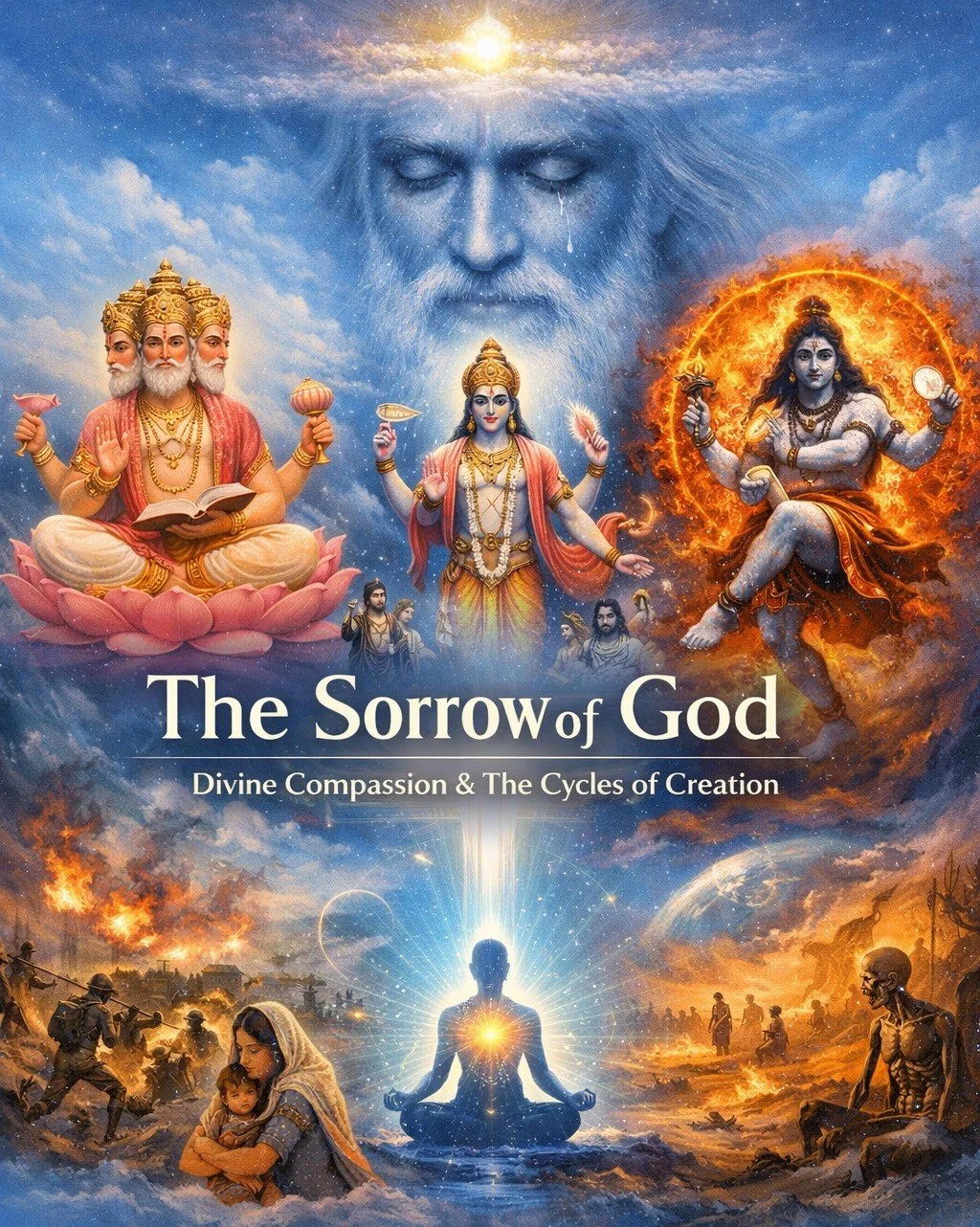

Explore the deep spiritual cosmology of planetary souls, alien interference, karmic zones, and cosmic wars based on Bapuji Dasharathbhai Patel’s knowledge. Understand how Paramshanti (supreme peace) can restore universal balance and protect human consciousness from artificial and dark energies.