
The Divine Journey of the Pandavas to Heaven (Conversation Between Narada and Yudhishthira) part 1
The Great Departure: Journey to the Himalayas
After Lord Krishna’s departure from the world, a deep dispassion arose in the hearts of the Pandavas. Guided by the wisdom of detachment, Yudhishthira, along with his brothers, Draupadi, and a dog, began the final journey towards the Himalayas. This journey symbolizes the soul’s ascent from the physical to the spiritual realms. As they climbed higher, one by one, Draupadi and each of the brothers fell — unable to continue the journey due to their remaining imperfections. Only Yudhishthira continued onward, accompanied by the dog. This dog, later revealed as none other than Yamaraja himself, represented dharma and divine loyalty.
Indra’s Chariot and the Test of Dharma
Indra descended with his celestial chariot to invite Yudhishthira to heaven. However, Yudhishthira refused to enter without his loyal companion — the dog. Indra warned that if a dog even looked upon a yajna or act of charity, it could nullify the merit of that deed. Yet, Yudhishthira declared firmly,
“I will not abandon this being who has shown faithfulness and companionship.” At that moment, the dog transformed into Yamaraja and blessed Yudhishthira for his unwavering dharma. Thus, Yudhishthira became one of the few in the cosmos to ascend to heaven in his physical body.
The Meaning Behind the Ascent with the Body
The fact that Yudhishthira entered heaven with his body carries immense significance. The body represents physical attachment — emotions, desires, and material memories. Narada later reveals that these earthly attachments accompany the body, making the transition incomplete. Therefore, true liberation requires rising in soul consciousness, free from moha (illusion) and bodily awareness.
Yudhishthira’s journey symbolizes the struggle of the soul between attachment and liberation. Only when one attains complete detachment and becomes a being of light — as taught by Bapuji — can one ascend beyond the heavenly realms into the higher divine dimensions.
The Conversation Between Narada and Yudhishthira
Upon reaching heaven, Yudhishthira was astonished to see Duryodhana seated on a radiant throne, worshipped and respected by celestial beings. This sight filled Yudhishthira with disbelief and anger — for this was the same Duryodhana responsible for the suffering, exile, and humiliation of the Pandavas and Draupadi.
Narada, appearing before Yudhishthira, smiled and gently explained:
“O King, in heaven, all past oppositions dissolve. The enmities and attachments of the mortal plane have no meaning here. Duryodhana attained this place through his Kshatriya dharma — he died bravely on the battlefield, facing his fate with courage.”
Narada reminded Yudhishthira that the sufferings experienced on Earth were the result of his own karmas — the choices he made, such as gambling away his kingdom and wife. Heaven, Narada said, is a realm beyond judgment, where only the purified essence of karma remains.
The Inquiry About the Brothers
Still yearning for his loved ones, Yudhishthira asked Narada where his brothers and Draupadi were. He declared: “Where my brothers and my beloved Draupadi are, there lies my heaven. Without them, I find no joy in this celestial abode.” Hearing this, the celestial messenger took Yudhishthira along a dark, dreadful path — the realm of hell (Naraka) — to witness where his brothers and companions had gone.
The Vision of Hell
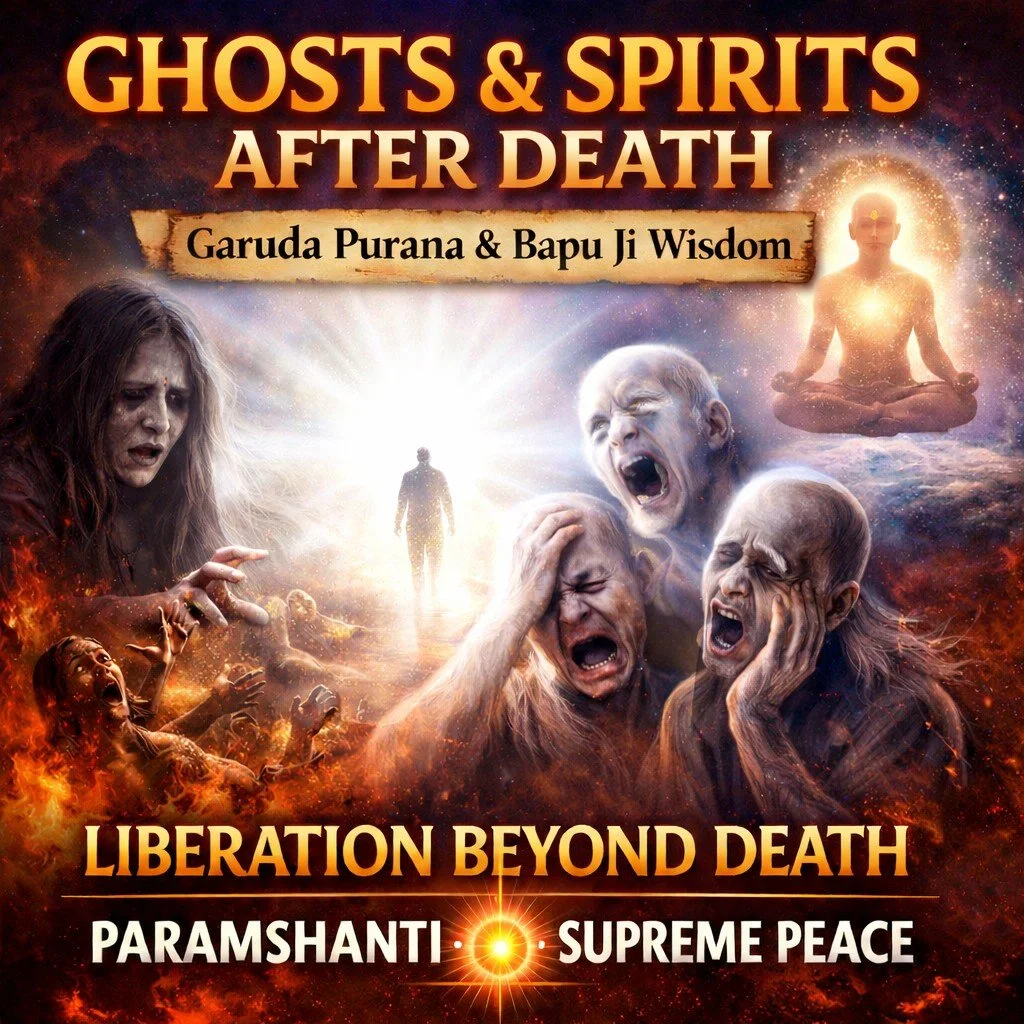
As they descended, Yudhishthira encountered horrifying scenes — darkness, foul odors, rivers of blood, iron birds with claws of fire, and tormented souls crying for relief. These souls represented the outcomes of earthly attachments, anger, greed, and hatred. This scene deeply disturbed Yudhishthira. Because he had come with his physical body, he could still experience the sensations of suffering — smell, fear, and disgust — something a soul in pure form would not feel. Yet, amid these cries, he heard the tormented souls calling out: “O King Yudhishthira, please stay for a moment! Your presence gives us relief from our suffering. We feel peace when you are near!” Moved by compassion, Yudhishthira paused, spreading divine calmness and comfort among the suffering souls. His very presence brought them Paramshanti.
Spiritual Meaning Behind the Vision
This part of the Mahabharata holds immense spiritual significance. The journey through hell represents the cleansing of residual karmas and emotional attachments that bind the soul to the cycle of life and death. Yudhishthira’s descent into hell symbolizes the soul’s final purification before ultimate liberation.
As Bapuji Dashrathbhai Patel explains —
“When a soul leaves the earthly body, the emotions and attachments stored within the subtle body begin to dissolve. Only a soul established in supreme peace — Paramshanti — can rise beyond all dimensions and reach the Infinite Divine Light.”
The Lesson for Humanity
This story is not just about the Pandavas — it reflects the journey of every soul. Each one of us carries memories, attachments, and emotions tied to this body. When we depart, these impressions can pull us downward unless we learn the art of detachment and remain in soul awareness.
Universal Message of Paramshanti
Yudhishthira’s experience reveals that even the most righteous can fall into lower realms if attached to bodily emotions. Hence, one must rise beyond both heaven and hell into the eternal light — the infinite abode of Paramshanti. Today, as countless souls across the multiverse remain trapped in suffering — in unseen realms, lower dimensions, and astral hells — let us collectively radiate the vibrations of Paramshanti (Supreme Peace) to them all.
Conclusion
The ascent of Yudhishthira is not merely a story of the Mahabharata but a revelation of soul evolution — from attachment to awareness, from dharma to divine light, from earthly illusion to eternal peace.
Let every soul remember: “We are eternal beings of light — not bound by body or emotion, but united in supreme peace.”


Explore the deep spiritual cosmology of planetary souls, alien interference, karmic zones, and cosmic wars based on Bapuji Dasharathbhai Patel’s knowledge. Understand how Paramshanti (supreme peace) can restore universal balance and protect human consciousness from artificial and dark energies.