The Seven States of the Soul According to the Vedas
An Experiential Journey from Awareness to Brahmic Unity
The Vedas and Upanishads describe consciousness not as a single, fixed experience, but as a vast spectrum of inner states through which the soul evolves. These seven states of the soul reveal the journey from ordinary awareness to the highest realization of unity with Brahman. Understanding them is not merely philosophical; it is a practical map for inner awakening, meditation, and liberation.
1. The Waking State (Jāgrat Avasthā)
The waking state is the condition in which we interact with the physical world through the senses and the body. In this state, consciousness is outward-facing, engaged with actions, responsibilities, thoughts, and perceptions. According to the Mandukya Upanishad, this is the most familiar state, yet paradoxically the least lived consciously.
Most people appear awake but remain lost in memories of the past or imaginations of the future. True waking consciousness means remaining fully present in the “now.” Presence itself is freedom. When awareness stays anchored in the present moment, karmic repetition weakens and conscious choice becomes possible.
2. The Dream State (Svapna Avasthā)
The dream state arises when consciousness turns inward and begins to project images, stories, and experiences from the subconscious mind. These dreams are not random; they are formed from accumulated impressions (samskāras), emotions, desires, and memories—sometimes even from past lives.
Even while awake, many people live predominantly in this dream state—planning, regretting, imagining, and replaying experiences. Such mental wandering is a subtle form of dreaming. The Upanishads teach that liberation begins when one recognizes this tendency and gently returns awareness to the present.
3. The Deep Sleep State (Suṣupti Avasthā)
Deep sleep is a state where both waking awareness and dream projections dissolve. The five sense organs and the five organs of action withdraw into rest. There is no experience of pleasure or pain, no thought, no action.
This state is often described as blissful, not because something is experienced, but because suffering temporarily ceases. During death, many souls naturally enter a state similar to deep sleep. Yet deep sleep is still unconscious bliss; awareness itself has not awakened.
4. The Fourth State – Transcendental Awareness (Turīya)
Beyond waking, dreaming, and deep sleep lies the fourth state, Turīya. This is pure awareness—silent, formless, and fully awake. There are no thoughts, no images, no projections of mind or intellect. Consciousness rests in itself. Turīya is like a clear screen on which all experiences appear and disappear, yet the screen itself remains untouched. This is the true beginning of the spiritual journey, where the seeker becomes a witness rather than a participant. Bliss here is stable, silent, and independent of circumstances.
5. The Fifth State – Cosmic Consciousness (Turīyātīta)
When transcendental awareness becomes continuous, it matures into cosmic consciousness. Here, the individual no longer falls back into unconsciousness. Silence becomes permanent, and action flows effortlessly. In this state, one lives liberated while alive (jīvan-mukti). The body may act, but the soul remains unattached. Meditation becomes effortless, and awareness remains established in the eternal witness. The sense of individuality begins to dissolve into universality.
6. The Sixth State – Divine Consciousness
Divine consciousness arises when awareness transcends mind, intellect, body, subtle realms, and even the causal world. The soul enters the realm of eternity and begins to embody divine qualities naturally.
Here, effort ends completely. Knowledge, power, compassion, and clarity flow spontaneously. Nothing remains hidden, and the universe is perceived as an expression of divine intelligence. This is the state of great yogis and siddhas, where the soul functions beyond death and time.
7. The Seventh State – Brahmic Consciousness (Aham Brahmāsmi)
The final and ultimate state is Brahmic consciousness—the realization of complete non-duality. “I am Brahman” is no longer a thought or belief, but a living reality. There is no difference between devotee and God, knower and known, drop and ocean. In this state, individuality dissolves completely. Ego ceases, and only pure existence-consciousness-bliss remains. This is total liberation, the complete blooming of the lotus of awareness. Beyond this, the scriptures declare, there is nothing further to attain.
Conclusion
The seven states of the soul are not abstract theories but living stages of consciousness accessible through meditation, self-awareness, and inner silence. Each stage represents a deeper release from conditioning and a closer return to our true nature.
To move through these states is to journey from disturbance to stillness, from separation to unity, and from time-bound existence to eternal being. May every soul gradually rise through these states and rest forever in supreme peace, supreme light, and supreme bliss.
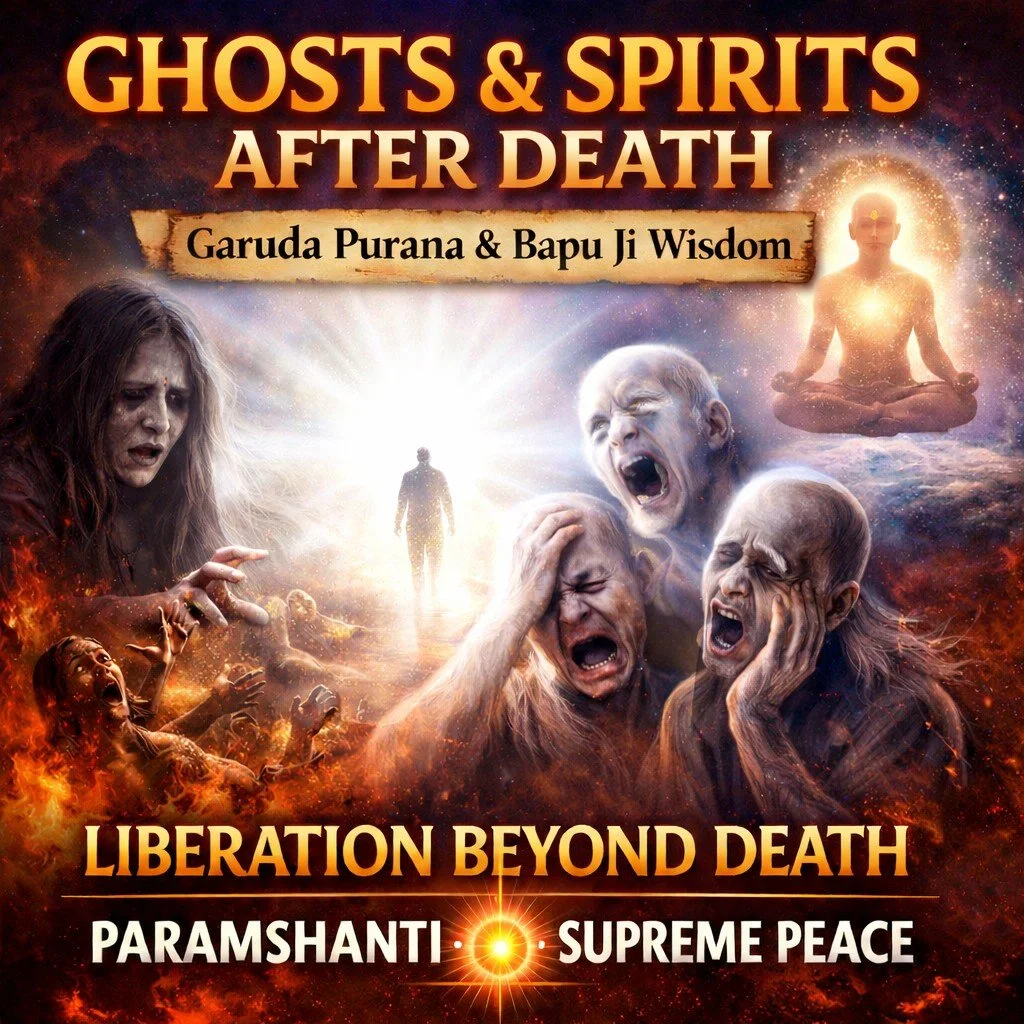
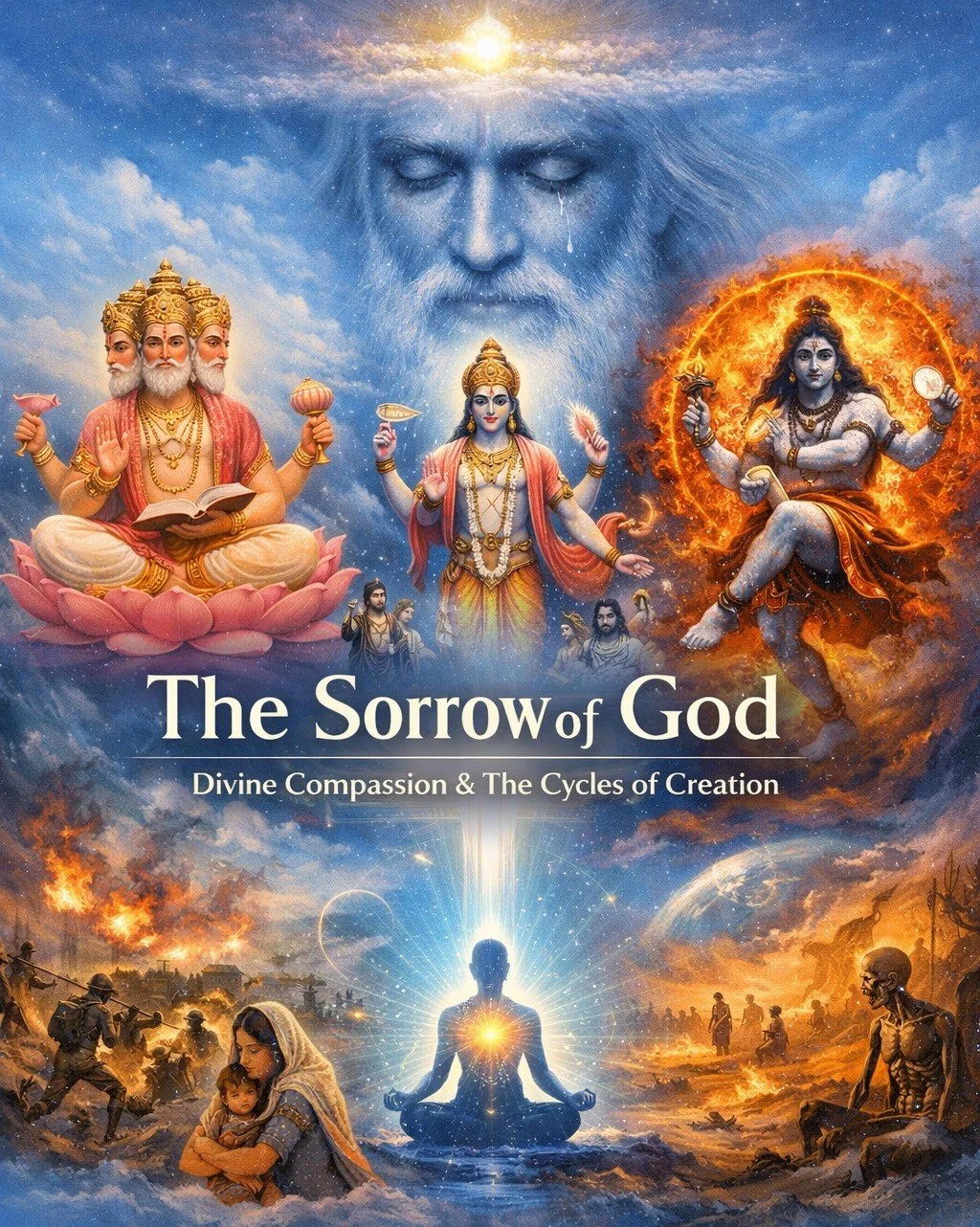

Explore the deep spiritual cosmology of planetary souls, alien interference, karmic zones, and cosmic wars based on Bapuji Dasharathbhai Patel’s knowledge. Understand how Paramshanti (supreme peace) can restore universal balance and protect human consciousness from artificial and dark energies.