
Episode 1391, Eternal Soul & Transience of Worldly Relations — Insights from the Mahabharata and Sanatan Scriptures
This divine discourse is truly a treasure of eternal wisdom — blending the message of Mahabharata’s Shanti Parva, Upanishadic truths, Ramayana’s lessons, and Tulsidas ji’s devotion, all converging into one essence — the eternal nature of the soul and the transient illusion of worldly relations.
The Dialogue Between Narada and Yudhishthira
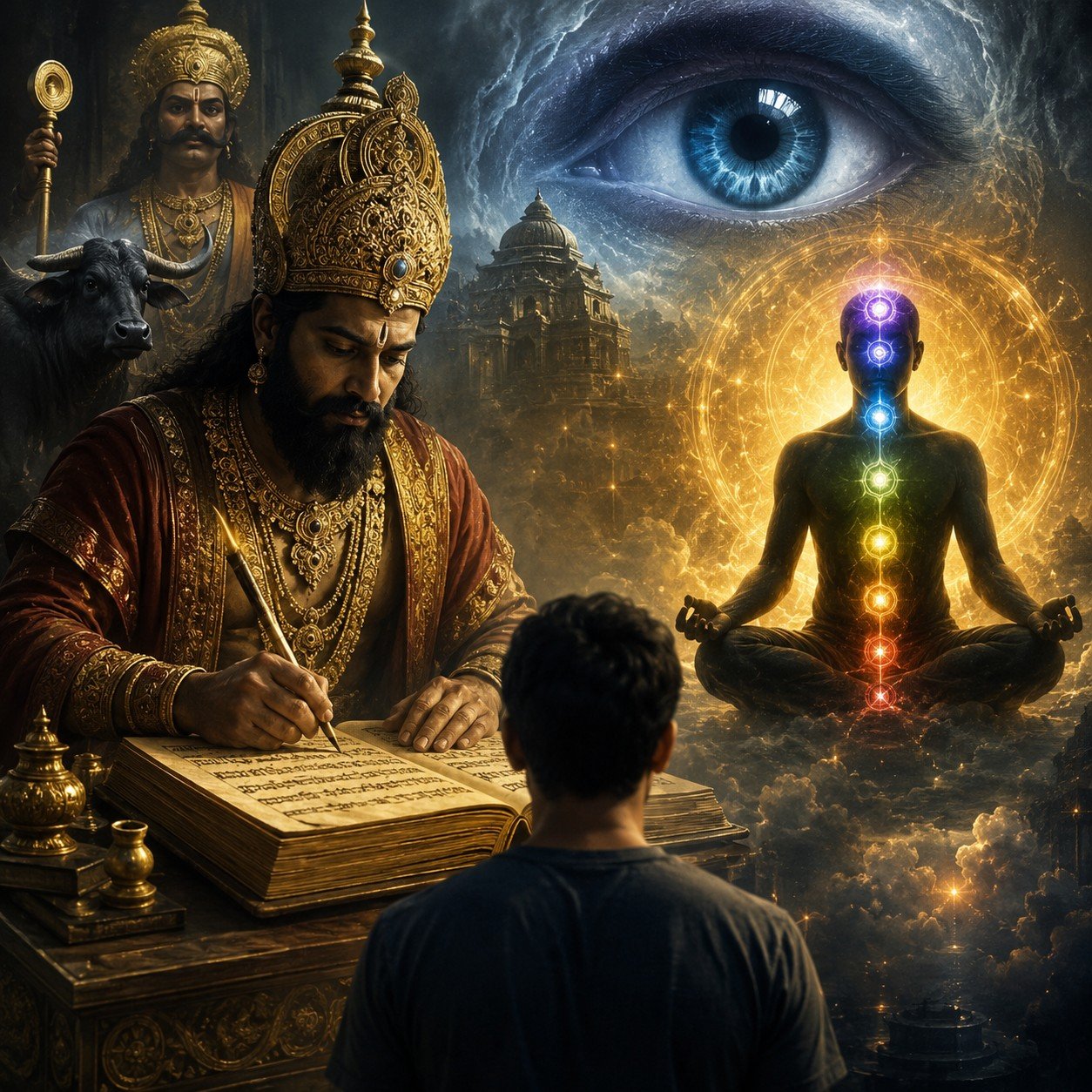
In the Shanti Parva of the Mahabharata, there is a deeply spiritual dialogue between Devarshi Narada and Dharmaraj Yudhishthira.Yudhishthira, burdened by questions after the great war, humbly asks Narada: “O Devarshi, tell me truly — who is whose father, who is whose son, and who is whose relative? Why do these relationships seem so real, yet end so soon?” Narada replies with divine calmness and supreme insight: “O King, understand that there is no permanent relationship in this physical world. The body is temporary, but the soul is eternal. Whoever is your father in this life may have been your son or your enemy in another. Whoever is your child today might have been your parent before. The soul continues its journey, taking new forms according to karma, while worldly bonds dissolve at death.” Thus, Narada reminds us that all relationships — whether of love, attachment, or conflict — are bound by karma and illusion (Maya).
Knowledge and Liberation
Liberation is achieved by transcending the duality of existence, indicating that mere possession of knowledge is futile without inner awakening. The essence of human life lies in the pursuit of connecting with the divine, achieved through knowledge, devotion, or strong adherence to one's faith, ultimately leading to remembrance of God at the time of death. It emphasizes that attaining higher realms like Vishnu Lok or Shiva Lok is preferable to being trapped in mundane pleasures.
Importance of Spiritual Practice
Sukhdev Ji emphasizes the need to renounce physical attachments and focus on the worship of Shri Hari, cultivating love for His name. He advises that at all times and in all circumstances, one should seek refuge in God, as this leads to the true purpose of human life and overall welfare. In a Mahabharata reference, Vidura urges Dhritarashtra to give the Pandavas their rightful share, highlighting that injustice leads to spiritual downfall.
Vidura's Wisdom
Duryodhana disrespected Vidura, leading to the Kaurava family's downfall, as Vidura was a divine soul incarnated from Yamraj to guide righteousness. Vidura's teachings emphasize detachment from worldly ties and the importance of pursuing spiritual knowledge to navigate life and mortality. In the aftermath, Dhritarashtra and his kin reflect on Vidura's wisdom, contemplating the futility of attachment to the material world.
Dhritarashtra's Departure
Yudhishthir laments the absence of Dhritarashtra, Gandhari, and Kunti, questioning his worthiness as they seem to have left him. Sanjay, with his divine vision, cannot ascertain their whereabouts, but Naradji reassures Yudhishthir that Dhritarashtra has not gone to harm himself but is seeking the blessings of the Saptarishis. Naradji advises Yudhishthir not to let his emotions cloud his judgment and to allow Dhritarashtra to find liberation by letting go of worldly attachments.
The Cycle of Karma and the Web of Maya
This world is a grand stage of karmic exchange. Each soul experiences joy and sorrow, union and separation, success and failure, as results of its own deeds. The Mahabharata teaches that the physical world is governed by Karma Nyaya — the divine law of cause and effect. No relation, no situation, and no event occurs without a reason. Every meeting is predestined; every separation is also divine. When a soul leaves the body, it sheds not just its physical form but also all worldly roles — father, mother, son, wife, friend, or foe. What remains is only the immortal soul — pure, eternal, and divine.
Lessons from the Ramayana and Tulsidas Ji
Goswami Tulsidas Ji beautifully expressed this truth in his sacred verses. He described how the Lord creates the play of relations only to guide souls toward detachment and realization. In the Ramayana, even Lord Rama — though the embodiment of Dharma — experiences the pain of separation from His loved ones. Yet, His life teaches the supreme lesson of non-attachment (Vairagya) and surrender to divine will (Bhakti and Gyana).
The Supreme Knowledge of Oneness
All souls are divine sparks of the same eternal Supreme Power. When one realizes this truth, the illusion of separation disappears. The Upanishads declare: “Ayam Atma Brahma — This Self is the Supreme.” True peace comes when the soul realizes its eternal nature beyond the cycle of birth and death.
Conclusion
The conversation between Narada and Yudhishthira, the teachings of the Mahabharata, and the wisdom of the Ramayana all reveal one supreme truth: The soul is eternal. Relationships are transient. Only divine knowledge brings liberation. When one lives in this awareness, there arises Paramshanti (Supreme Peace) — the peace beyond understanding, beyond illusion, beyond karma.
Let us all remember:
We are not these temporary bodies or relations — we are eternal souls, parts of the Infinite Supreme Light. The message emphasizes the importance of strengthening the connection between the soul and the divine, as worldly relationships are transient and ultimately inconsequential. It encourages individuals to focus on their spiritual journey and not to become obstacles for themselves or others. With the hope for peace and knowledge to spread globally, it emphasizes the need for inner fulfillment and a positive mindset.

Discover the true meaning of Amrit Vela beyond the early morning hours. Learn the four types of Amrit Vela, the greatness of the Sadguru, Brahma Gyan, the symbolic meaning of Samudra Manthana, the power of the Divine Name, Guru-disciple wisdom, meditation, self-realization, and the path to Supreme Peace through Behad spiritual knowledge.